
Riccia nigrella DC.
Riccia nigrella is a small complex thallose liverwort with narrow, rather parallel-sided lobes (0.5-1.2 mm wide) which branch dichotomously. The upper surface tends to be a shiny dark green when young, becoming brownish orange with age, initially along the margins but sometimes over the entire thallus, particularly in more exposed habitats. There is a distinct groove running down the central line of the upper surface. The underside is covered with dark purple to blackish scales, which can sometimes be seen from above as a black outline along the margins, and are easily visible when the thallus dries and rolls up. It is found on exposed soil, in full sun to partial shade, often intermixed with other Riccia species.
Scroll down for photos with labeled parts and more detailed descriptions.

Detailed Descriptions with Photos (click to enlarge)
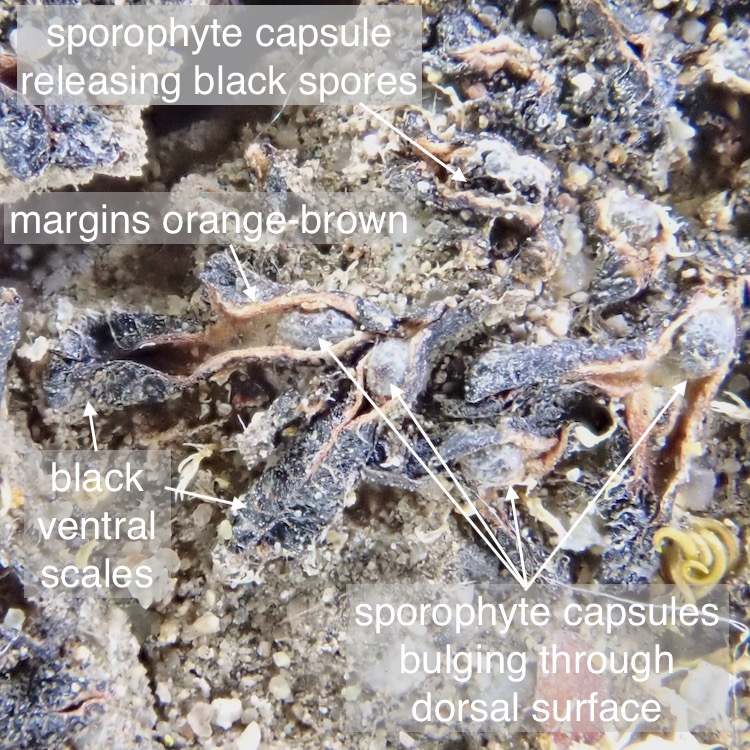
The upperside of Riccia nigrella is shiny green with a narrow groove down the centerline, which is very deep and distinct near the apex but may fade proximally. The margins are typically brownish-orange, and indeed the entire upper surface may become brownish-orange in older or more exposed plants.

The underside of Riccia nigrella is covered with shiny black scales. I have noticed, however, that some very young plants in more shaded habitats have hyaline (transparent) scales and thus the underside appears green.
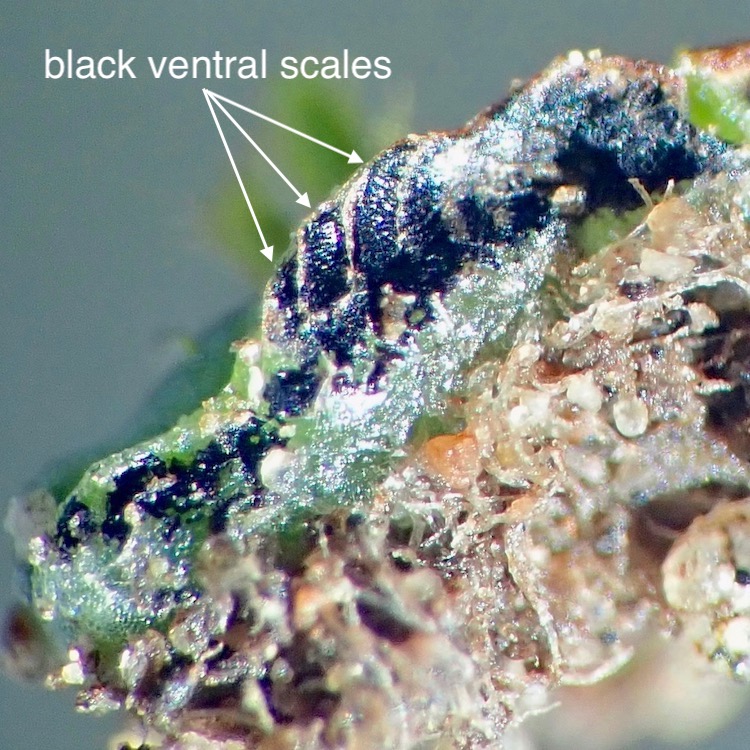
The ventral scales of Riccia nigrella can be seen clearly when the plants are dry and the thallus margins have folded in. The photomicrograph inset shows that the edges of the scales are in fact transparent, and the transparent edge is also visible on the dried plant.

The reproductive organs of Riccia nigrella are found within the narrow grooves, as shown in this photomicrograph of a cross-section of the thallus. Riccia nigrella is monoicous, with both female archegonia, each containing a single egg, and male antherida, each containing thousands of sperm, occurring within the same individual plant. Upon fertilization, the egg develops into the sporophyte, the part of the plant that produces spores.
For a review of the liverwort life cycle click here.

As with all Riccia species, the sporophytes develop within the thallus and are not visible until the summer dry months when they bulge through the eroding upper surface. Unlike most liverwort species, the Riccia sporophyte lacks both a foot and seta and consists simply of a capsule which dehisces in an irregular fashion rather than along 2-4 lines.

Riccia nigrella spores are dark brown to black, 67-82 μm, and have 7-12 areolae on the distal surface. In order to visualize spore ornamentation, these photomicrographs have been overexposed, resulting in a lighter brown color. Less mature spores also have a lighter color.
In contrast to most other liverwort species, Riccia species lack the sterile spring-like elater cells which assist in spore disperal.

Riccia nigrella appears to be a “perennial” species, at least in some microhabitats. This photo was taken in early January, shortly after the first rains of the season. The distal regions of the thalli are refreshed and green. One of last year’s sporophyte capsules can still be seen, complete with spores. Several cavities can be seen in the older parts of the thallus where sporophytes have released all their spores.

Habitat and Distribution
Riccia nigrella grows on exposed soil in partial shade or even full sun, in small distinctive rosettes or in large messier patches, often alongside other Riccia species. Particularly good spots to look for Riccia are on seldom used trails where the soil has been disturbed enough that the larger vascular plants have retreated but not so much as to destroy the bryophytes.

Riccia nigrella is found throughout California, as well as in scattered locations across the United States, in Chile, Europe, N. Africa and Australia.
Map generated by google maps using data from the Consortium of Bryophyte Herbaria of collections accessioned in herbaria.

 Bryophytes of Santa Barbara