Riccia trichocarpa M. Howe
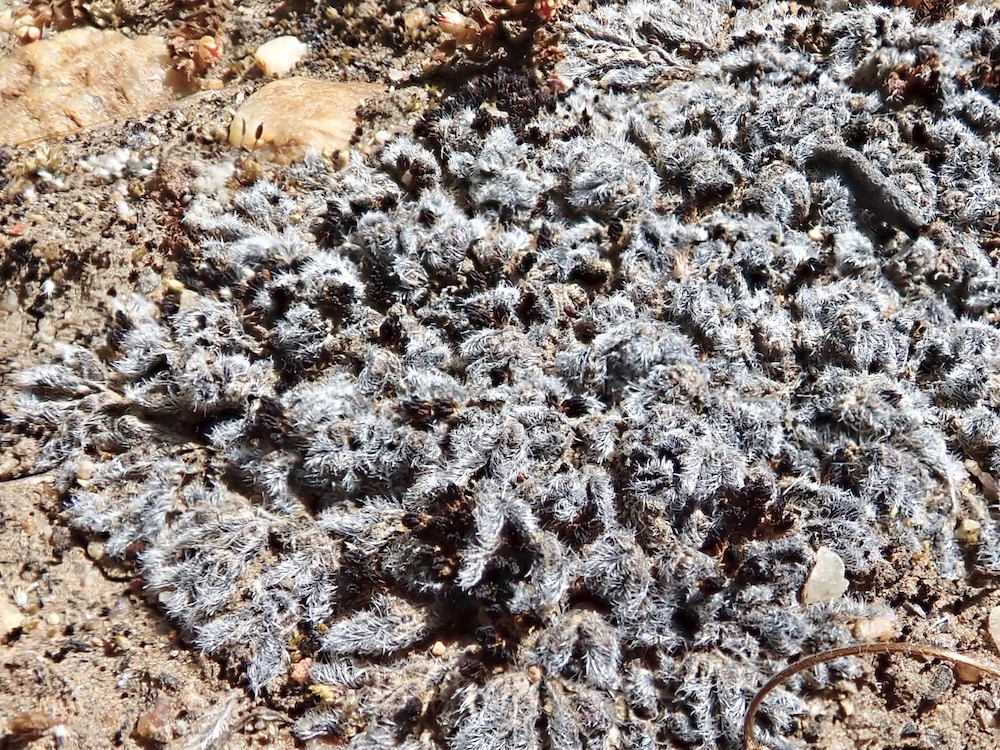
Riccia trichocarpa is a small complex thallose liverwort with distinctive long hyaline cilia (300-900 µm) along the lateral margins as well as at the lobe tips and typically on the upper surface over the sporophytes. When moist, the upper surface of the thallus is light green, and the underside is black. Upon drying, the margins roll in, revealing the black underside and causing the cilia to stick out every which way, resulting in a distinctive grey fuzzy caterpillar look. It is found on exposed sandy soil, typically in full sun, often intermixed with other Riccia species.
Scroll down for photos with labeled parts and more detailed descriptions.
Detailed Descriptions with Photos (click to enlarge)
Riccia trichocarpa is immediately recognizable when dry, with its thallus margins rolled in, showing off its long white cilia (300-900 µm) set off by the black underside.
Like most liverworts, Riccia trichocarpa is desiccation tolerant, going into a state of suspended animation when dry, and resuming growth upon rewetting.
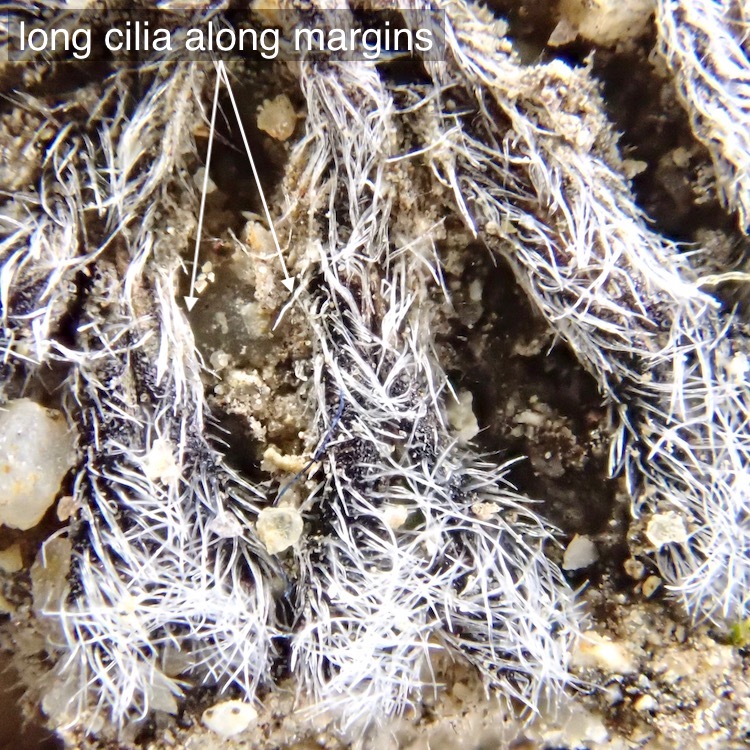
When moist, the light green, almost crystalline upper surface of Riccia trichocarpa is visible. The distinctive long white cilia are seen at the lobe tips, along the lateral margins, and oftentimes even on the surface of the plants. The deep, long, dorsal groove is also quite distinct.

This close up of Riccia trichocarpa shows some long white cilia on the surface of the plants atop the sporophytes within the thallus, as well as at the lobe tips and along the margins.

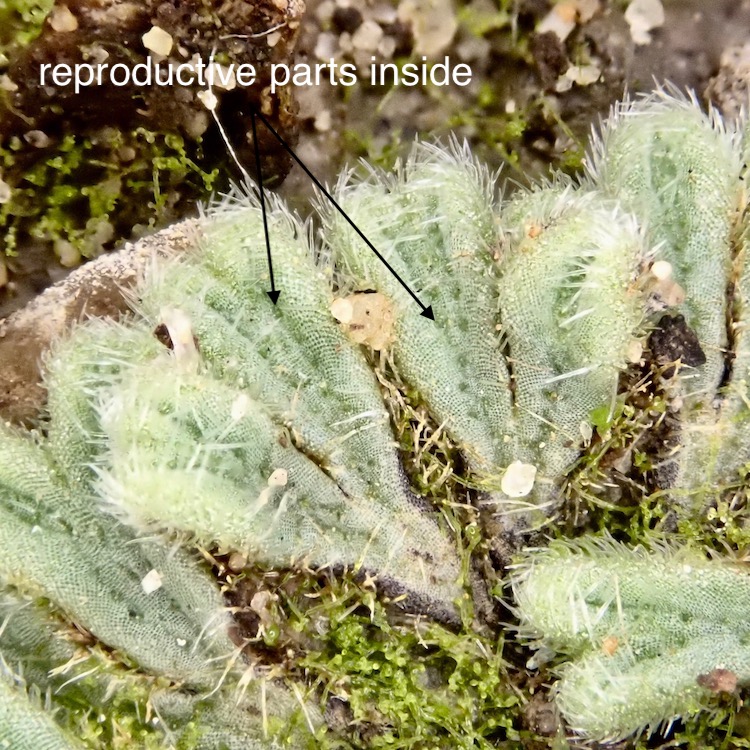
The reproductive organs of Riccia trichocarpa are hidden within the thallus, along the central groove, detectable only by the small holes or depressions as seen in this photo.
The reproductive organs of Riccia tichocarpa are found within the narrow grooves, as shown in this photomicrograph of a cross-section of the thallus. Riccia trichocarpa is monoicous, with both female archegonia, each containing a single egg, and male antherida, each containing thousands of sperm, occurring within the same individual plant. The egg within the archegonium shown here has actually already been fertilized and is beginning to develop into a sporophyte.
For a review of the liverwort life cycle click here.
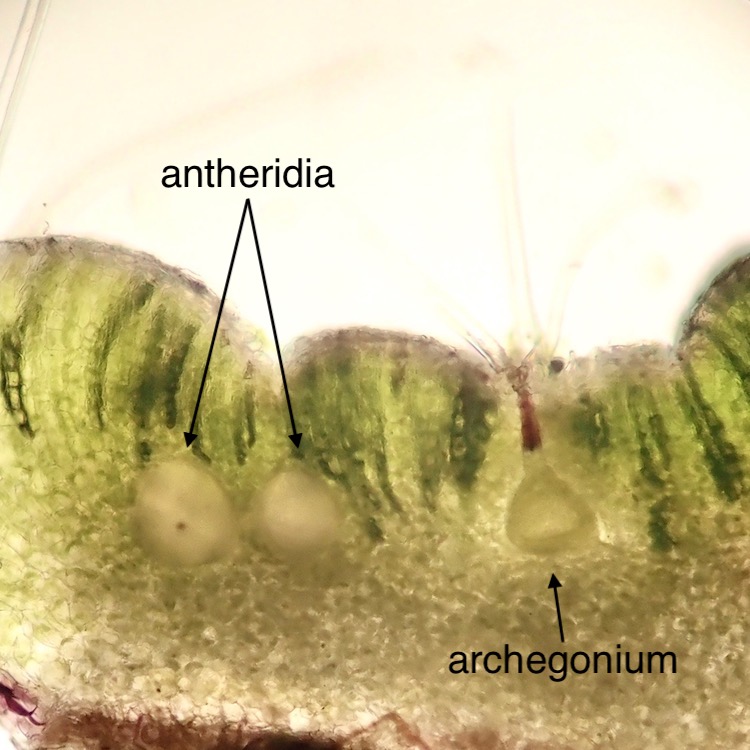
Upon fertilization, the egg develops into the sporophyte, the part of the plant that produces spores. In this photomicrograph of a cross-section of Riccia tichocarpa, a developing sporophyte can be seen with immature spores. The neck of the archegonium is still visible as a purple-black stem atop the sporophyte capsule, and hyaline cilia can also be seen on the dorsal surface above the sporophyte. As in all Riccia species, the sporophytes remain within the thallus and consist of a capsule only, with no seta or foot.

This photo shows a rehydrated Riccia trichocarpa plant under the dissection microscope. One lobe has been cut off, revealing the green inner cells. The large black spores are emerging from the upper light green surface. The hyaline cilia along the lateral margins can be seen, as well as the purplish black underside and hyaline rhizoids which attach the plant to the substratum.
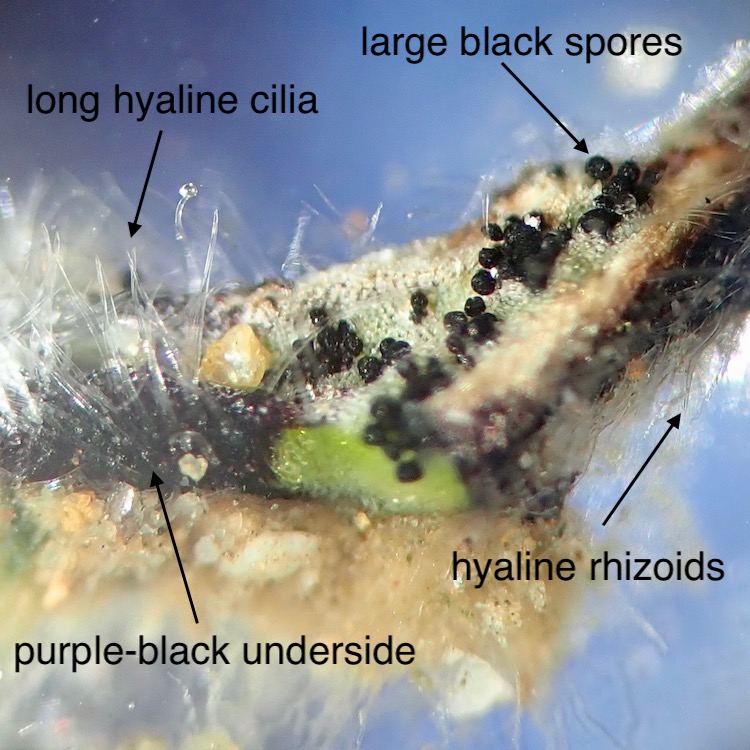
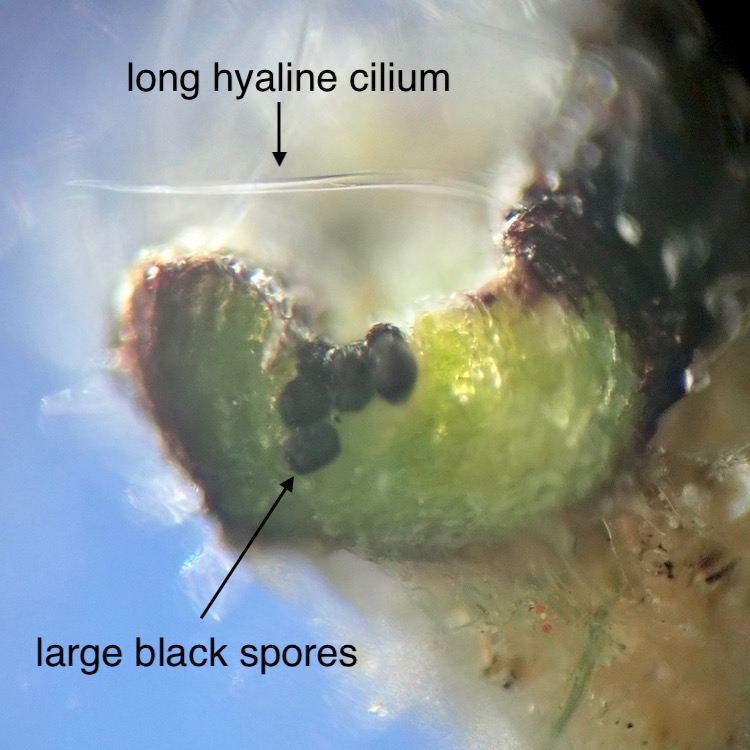
In this close up view of a Riccia trichocarpa thallus in cross section, the large black/brown spores are visible within the thallus, and emerging from upper surface. The capsule dehisces irregularly rather than by lines of dehiscence, and unlike most liverwort species, the spores are released without the aid of spring-like elater cells.
This cross-section of Riccia trichocarpa viewed at 100x under the compound microscope shows the green narrow finger-like photosynthetic chambers atop the white spongy parenchymal cells. One can also see also that the hyaline rhizoids, which attach the plant to the substratum, are unicellular as in all liverworts.

Habitat and Distribution
Riccia trichocarpa typically grows on bare sandy or gravelly soil in full sun or some shade, often alongside other Riccia species. In this photo, the lighter green liverworts are Riccia trichocarpa, and the darker green liverworts are primarily Riccia nigrella. The emerald green plants are Timmiella, a moss.

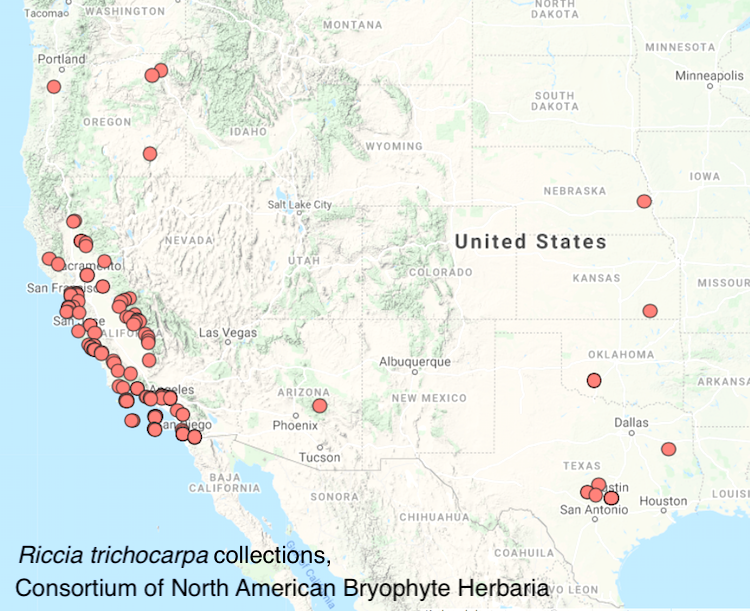
Riccia trichocarpa occurs throughout western North America and is reportedly widespread in California.
Map generated by google maps using data from the Consortium of Bryophyte Herbaria of collections accessioned in herbaria.