
Riccia sorocarpa Bisch.
Riccia sorocarpa is a small complex thallose liverwort with rather wide lobes (0.6-1.8-2.0?mm) which branch dichotomously once and have a distinct median groove which ends in a v-shape near the apex of the lobes. The upper surface is light green, somewhat spongey, becoming whitish with age or when dry. The underside is covered with colorless scales, which are sometimes visible from above as a colorless margin. It is found on exposed soil, in full sun to partial shade, often intermixed with other Riccia species.
Scroll down for photos with labeled parts and more detailed descriptions.

Detailed Descriptions with Photos (click to enlarge)
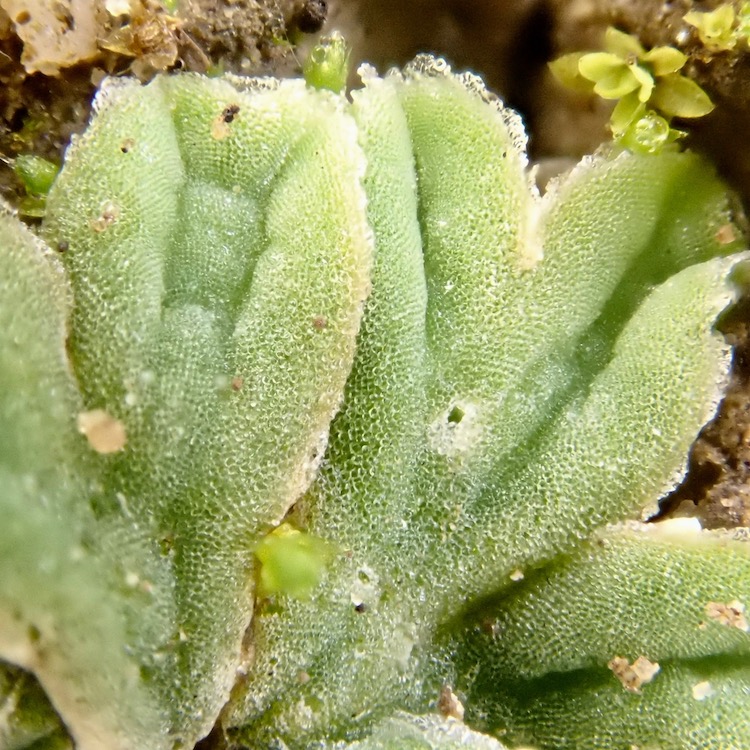
The upper surface of Riccia sorocarpa is pale green, becoming yellowish-white with age. The v-shaped median groove at the lobe apices may vary considerably in width, even on adjacent lobes, and gradually disappears in the proximal regions of the lobes.

At closer magnification, one can often see a white fringe along the margins of Riccia sorocarpa. These are the hyaline scales peeking out from the underside of the thallus.
The light green lower (ventral) surface of Riccia sorocarpa is covered with a generous layer of colorless, unicellular rhizoids. The hyaline scales can only clearly be seen along the margins (see below).
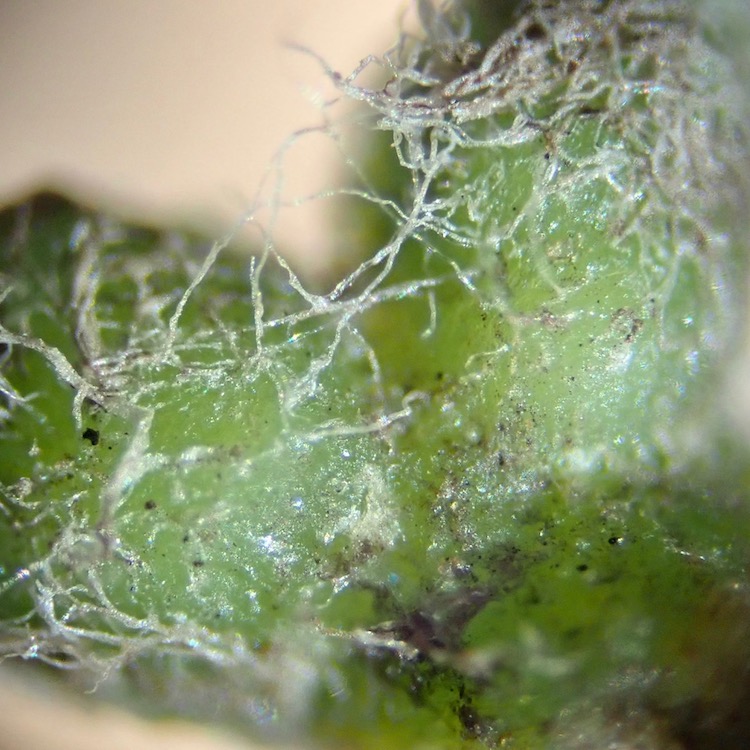
The hyaline scales on the underside of Riccia sorocarpa often extend beyond the thallus margin.

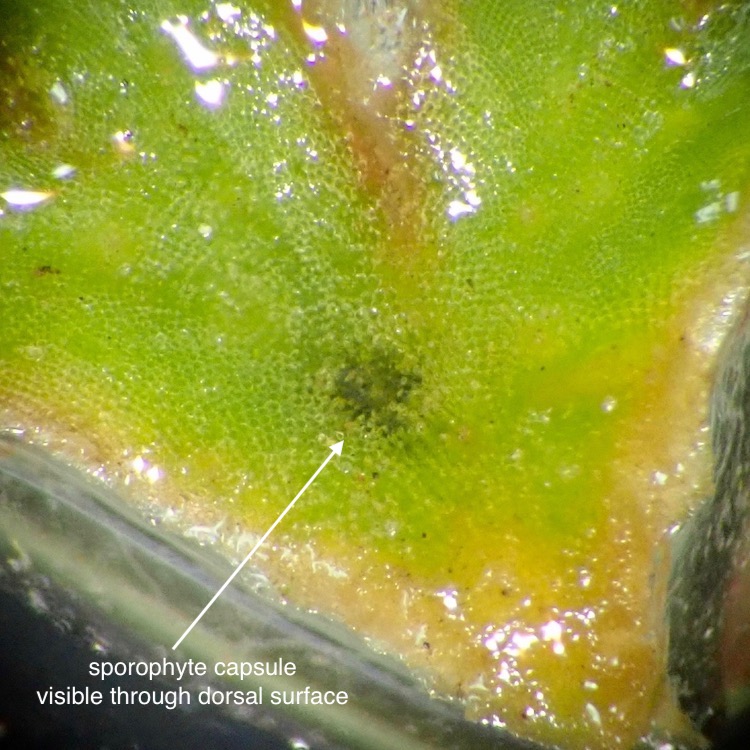
As with all Riccia species, the sporophytes of Riccia sorocarpa develop within the thallus and are not visible until the summer dry months when the upper surface begins to erode. In this photo taken in late spring through a dissection microscope, a hint of one sporophyte capsule can be seen through the upper surface.
For a review of the liverwort life cycle click here.
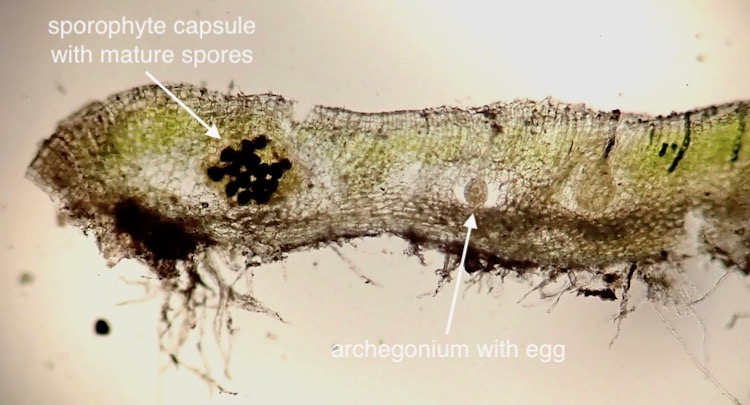
This cross-section of a Riccia sorocarpa thallus shows several stages of sporophyte development. An egg in an archegonium awaiting fertilization will eventually develop into a mature sporophyte with mature spores. Note that Riccia sporophytes consist of only the capsule, lacking a seta and foot.
This photomicrograph of a Riccia sorocarpa thallus shows an intermediate stage in sporophyte development, with an immature sporophyte capsule with white immature spores. The neck of the archegonium can still be seen, like a purple stem on a fruit.

In the summer dry months, Riccia sorocarpa becomes quite white, the margins roll in slightly, and the upper surface erodes, releasing the spores from the sporophytes within the thallus.
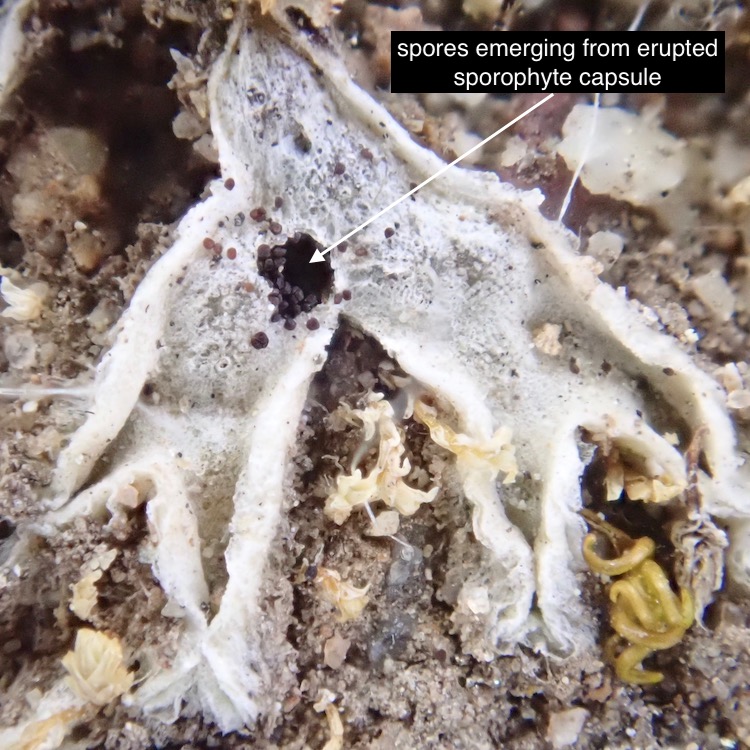
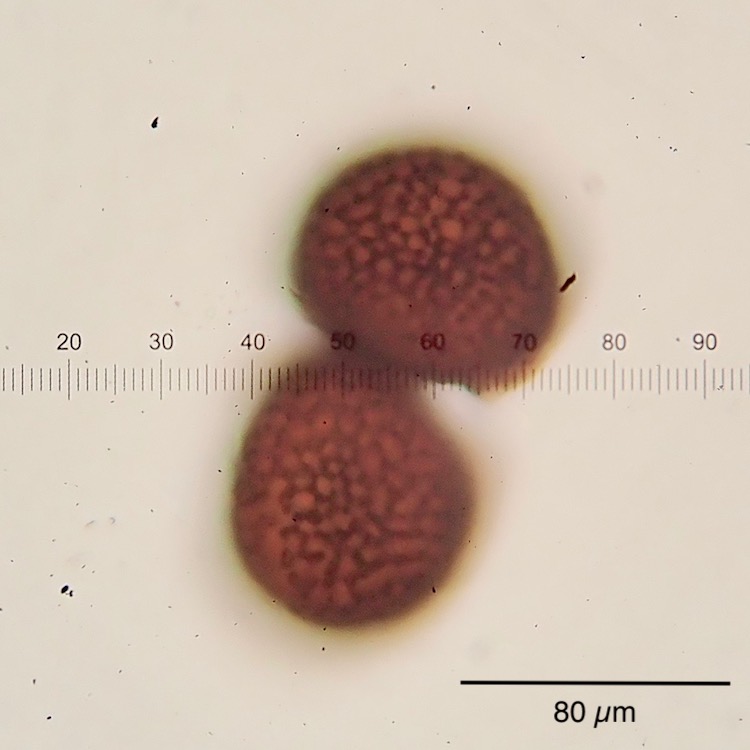
According to Doyle and Stotler, the spores of Riccia sorocarpa are reddish to dark brown, 60-98 μm wide, have 8-12 areolae across the distal surface with papillae at the intersections, and have more finely granular proximal surfaces.
This first photomicrograph shows the areolae on the distal faces of two Riccia sorocarpa spores.
The finely granular proximal surfaces can be seen on the lower two Riccia sorocarpa spores in this second photomicrograph.
In contrast to most other liverwort species, Riccia species lack the sterile spring-like elater cells which assist in spore disperal.

Habitat and Distribution
Riccia sorocarpa typically grows on exposed soil in partial shade or even full sun, often alongside other Riccia species. Particularly good spots to look for Riccia are on seldom used trails where the soil has been disturbed enough that the larger vascular plants have retreated but not so much as to crush the liverworts.

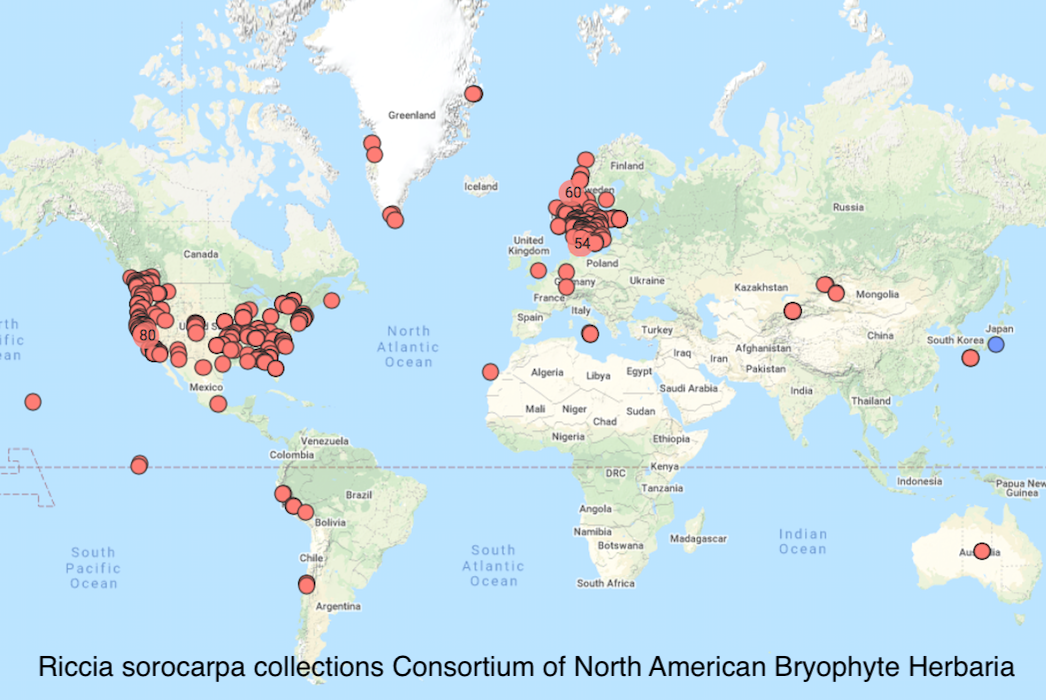
Riccia sorocarpa is found throughout California and across North America, as well as in South America, Europe, Asia, Africa, New Zealand, and Australia.
Map generated by google maps using data from the Consortium of Bryophyte Herbaria of collections accessioned in herbaria.
 Bryophytes of Santa Barbara