
Riccia californica Austin
Riccia californica is a small complex thallose liverwort (lobes 2-3mm wide) with a pale green upper surface and slender, rather short (50-400μm) hyaline cilia along the margins, particularly at the chubby lobe apices. The thalli branch dichotomously and have a distinct groove at the apex of the lobes, which widens and then disappears proximally. Plants often form distinct rosettes, but large populations may look more chaotic as individuals overlap. It is found on exposed soil, in full sun to partial shade, often intermixed with other Riccia species. Note that plants that are very young or in wet habitats may have few or even no cilia.
Scroll down for photos with labeled parts and more detailed descriptions.

Detailed Descriptions with Photos (click to enlarge)
Riccia californica‘s pale green, dichotomously branching thallus has margins which tend to bulge alongside the wide dorsal groove at the lobe apices, looking rather chubby and showing off the short hyaline cilia. Older plants begin to fade to a pale yellow, particularly along the edges.
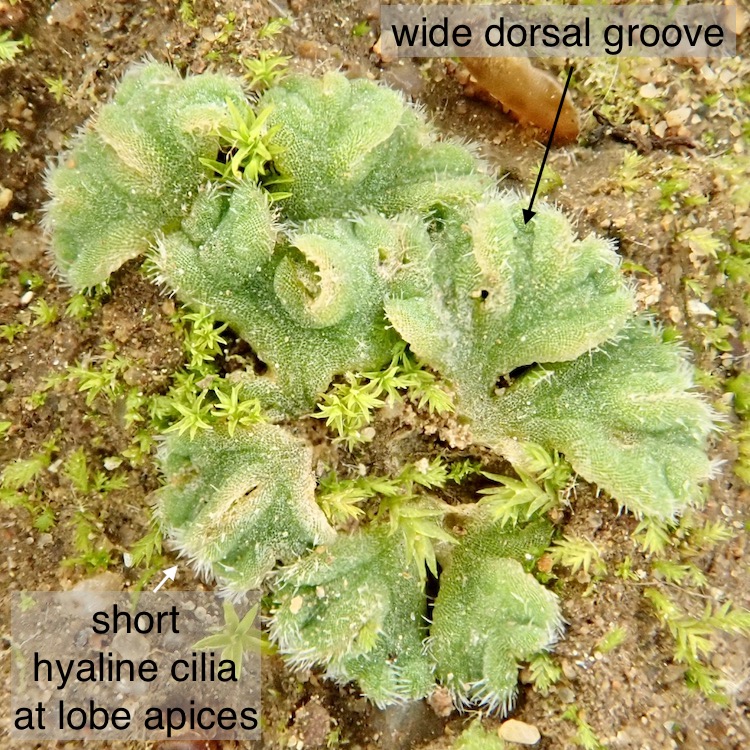
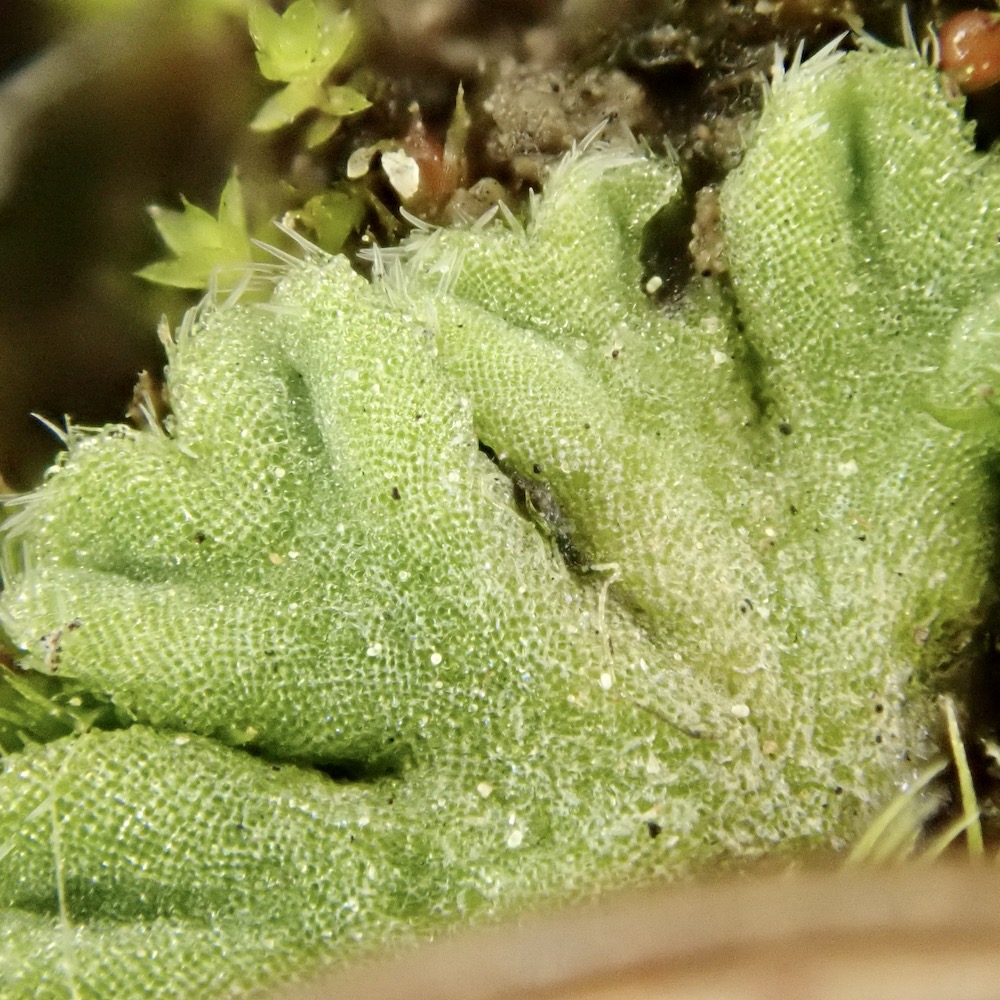
Riccia californica‘s pale green upper surface has a frosty look to it. The short (50-400μm) hyaline cilia are generally restricted to the lobe tips, but sometimes extend along the margins, and may be subtle or even absent on young plants.
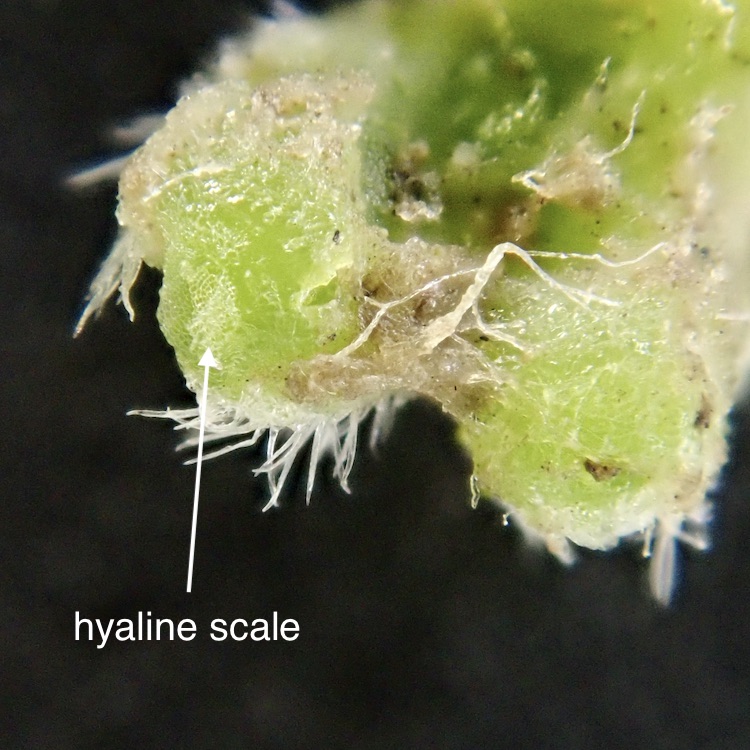
Riccia californica‘s underside has inconspicuous colorless (hyaline) scales, as well as colorless rhizines, which attach the plant to the substratum. Apparently some populations may have conspicuous black ventral scales (William Doyle and Raymond Stotler) but I have never encountered this.
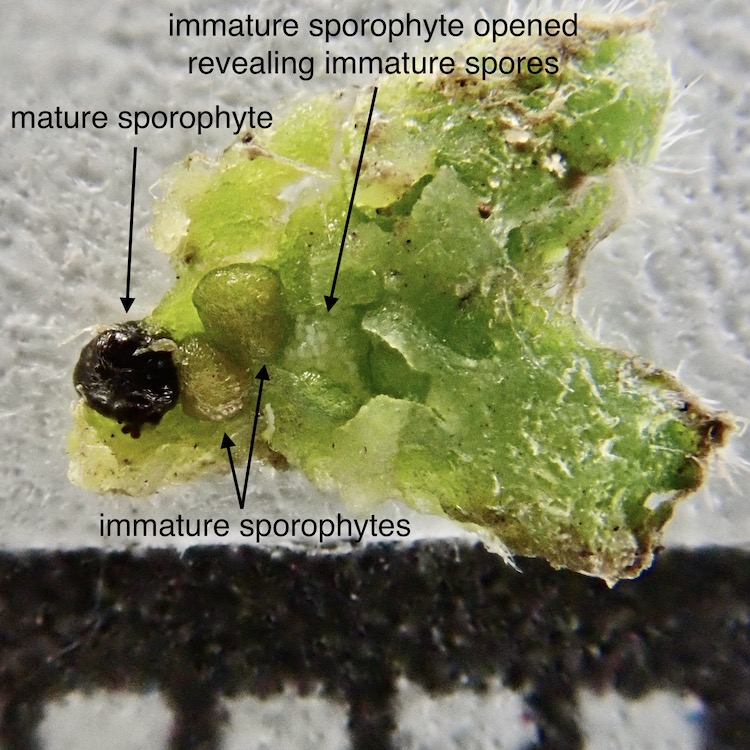
As with all species in the genus, Riccia californica sporophytes develop within the thallus and are not visible until the summer dry months when the upper surface of the thallus erodes. Here, the thallus has been dissected to reveal a mature black sporophyte capsule and immature green capsules. One capsule has been opened, revealing the immature spores within.
For a review of the liverwort life cycle click here.
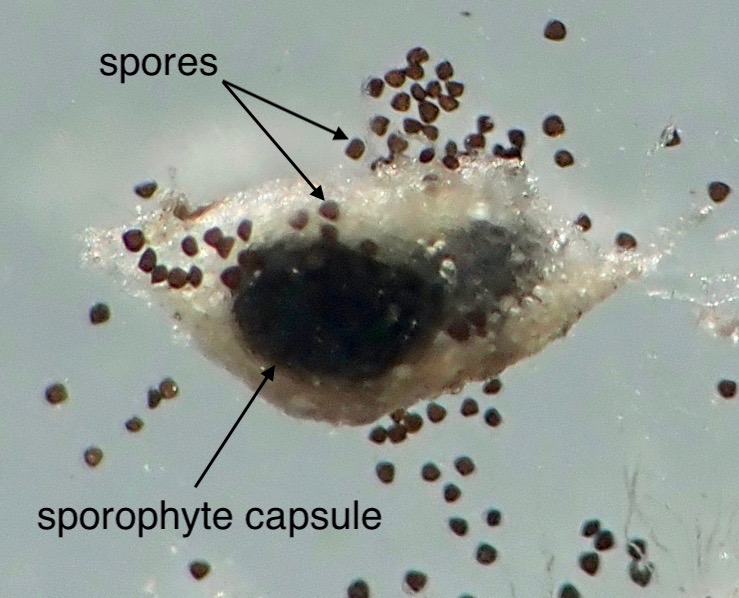
This cross-section of the Riccia californica thallus shows the mature black sporophyte capsule with mature dark brown spores floating out. In contrast to most other liverwort species, Ricciasporophytes consist of only the capsule, lacking a seta and foot.
This cross-section of a Riccia californica thallus shows the hyaline cilia extending from the sides of the upper thallus, and colorless rhizoids extending from the ventral surface. On the right, an immature sporophyte capsule is filled with colorless immature spores. The circular empty space on the left is where one immature sporophyte capsule has been removed.

The spores of Riccia californica are rather small (64-89 μm in diameter), light brown turning dark brown when mature, and have 8-13 areloae across the distal spore face, with blunt papillae at the corners of the areolae, as seen in this photomicrograph at 400x magnification.
In contrast to most other liverwort species, Riccia species lack the sterile spring-like elater cells which assist in spore disperal.

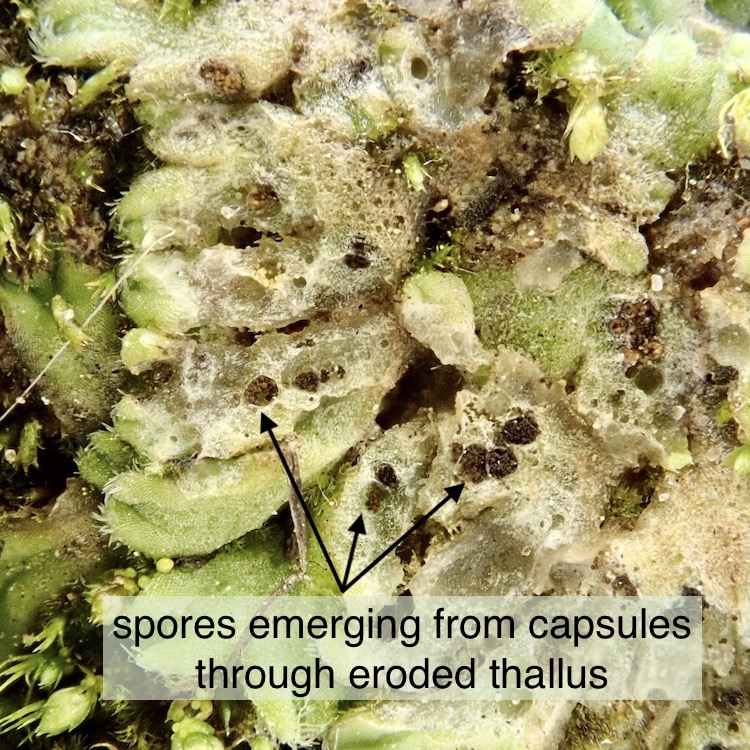
Upon maturation, the upper surface of Riccia californica erodes, releasing the spores from the sporophyte capsules.
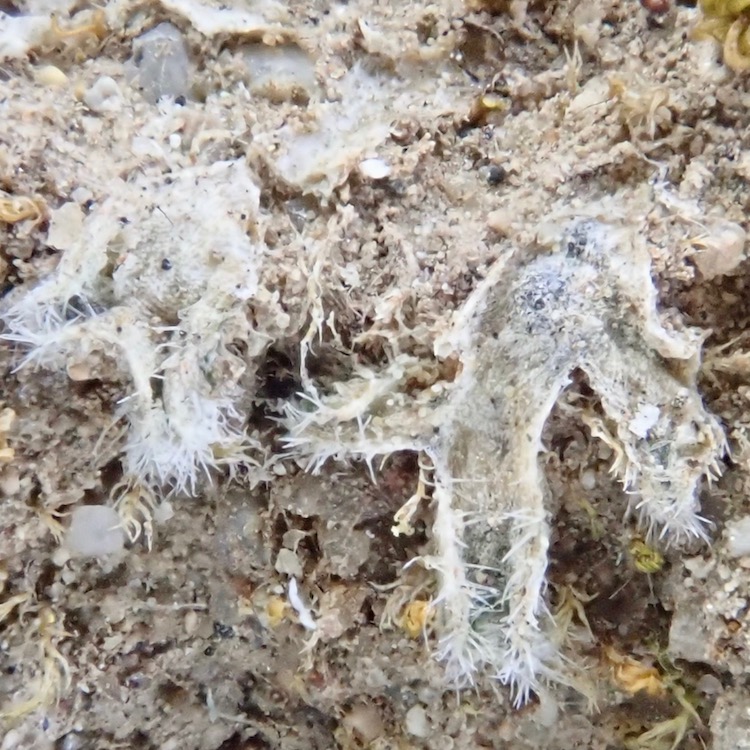
Later in the season, Riccia californica‘s cilia may be more numerous, extending further down the margin, or perhaps are simply more prominently displayed as it begins to dry and roll up.

Riccia californica looks very pale when dry, the margins roll in slightly, and the cilia are accentuated.
Habitat and Distribution
Riccia californica typically grows on exposed soil in partial shade or full sun, often alongside other Riccia species. Particularly good spots to look for Riccia are on seldom used trails where the soil has been disturbed enough that the larger vascular plants have retreated but not so much as to destroy the bryophytes.
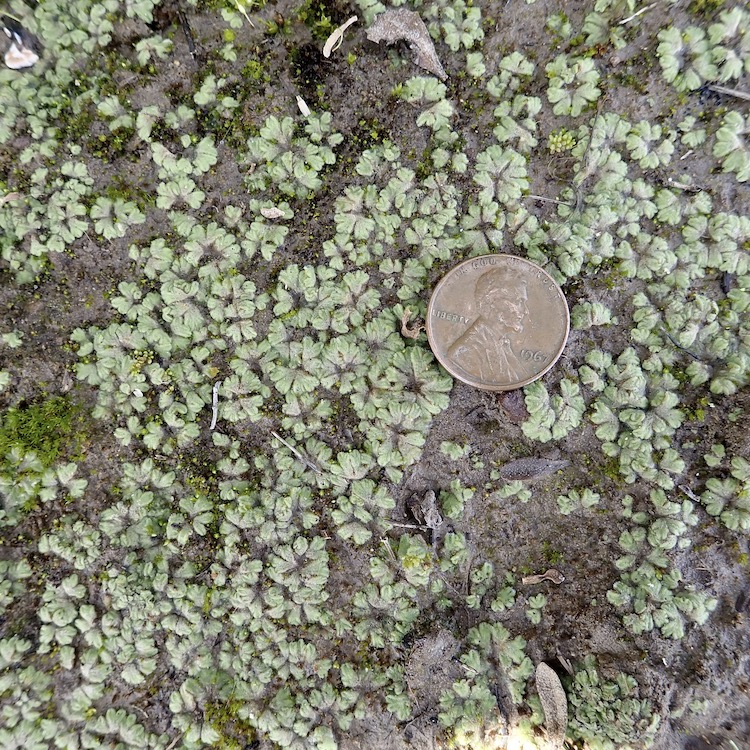
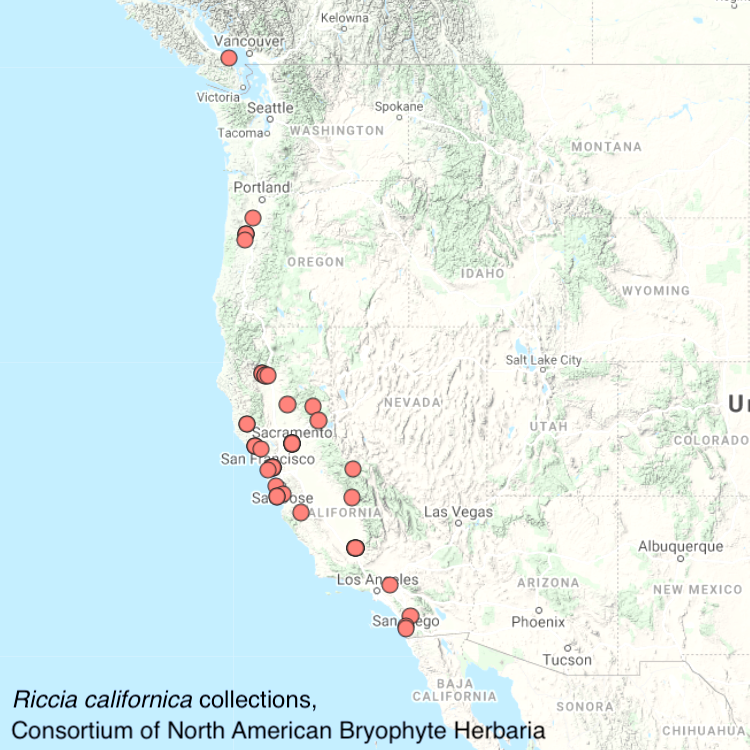
Riccia californica is found in California, Oregon and into southern British Columbia. It is quite common here in Santa Barbara County, at least as common as Riccia nigrella and Riccia sorocarpa, if not moreso, at least in the front country.
Map generated by google maps using data from the Consortium of Bryophyte Herbaria of collections accessioned in herbaria.
Name: The genus Riccia is named after Pietro Francesco Ricci, an Italian amateur botanist from the 1700s. The specific epithet, californica, refers to the fact that this species is found primarily in California.
Similar Species in Santa Barbara County
Riccia glauca and Riccia beyrichiana, neither yet reported for mainland Santa Barbara County but present on the Channel Islands, also have rather large, pale green thalli with marginal cilia, but these have conspicuous ostioles and large spores (mostly 85-125 μm in diameter).
Riccia sorocarpa is also light green and has colorless ventral scales but lacks chubby apices and marginal cilia, giving it a cleaner, smoother, rather naked look. The two often grow intermixed, sometimes also with Riccia nigrella.

 Bryophytes of Santa Barbara