Tortula acaulon (Withering) Zander, also known as Phascum cuspidatum Hedwig

Tortula acaulon is a very small (2-4 mm), ephemeral moss, which grows on exposed soil, often in disturbed areas, in dense clusters or scattered amongst other small and ephemeral moss species. Here in Santa Barbara County, the leaves typically have long awns, which give the clump a furry appearance. The very short sporophyte is immersed within the leaves, which envelop it rather loosely, and its shiny brown oblong capsule is easily seen when it matures.
Scroll down for more photos (click to enlarge) and descriptions of habitat, plants, leaves, sporophytes, spores, distribution map, name origin, and similar species.
Tortula acaulon Phascum cuspidatum
Tortula acaulon (CAH #1061) CC BY-NC Amanda Heinrich
Habitat: Tortula acaulon grows on seasonally moist soil, often in disturbed areas, in partial shade or full sun.
Tortula acaulon Phascum cuspidatum
Tortula acaulon, lightest green in center, surrounded by other moss species, on soil in partial shade in early January (CAH #1064). CC BY-NC Amanda Heinrich
Tortula acaulon Phascum cuspidatum
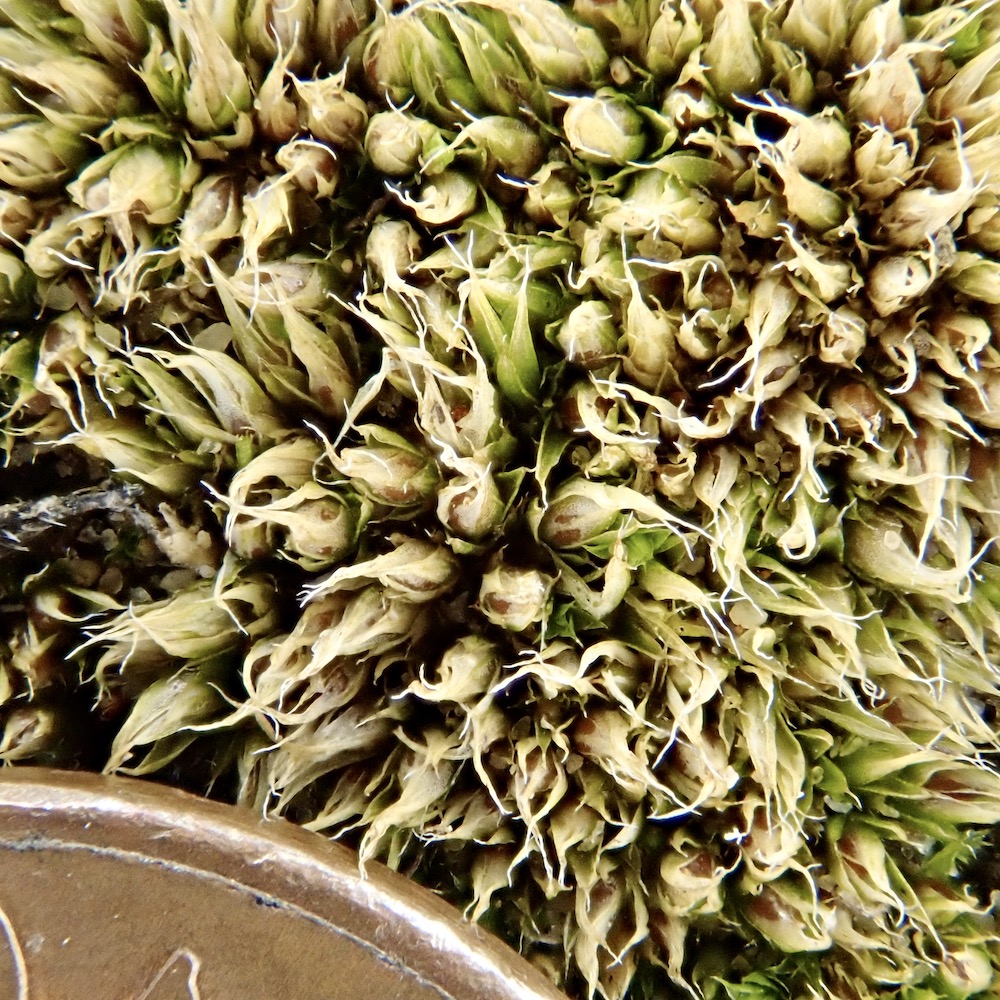
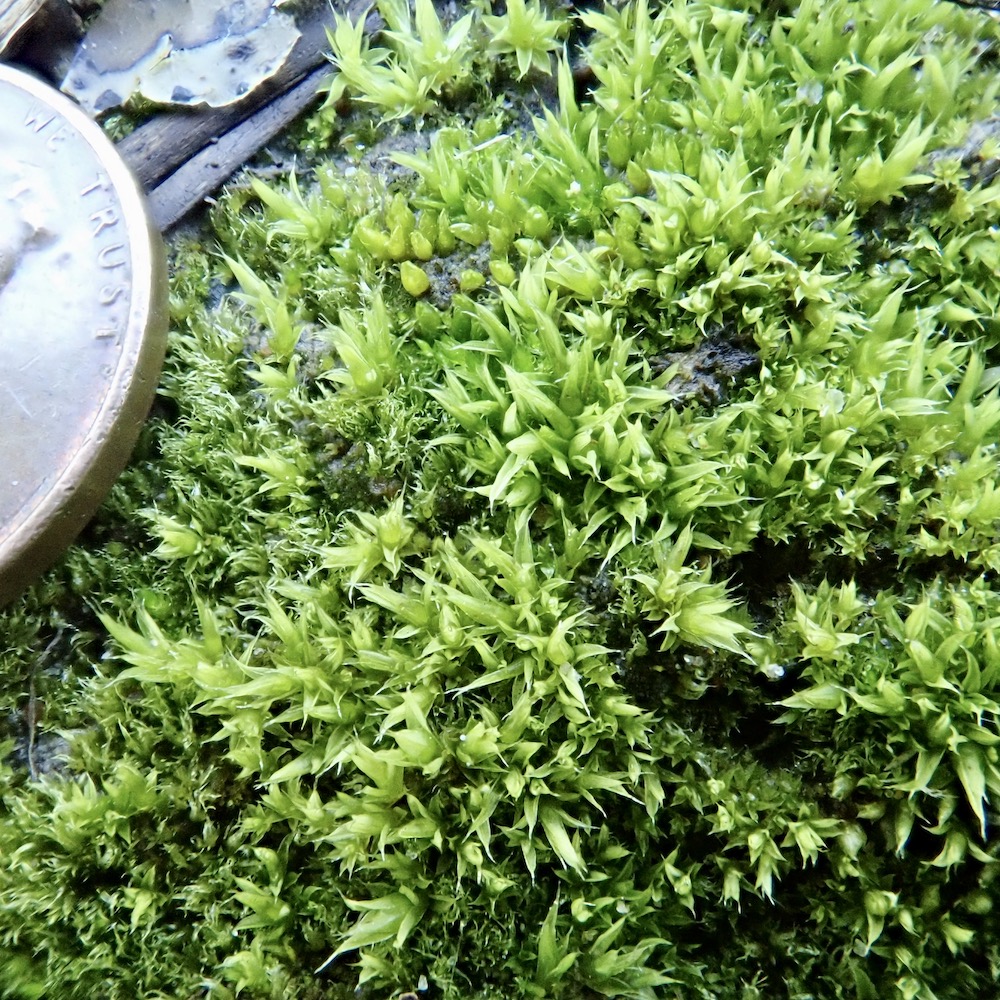
Tortula acaulon in center with penny, on soil in full sun, early March (CAH #1061). CC BY-NC Amanda Heinrich
Habit:  Tortula acaulon plants may form dense clumps or be scattered amongst other ephemeral moss species.
Tortula acaulon Phascum cuspidatum
Young green Tortula acaulon plants, comparatively large, scattered amongst tiny wispy Ephemerum serratum and a few compact bulbous Acaulon muticum plants, in partial shade in January (CAH #1064). CC BY-NC Amanda Heinrich
Tortula acaulon Phascum cuspidatum
More mature, tightly packed Tortula acaulon plants in full sun, drying somewhat in early March (CAH #1061). CC BY-NC Amanda Heinrich
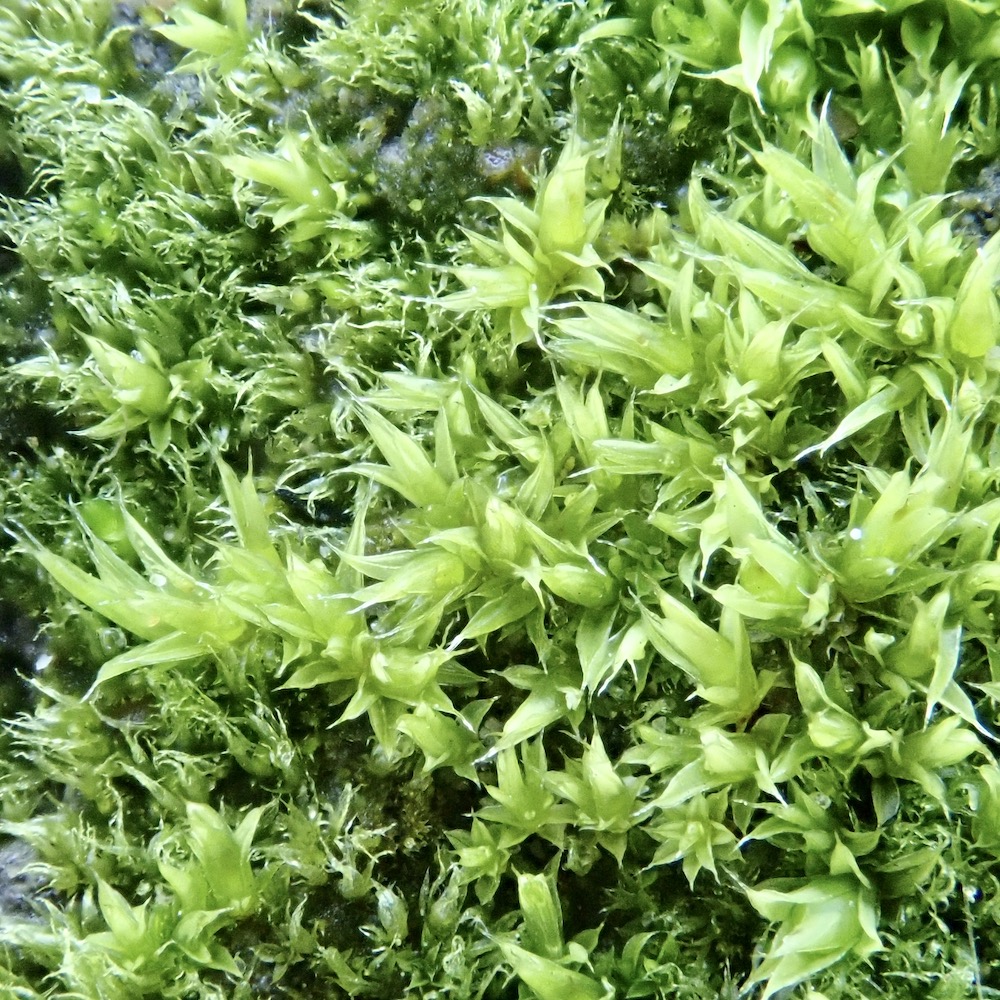
Plants:  Tortula acaulon plants are budlike, with just a few leaves originating from a stumpy stem. When moist, the leaves are held slightly outward, revealing the sporophyte capsule. When dry, leaves become more erect and overlap one another, loosely enveloping the sporophyte.
Tortula acaulon Phascum cuspidatum
Young, moist Tortula acaulon plants with light green leaves held open, long awns apparent, immature sporophytes not yet visible, in shade in January (CAH #1064). CC BY-NC Amanda Heinrich
Tortula acaulon Phascum cuspidatum
More mature Tortula acaulon plants with leaves brown and drying, loosely clasping the visible, maturing brown sporophyte capsules, in full sun in March (CAH #1061). CC BY-NC Amanda Heinrich
Tortula acaulon Phascum cuspidatum
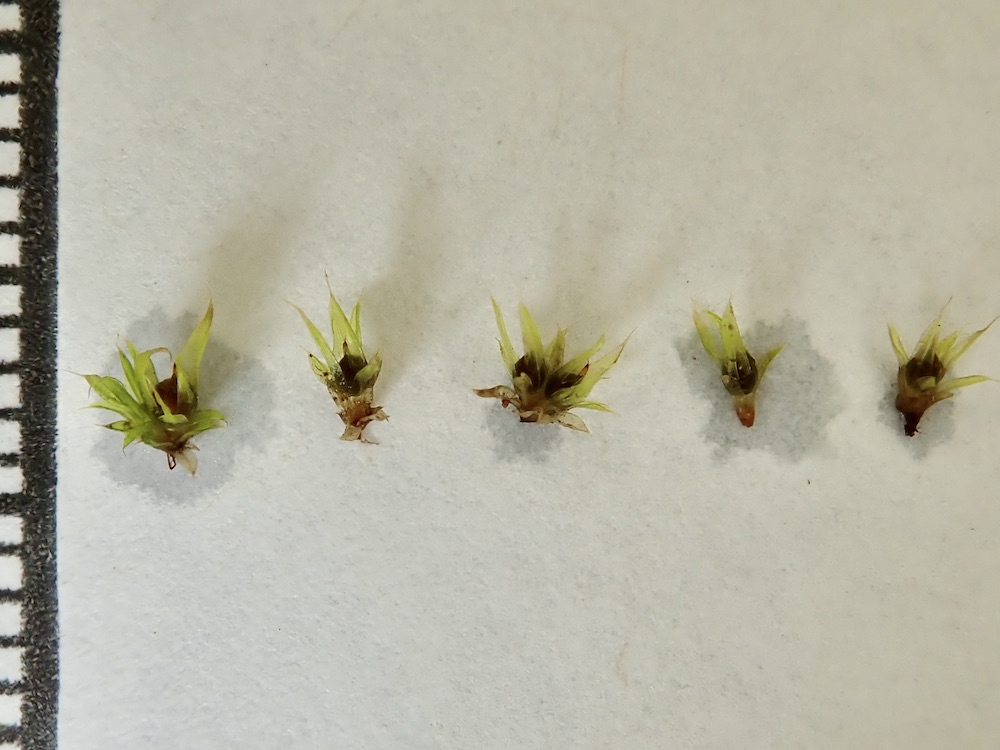
Five Tortula acaulon plants moist, leaves splayed, revealing sporophyte. Middle plant has forked stem (CAH #1064). CC BY-NC Amanda Heinrich
Tortula acaulon Phascum cuspidatum
Five Tortula acaulon plants dry, leaves somewhat loosely enveloping sporophyte. Plant second from right has forked stem (CAH #1061). CC BY-NC Amanda Heinrich
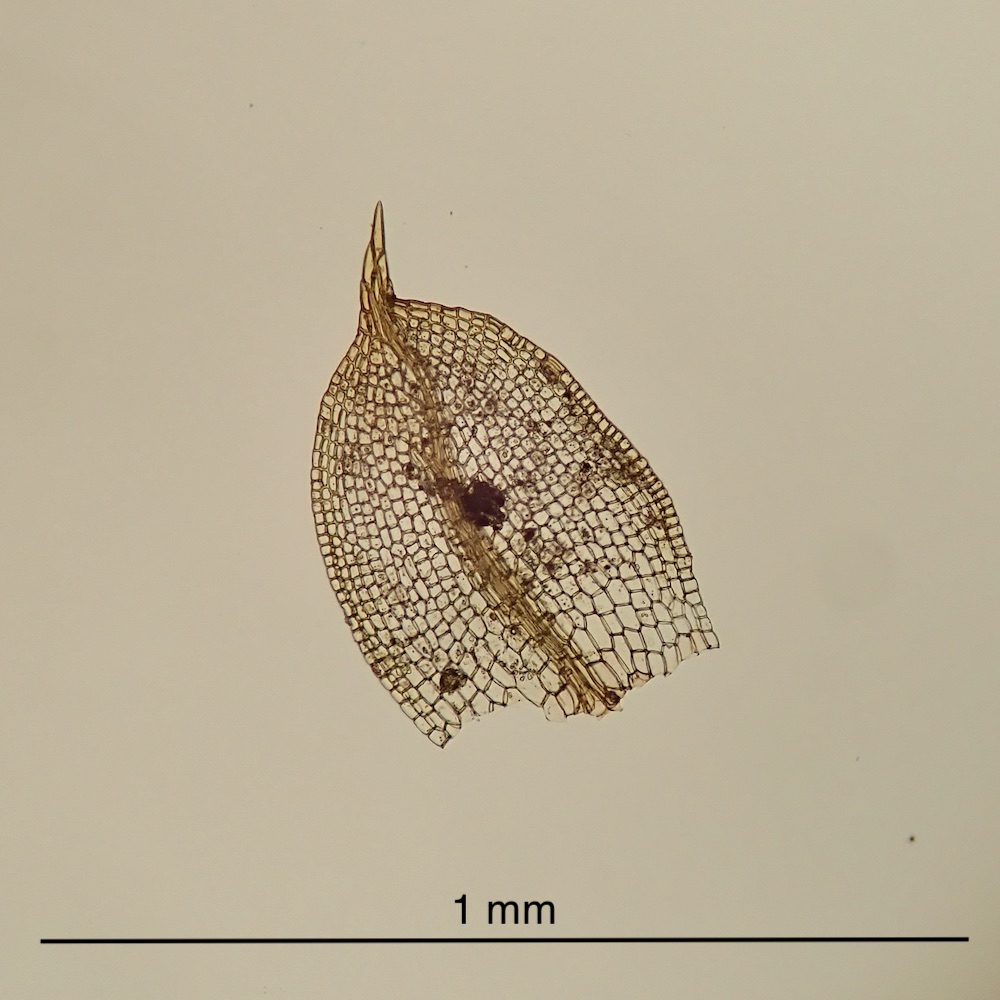
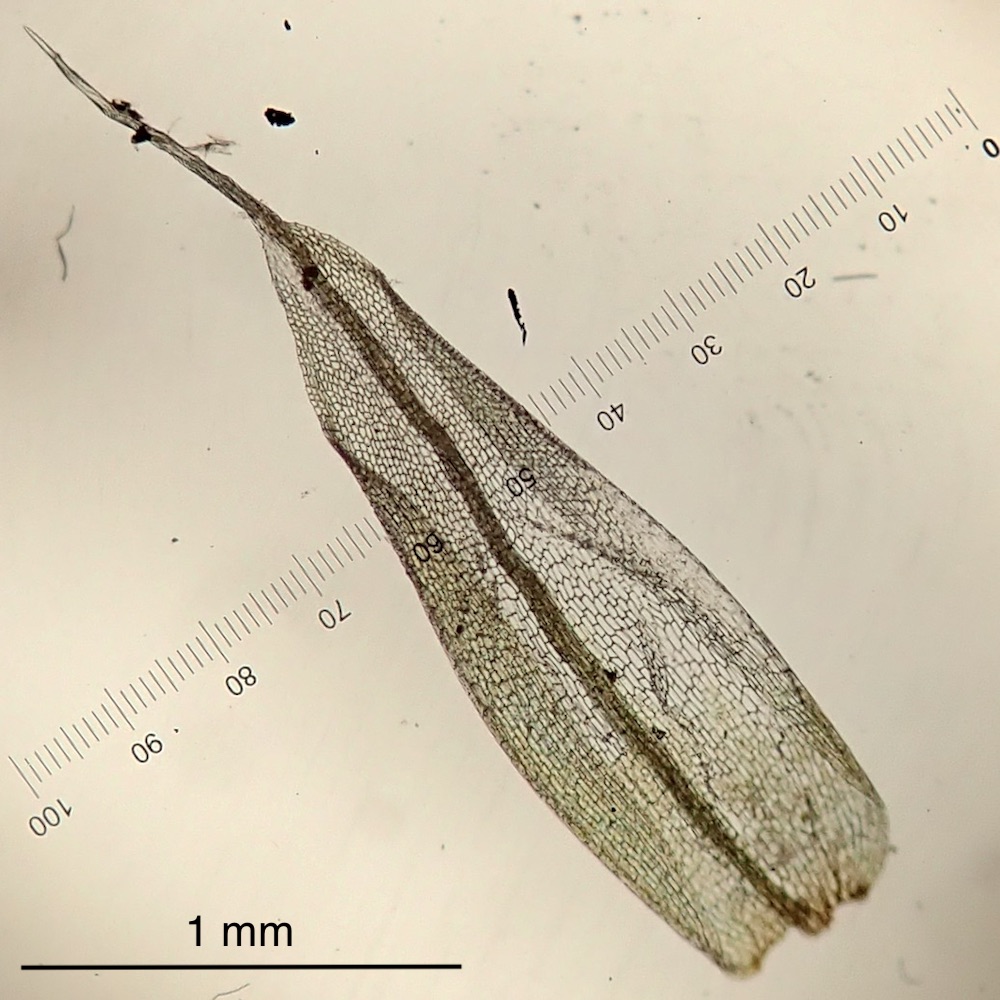
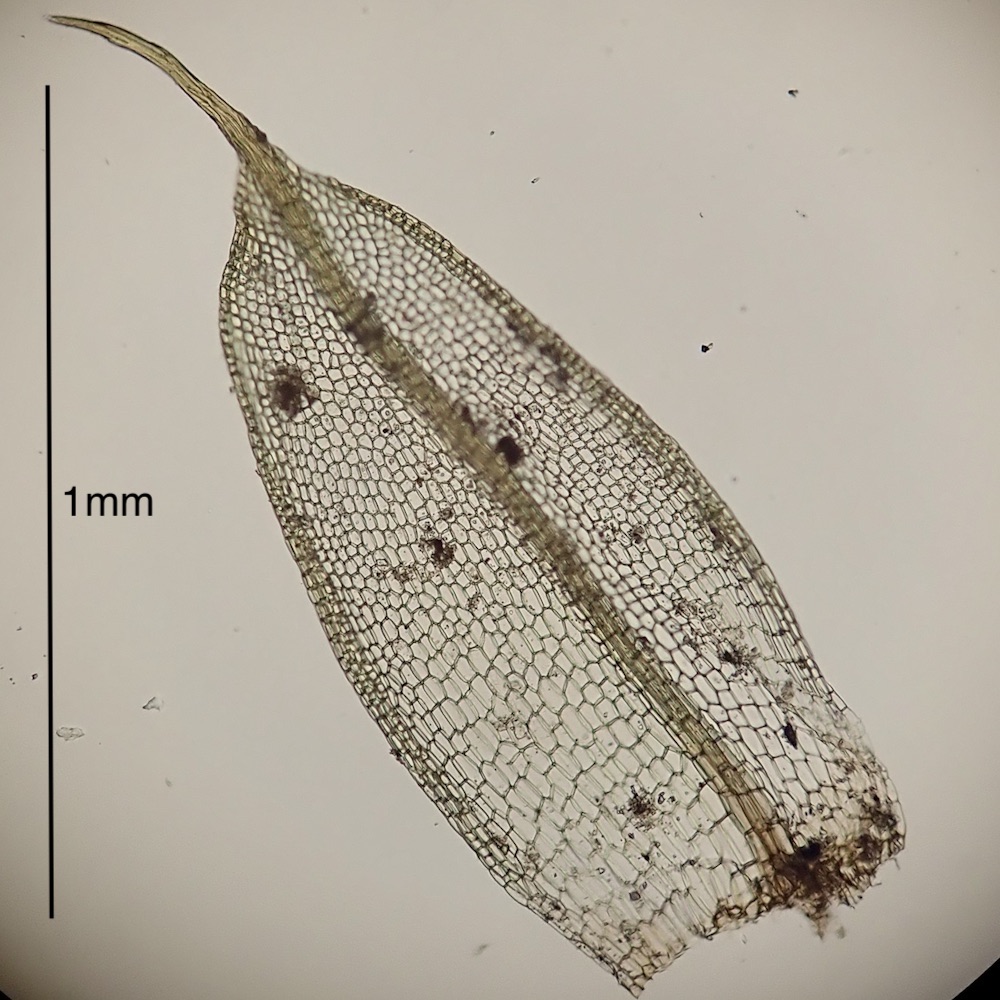
Leaves: Tortula acaulon leaves are oblong, of various sizes, with inner leaves longest (to 3.5 mm) and outer leaves shortest. Leaves may or may not have a long awn, though all plants I have encountered here in Santa Barbara County have had at least some leaves with very long awns, particularly the large innermost leaves which surround the sporophyte (perichaetial leaves). Margins of longer leaves are recurved.
Tortula acaulon Phascum cuspidatum leaf
Tortula acaulon medium leaf, 100x (CAH #1061). CC BY-NC Amanda Heinrich
Tortula acaulon Phascum cuspidatum leaf
Tortula acaulon small outer leaf, 100x (CAH #1064). CC BY-NC Amanda Heinrich
Tortula acaulon Phascum cuspidatum leaf
Tortula acaulon large inner enveloping (perichaetial) leaf (CAH #1061). CC BY-NC Amanda Heinrich
Tortula acaulon Phascum cuspidatum leaf cross section
Tortula acaulon leaf cross-section, showing recurved margins, 400x (CAH #1064). CC BY-NC Amanda Heinrich
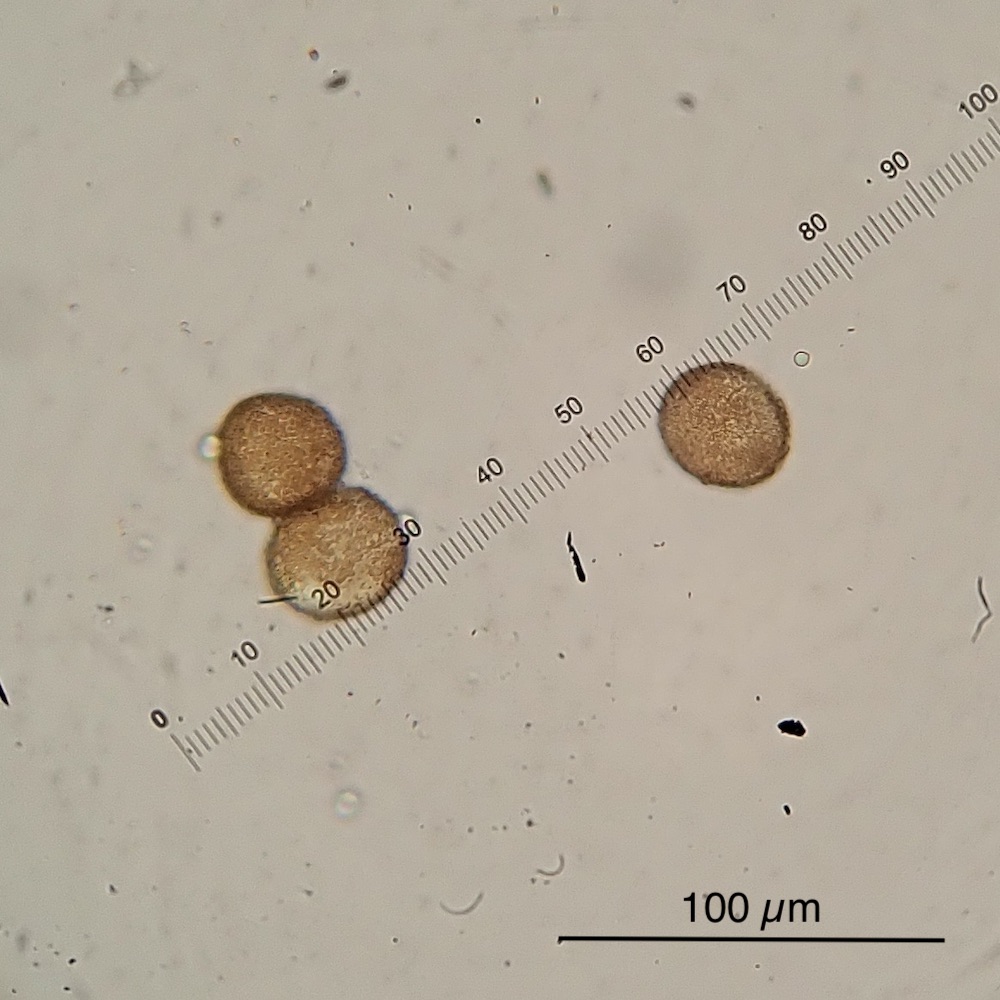
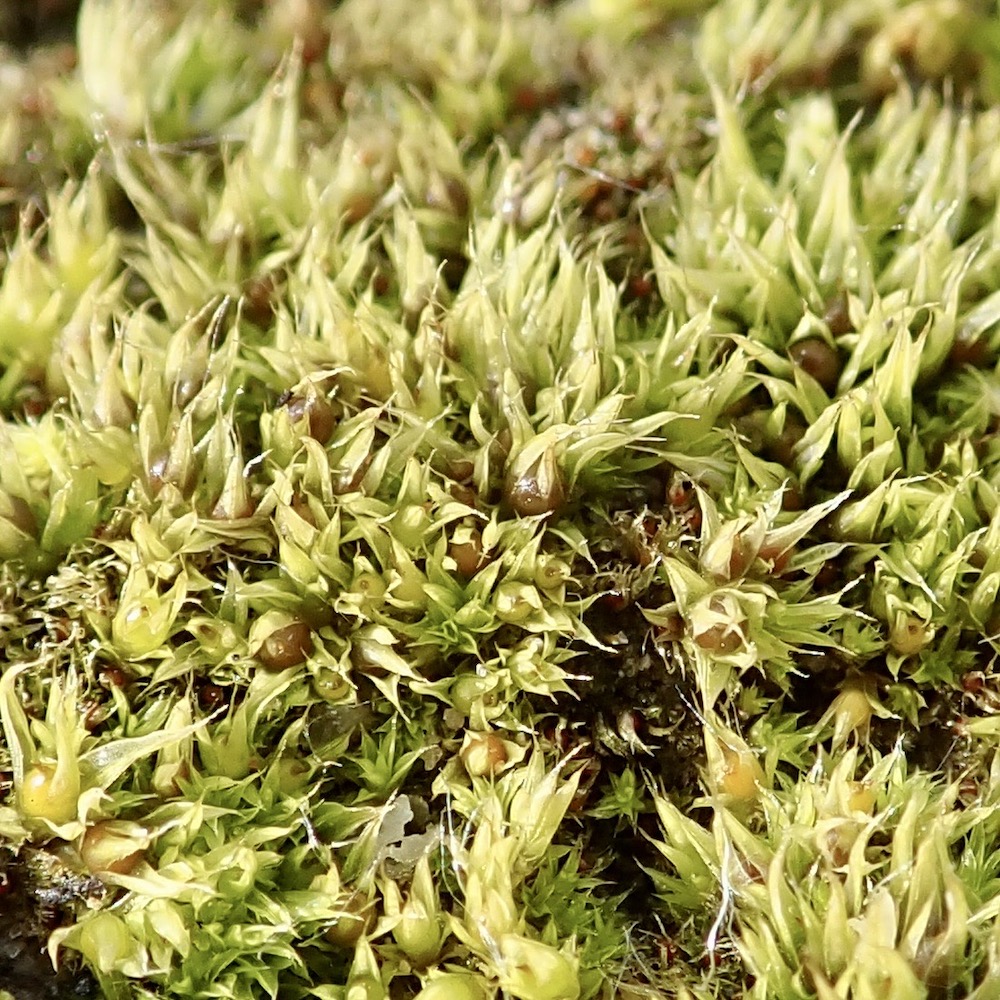
Sporophytes: Tortula acaulon sporophytes are very short (1-1.5 mm), and are immersed within the leaves, but not fully hidden. Capsules are spherical to oblong, becoming shiny chestnut brown when mature, and have a pointy cap (calyptra) which covers the variable nipple-like apiculus on top. The stalk (seta) is very short and unless dissected out, the sporophytes appear to be sessile. Upon maturation, the capsule simply decays (is cleistocarpous) to release the brown, finely papillose spores.
Tortula acaulon Phascum cuspidatum
Tortula acaulon moist plants with sporophytes at various stages of maturity, in partial shade in March (CAH #1064). CC BY-NC Amanda Heinrich
Tortula acaulon Phascum cuspidatum sporophytes
Five Tortula acaulon sporophytes, upper right calyptra removed (CAH #1061). CC BY-NC Amanda Heinrich
Tortula acaulon Phascum cuspidatum spores
Tortula acaulon densely papillose spores (CAH #1064). CC BY-NC Amanda Heinrich
Distribution:  Tortula acaulon is found throughout North America and Europe, as well as in Asia, Africa and New Zealand.

Tortula acaulon Phascum cuspidatum distribution
Tortula acaulon collections. Map generated by google maps using data from the Consortium of Bryophyte Herbaria of accessioned collections from herbaria.
Similar Species in Santa Barbara County
Acaulon muticum var. rufescens, another ephemeral moss growing in similar habitat, is smaller and more budlike, with leaves which lack awns and overlap tightly, completely obscuring the sporophyte. See photo below with the two species side by side.
Stegonia hyalinotricha, another ephemeral moss growing in similar habitat with very long hyaline awns, is smaller and more budlike, resembling miniature onions, with leaves tightly overlapping and completely obscuring the sporophyte.
Ephemerum serratum, yet another ephemeral moss growing in similar habitat, is much tinier, and likely to be overlooked, but may be collected along with other mosses, including Tortula acaulon. See photo below with the two species side by side.
Tortula acaulon Phascum cuspidatum with Acaulon muticum and Ephemerum serratum
Tortula acaulon larger light green plants top right, in the company of smaller, tighter bulbous Acaulon muticum lower right, and tiny wispy Ephemerum serratum, left, in partial shade in March (CAH #1064). CC BY-NC Amanda Heinrich
Tortula acaulon Phascum cuspidatum
Tortula acaulon moist and green with mature sporophytes, intermixed with the tinier Ephmerum serratum (CAH #1064). CC BY-NC Amanda Heinrich
Name: The genus name Tortula is derived from the Latin torta (twist) with the diminutive ending -ula, which refers to the twisted peristome teeth characteristic in most species, though lacking in Tortula acaulon. The species epithet acaulon refers to its resemblance to mosses in the genus Acaulon, in turn derived from the Greek a- (without) kaulos (stem).
References and Further Reading
Tortula acaulon, Flora of North America Vol. 27, www.efloras.org original version
Tortula acaulon, Flora of North America Vol. 27, www.efloras.org new version
California Mosses, Bill and Nancy Malcolm, Jim Shevock and Dan Norris. Available for purchase from the California Native Plant Society here.
Contributions toward a Bryoflora of California II. A Key to the Mosses, Daniel H. Norris and James R. Shevock, Madrono 51(2): 133-269. 2004. Available for purchase here.
Tortula acaulon, British Bryological Society Field Guide
Tortula acaulon, Mosses of New Mexico Outside of the Gila Wilderness
Phascum cuspidatum, Michael Lüth, Bildatlas der Moose Deutschlands