
Marsupella bolanderi Austin (Underw.)
Marsupella bolanderi is a small (<6mm high, 0.1-0.2mm wide) leafy liverwort, with two rows of green to reddish bilobed leaves remotely spaced on a reddish stem. It is typically found growing on sandy soil or on sandstone itself, in sun or shade. Plants may grow upright or prostrate and may form loose or dense patches.
Scroll down for photos with labeled parts and more detailed descriptions.

Detailed Descriptions with Photos (click to enlarge)
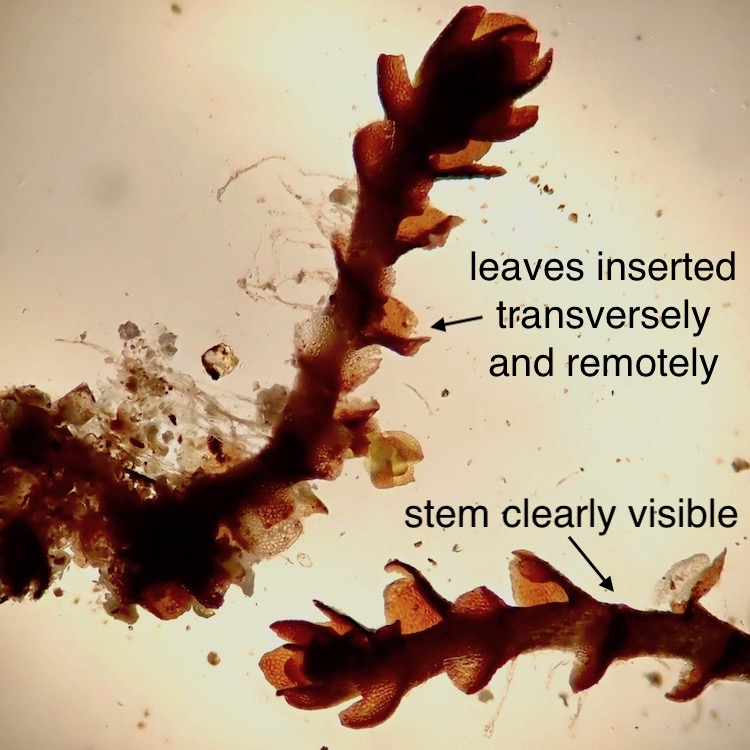
Marsupella bolanderi has two rows of leaves, which are transversely inserted into the stem, that is, they stick out at a right angle. The leaves are slightly concave and spreading, and are remotely distributed along the stem such that the stem and the colorless rhizoids are clearly visible when viewed under a microscope. In contrast to many other leafy liverwort species, Marsupella bolanderi lacks a third row of smaller underleaves.
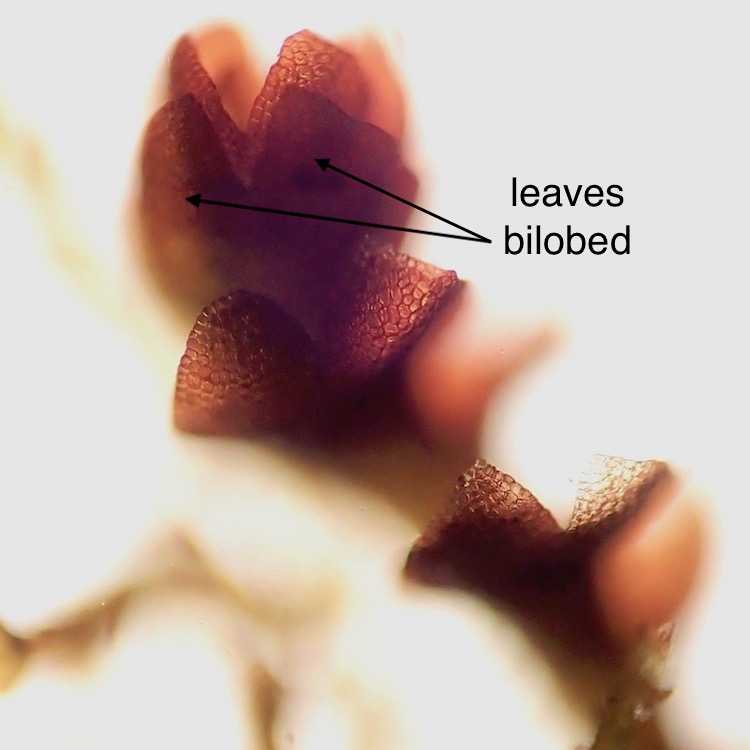
The leaves of Marsupella bolanderi are bilobed, with the sinus between the lobes extending about a third of the length of the leaf. The tips of the lobes are acute to obtuse, resulting in triangular to ovate lobes.
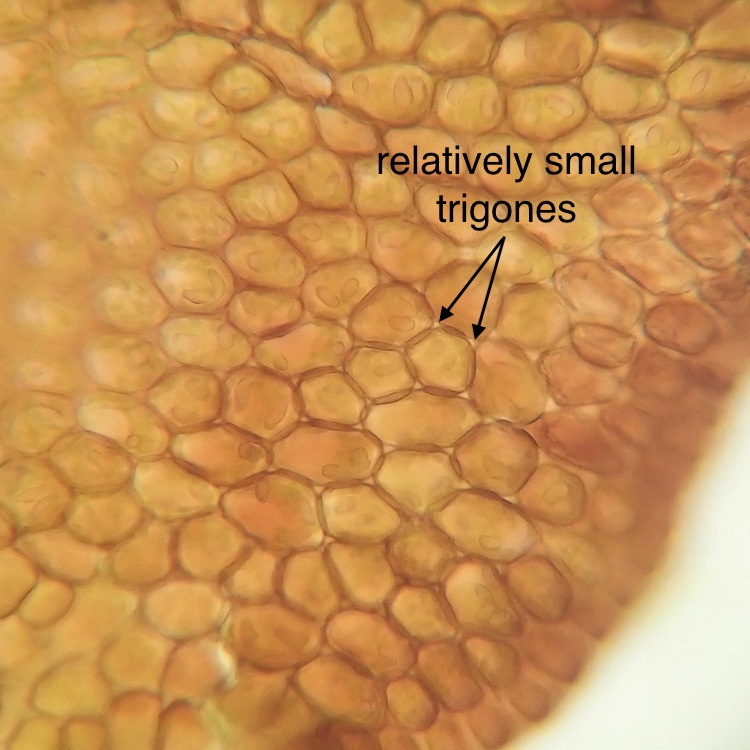
In this photomicrograph of a Marsupella bolanderi leaf magnified at 400x, one can see the reddish (vinaceous) cell walls and the rather small, triangular spaces between cells (trigones). This is in contrast to M. emarginata (not reported in Santa Barbara County), which has large, conspicuous trigones. The oil bodies within the cells are also visible, resembling funny little potatoes.
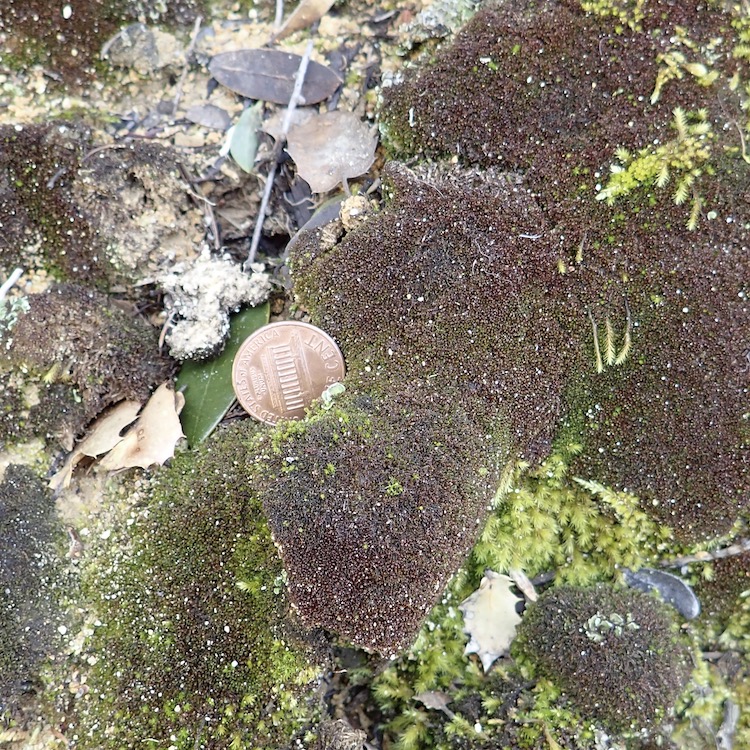
Though individual Marsupella bolanderi plants are quite small, they can form fairly extensive dense patches, visible from a distance as a dark maroon turf when moist and somewhat exposed.
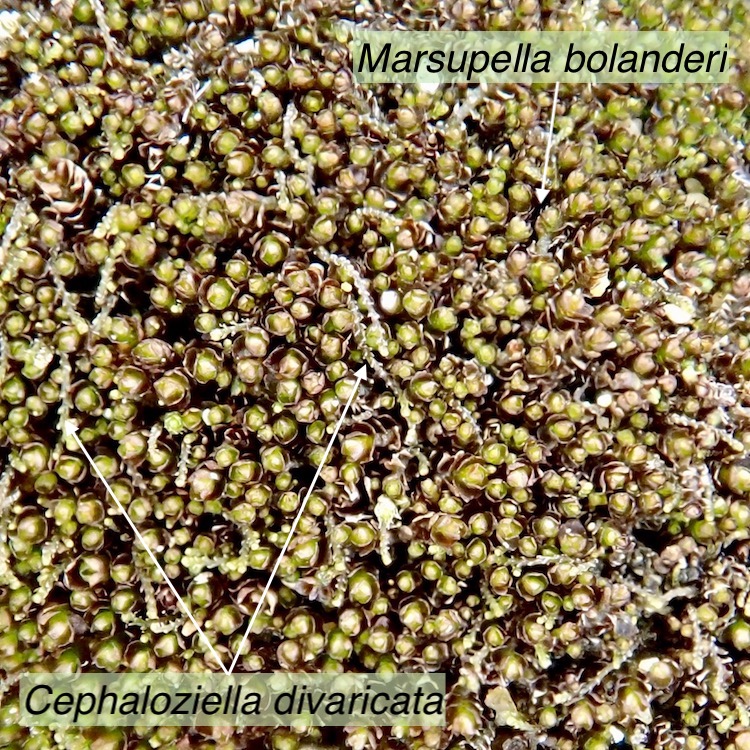
Marsupella bolanderi is often found with an even tinier, stringier leafy liverwort growing amongst it, Cephaloziella divaricata.
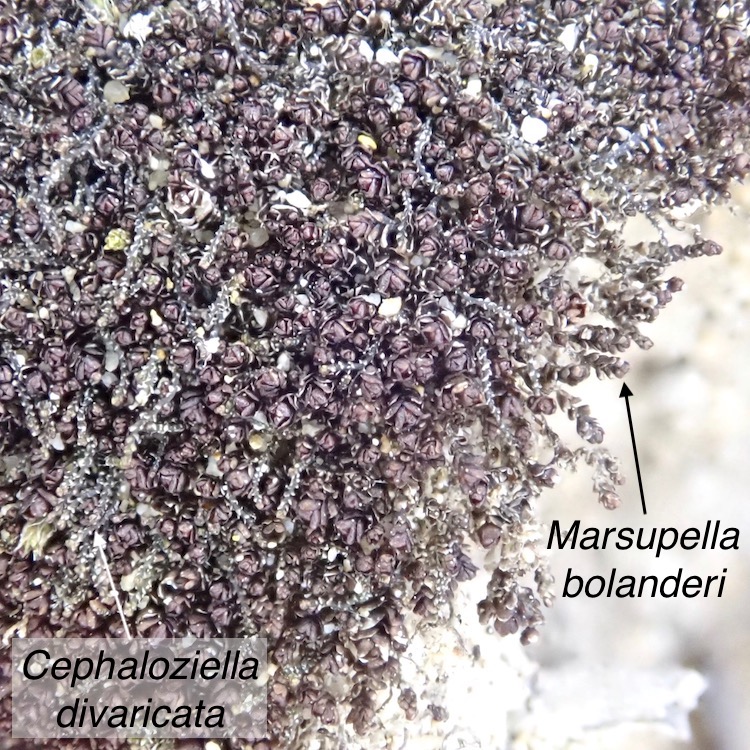
In this photo, Marsupella bolanderi and Cephaloziella divaricata are seen together again, this time moist, and a little greener. Cephaloziella divaricata are the skinnier, stringier plants often lying atop the more bulbous Marsupella bolanderi plants.
Habitat and Distribution
Marsupella bolanderi can be found on soil, particularly sandy soil, as well as on sandstone outcrops or on exposed rocks.
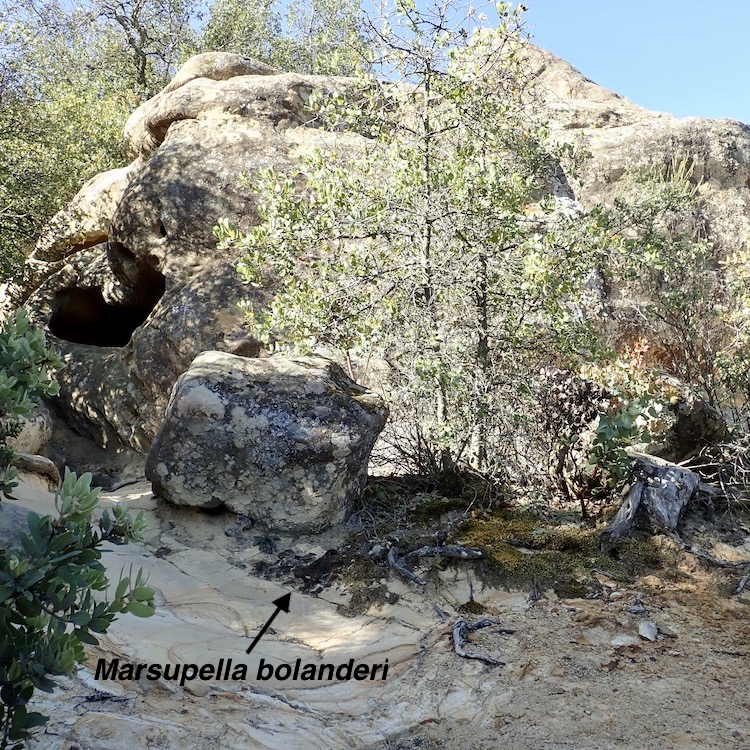
Marsupella bolanderi is said to occur from 65m-850m in elevation in California, Oregon and Washington, though a search of North American herbaria shows collections only in California.

 Bryophytes of Santa Barbara