Cephaloziella divaricata (Sm.) Schiffn. var. divaricata
Cephaloziella divaricata var. divaricata is a minute leafy liverwort with thread-like shoots, <0.5 mm wide and up to 1.2 cm long. Plants are typically reddish brown to black, but can be bright green when growing in shady, wet areas. There are two rows of deeply bilobed leaves on either side of the stem, as well as a third row of tiny, irregularly shaped underleaves.
Scroll down for photos with labeled parts and more detailed descriptions.

Detailed Descriptions with Photos (click to enlarge)
Cephaloziella divaricata var. divaricata plants are <0.5 mm wide and up to 1.2 cm long, shown here next to a penny for size reference.

The small green to red leaves of Cephaloziella divaricata var. divaricata are not much wider than the stem, and are deeply bilobed, with each lobe somewhat ovate-triangular in shape. Two rows of leaves are inserted transversely on either side of the stem. A third row of even tinier irregularly shaped “underleaves” are consistently found at least on vegetative shoots, i.e. shoots without reproductive organs.
Plants growing in more shaded and wet habitats are likely to be greener (scroll down for an example). Plants growing in more exposed and summer-dry habitats are likely to be reddish purple or even black.

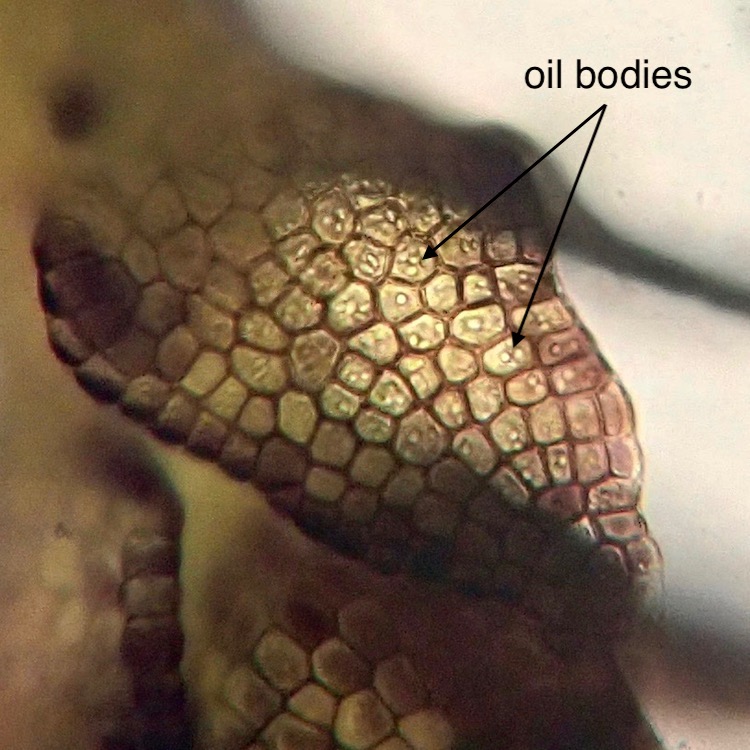
Each leaf cell of Cephaloziella divaricata var. divaricata has several small oil bodies.
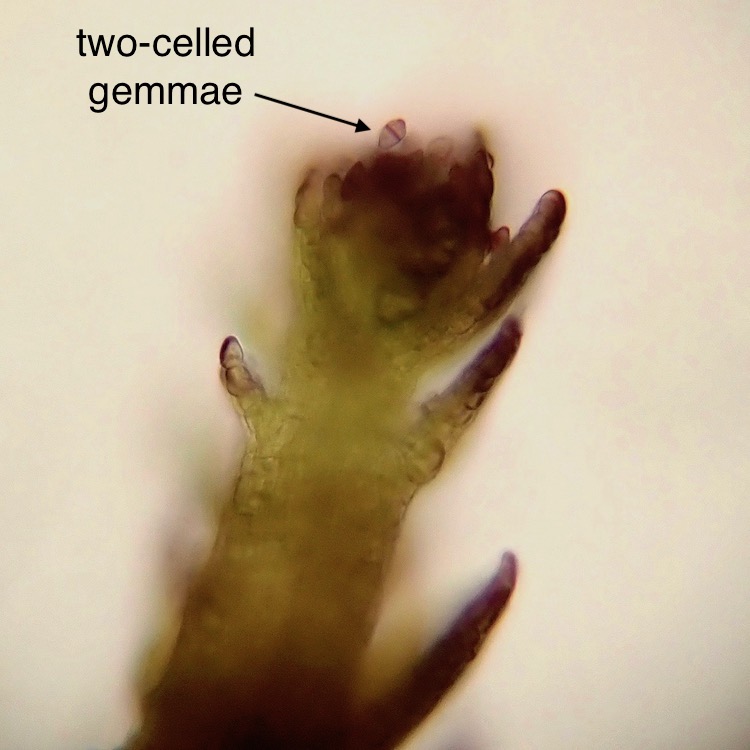
Cephaloziella divaricata var. divaricata commonly has two-celled gemmae nestled amongst the leaves near the tips of the shoots. These asexual reproductive propagules disperse and will develop into new plants if they land in a suitable habitat, allowing the plant to replicate in the absence of sexual reproduction.
Cephaloziella divaricata is often found growing amongst a slightly larger leafy liverwort, Marsupella bolanderi. The smaller shoots with pointier leaves in this photomicrograph are Cephaloziella divaricata var. divaricata. The three larger reddish-brown shoots with somewhat rounded leaves are Marsupella bolanderi.

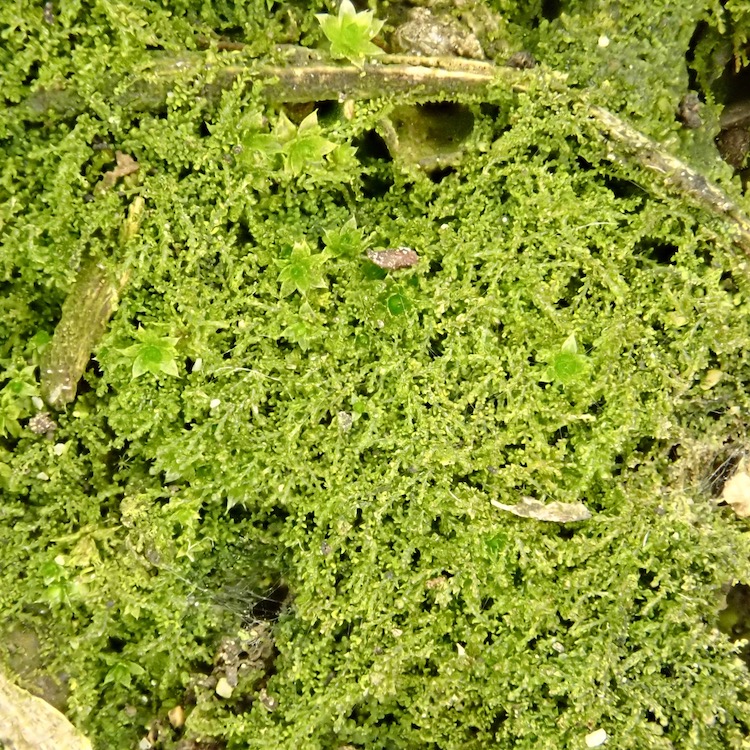
Cephaloziella divaricata var. divaricata can also be found growing amongst mosses. Here it is seen as patches of dark brown threads on a boulder amongst Homalothecium and other mosses.

Here, Cephaloziella divaricata var. divaricata is growing in a very moist, shaded microhabitat and appears bright green.
Habitat and Distribution
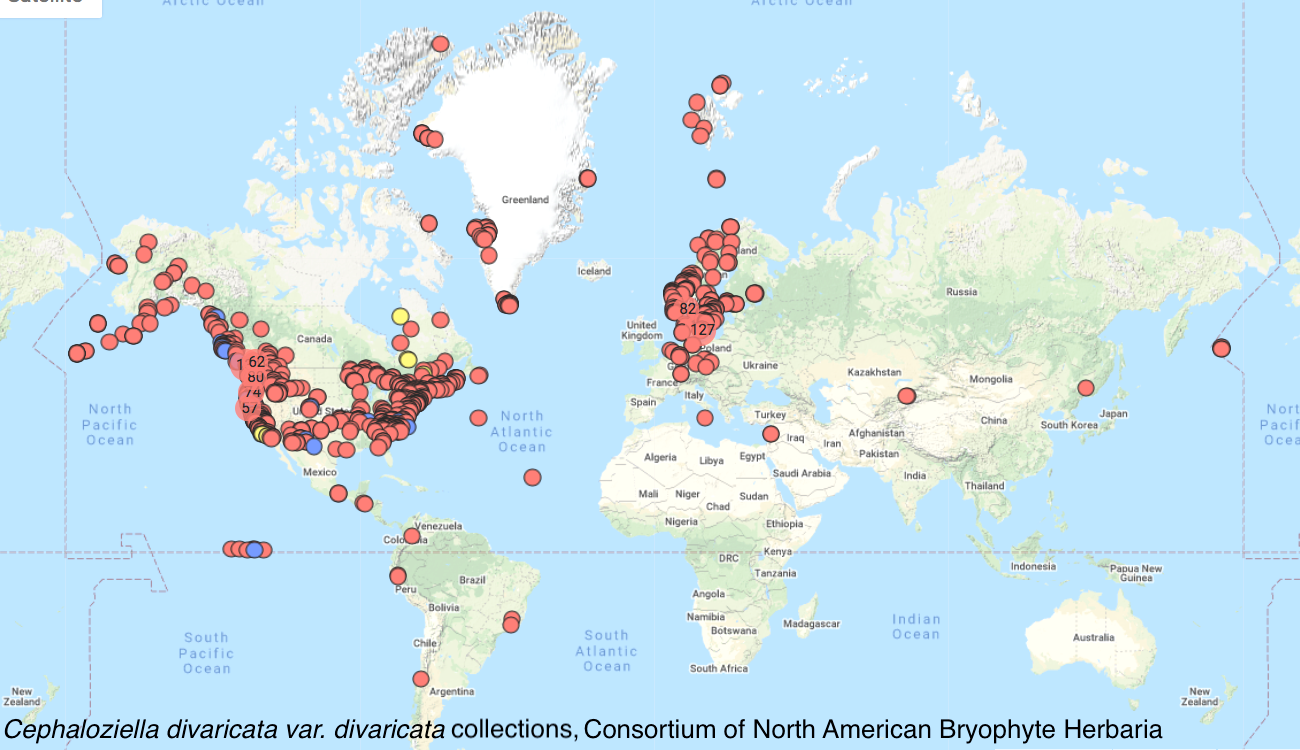
Cephaloziella divaricata var. divaricata can be found on soil, rocks and boulders and amongst other bryophytes, in North America, South America, Europe, N. Africa and New Zealand.
Here in Santa Barbara County I have found it most often on sandy soil, at the base of large boulders, particularly along the crest of the Santa Ynez Mountains.
Name: Cephaloziella plants resemble those in the genus Cephalozia, but are smaller and even cuter, hence the diminutive suffix –ella. In turn, the Greek terms cephale for head, and ozos for branch, refer to the female branches with enlarged tips. The species epithet, divaricata, is Latin for spreading or straggling.
Similar Species in Santa Barbara County: Cephaloziella turneri has serrated leaves and no underleaves.
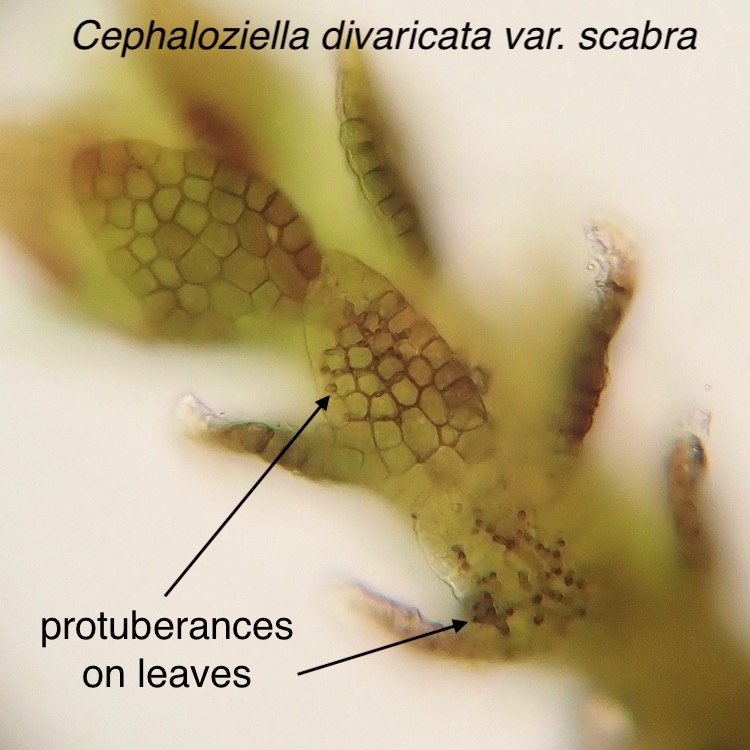
Cephaloziella divaricata var. scabra is reportedly a more greyish or yellowish-green color, has leaves with dentate margins, has prominent cellular protuberances on the abaxial surfaces of the leaves, and has typically 1-celled gemmae. It is less widespread and not reported for Santa Barbara County, though I have seen it in Solano County.