Dendroalsia abietina (Hooker) E. Britton

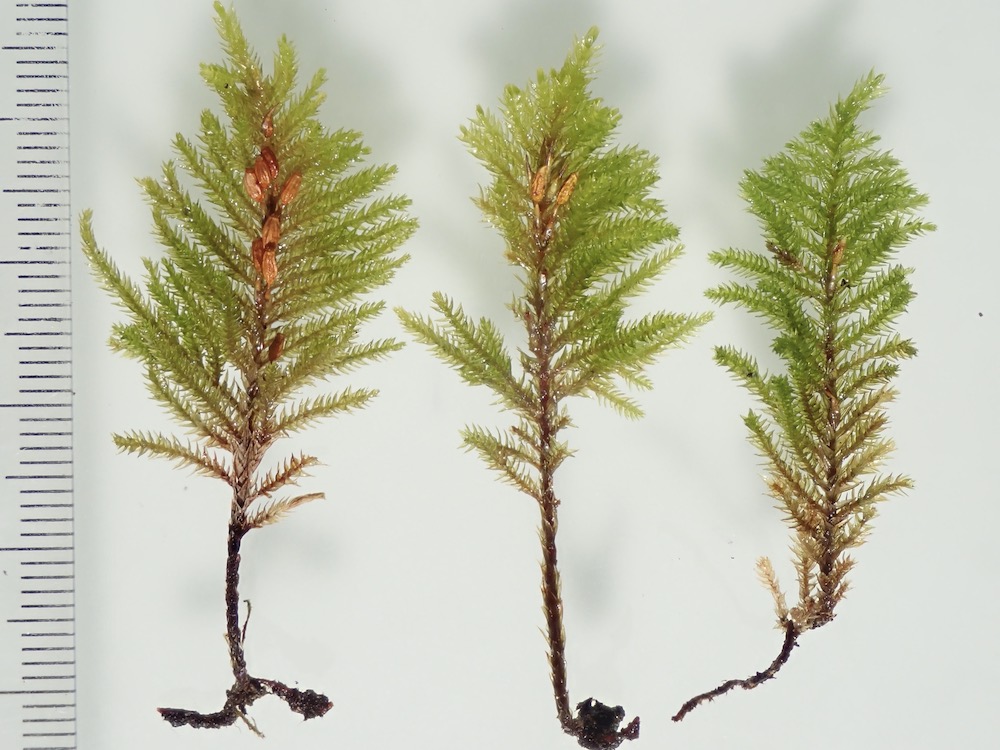
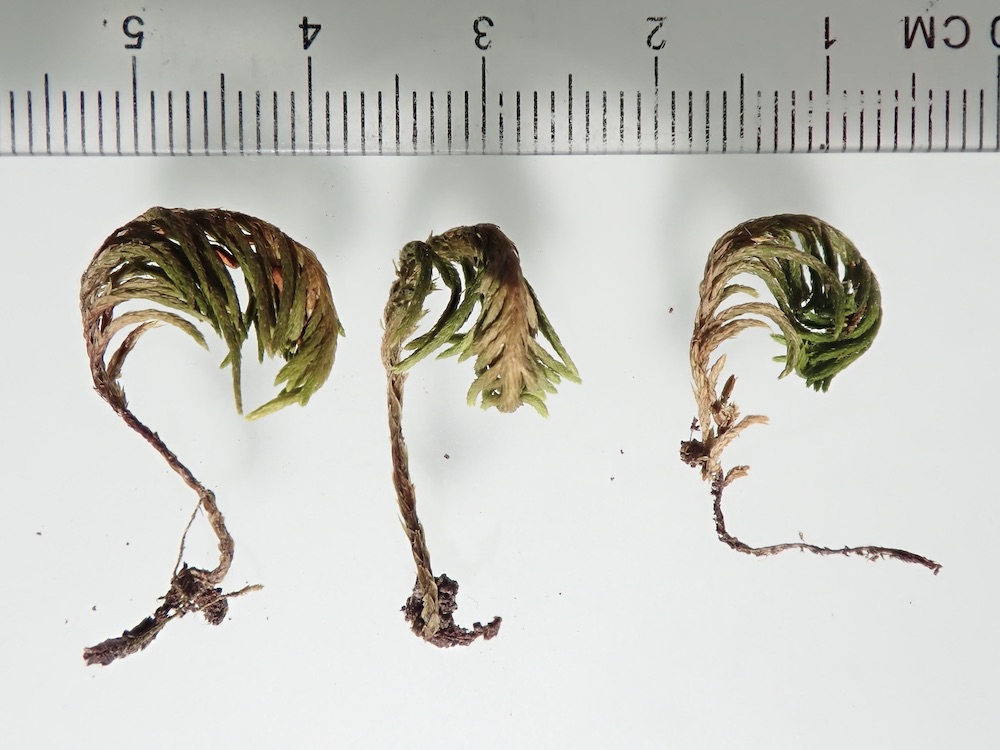
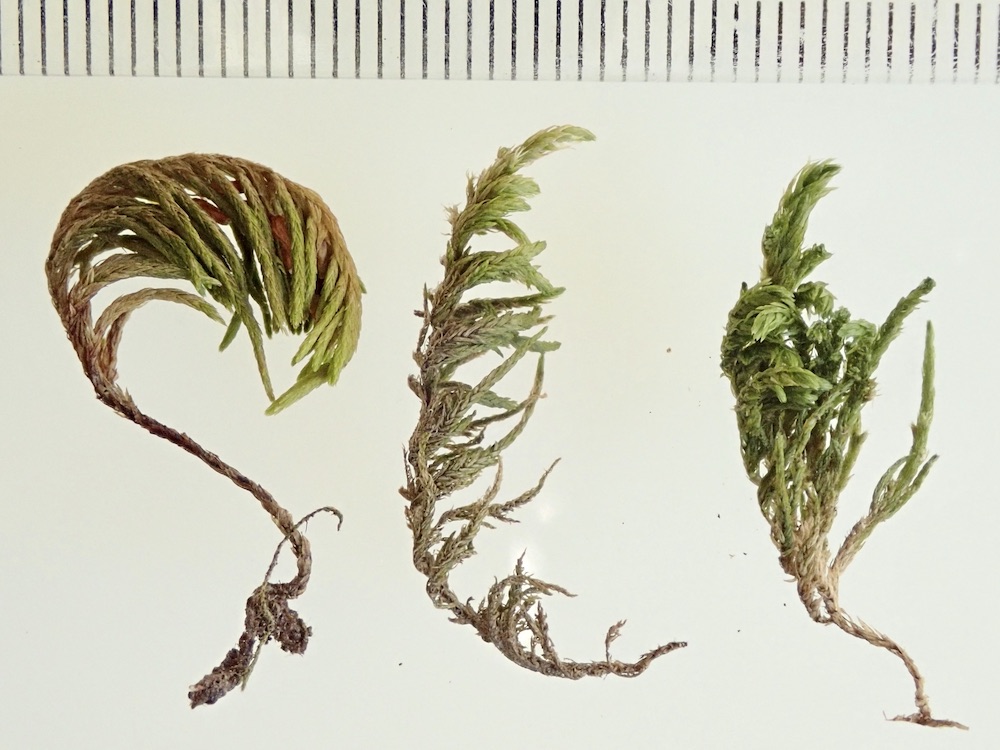
Dendroalsia abietina is a very large (10-15 cm), pleurocarpous moss, with sturdy stems and regularly pinnate branches, found on large boulders, rock walls and tree trunks, typically in partial shade. When moist, plants are bright green and soft, splaying out from the substrate like fern fronds. When dry, plants are dark green-brown and stiff, with branches folding in and stems curling in a highly characteristic fiddlehead manner. Its leaves are arranged in five distinct rows, giving the branches a quite organized, coniferous look, particularly when barely moist.
Scroll down for more photos (click to enlarge) and descriptions of habitat, male and female plants, leaves, sporophytes, distribution map, name origin, and similar species.
Dendroalsia abietina
Dendroalsia abietina CC BY-NC Amanda Heinrich
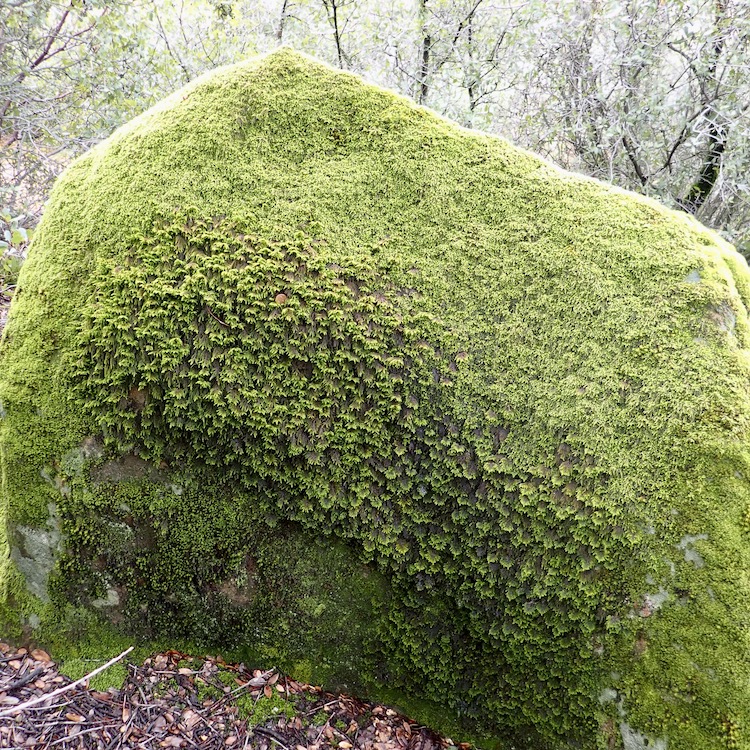
Habitat:  Dendroalsia abietina can be found on large boulders, rock walls, and tree trunks and branches, often covering large swaths, typically in partial shade.
Dendroalsia abietina
Dendroalsia abietina, moist, largest plants in center on large boulder, with other moss species such as Nogopterium gracile and Grimmia lisae. CC BY-NC Amanda Heinrich
Dendroalsia abietina
Dendroalsia abietina dry, largest plants in center on same boulder with Nogopterium gracile and Grimmia lisae. CC BY-NC Amanda Heinrich
Dendroalsia abietina
Dendroalsia abietina dry, on small coast live oak trunk. CC BY-NC Amanda Heinrich
Habit:  Dendroalisa abietina has fern-like pinnately branched secondary fronds, which grow along a prostrate primary stem hidden beneath. When dry, the branches fold in and the stems curl under like stiff, wiry fiddleheads. The fronds open when moist, and dangle horizontally or downward, softer but still quite sturdy.
Dendroalsia abietina
When moist, Dendroalsia abietina‘s regularly pinnate fronds dangle softly horizontally or downward. CC BY-NC Amanda Heinrich
Dendroalsia abietina
When dry, Dendroalsia abietina‘s branches fold in and stems curl under, with plants dangling downward. CC BY-NC Amanda Heinrich
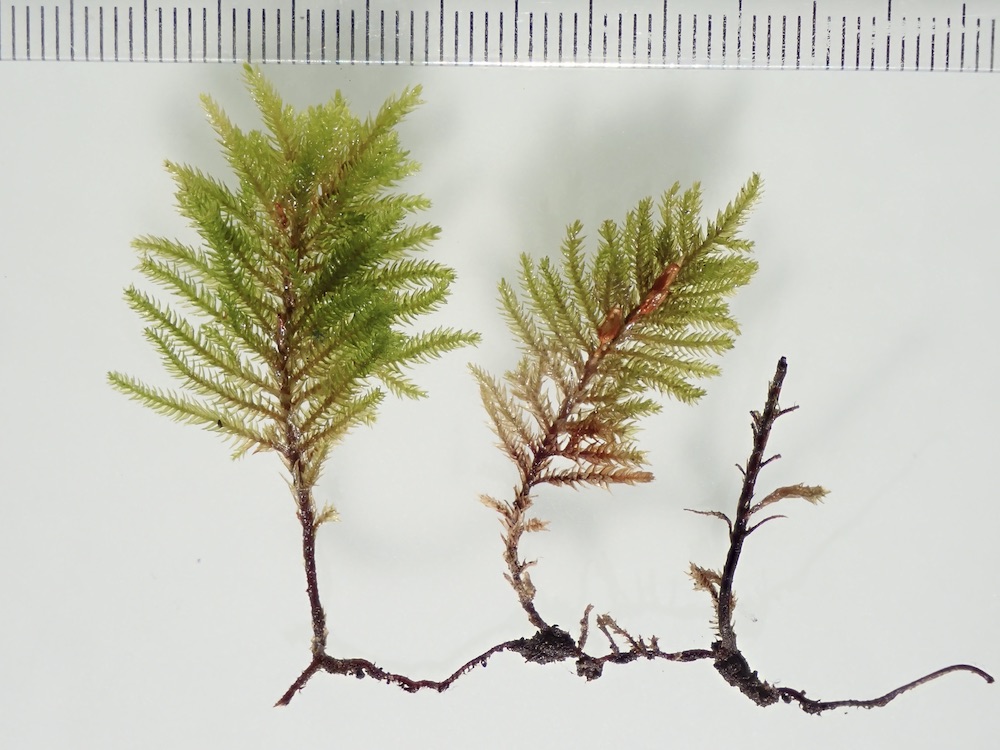
Plants:  Dendroalisa abietina plants are very large (10-15 cm), have thick, sturdy stems and regularly pinnate branches.
Dendroalsia abietina
The fern-like fronds of Dendroalsia abietina are secondary stems, which arise from a runner-like primary stem, seen here moist. The base of the secondary stem is typically naked (stipitate) with the pinnate branches beginning a few millimeters from the base. (CAH 987) CC BY-NC Amanda Heinrich
Dendroalsia abietina
The fern-like fronds of Dendroalsia abietina are secondary stems, which arise from a runner-like primary stem, seen here dry and curled like fiddleheads. (CAH 987) CC BY-NC Amanda Heinrich
Dendroalsia abietina
The fern-like fronds of Dendroalsia abietina open when moist, revealing any sporophytes which are present on female plants. The pinnate branches may themselves be branched (2-pinnate), though usually more irregularly so. (CAH 987) CC BY-NC Amanda Heinrich
Dendroalsia abietina
The fern-like fronds of Dendroalsia abietina curl up around the sporophytes when dry. (CAH 987) CC BY-NC Amanda Heinrich
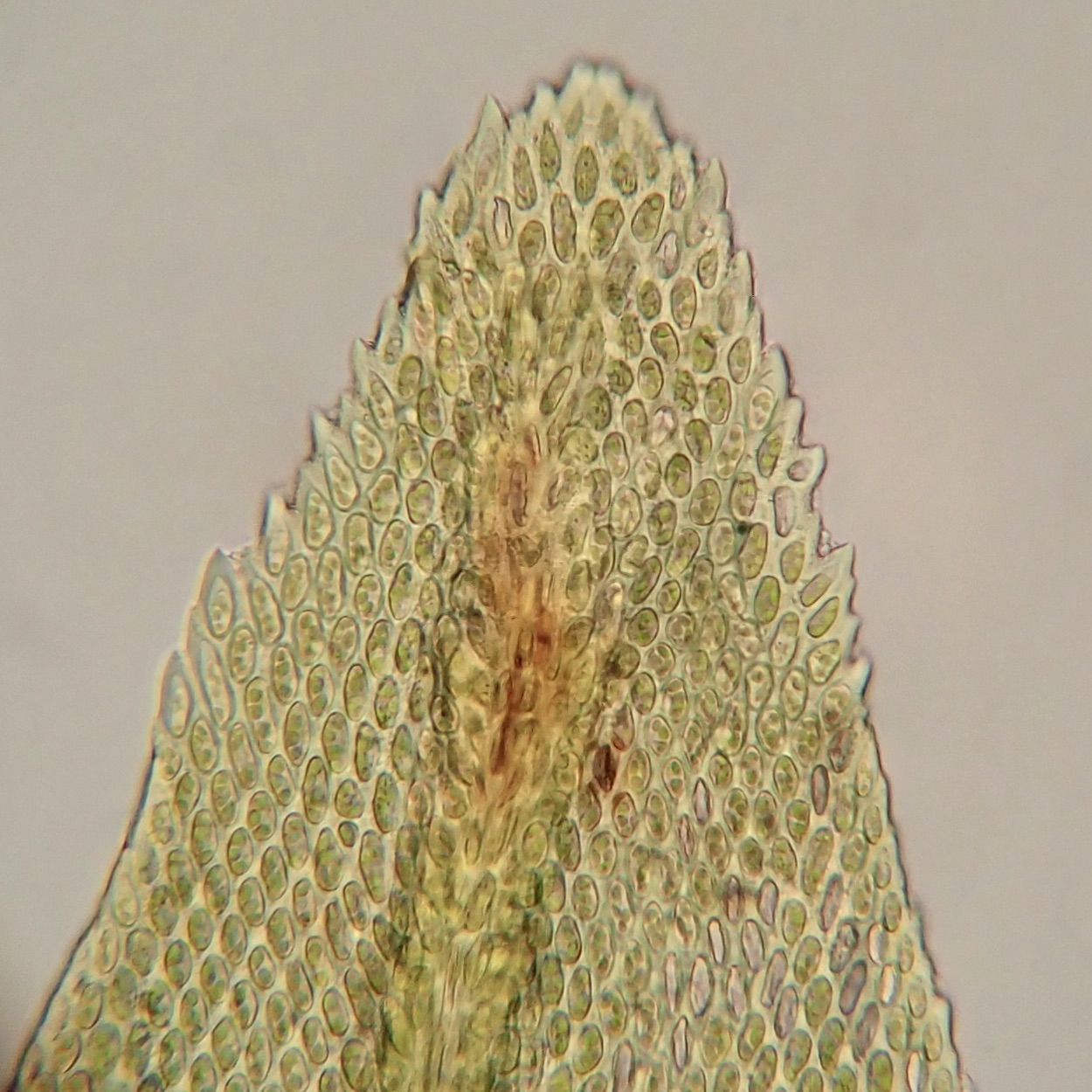
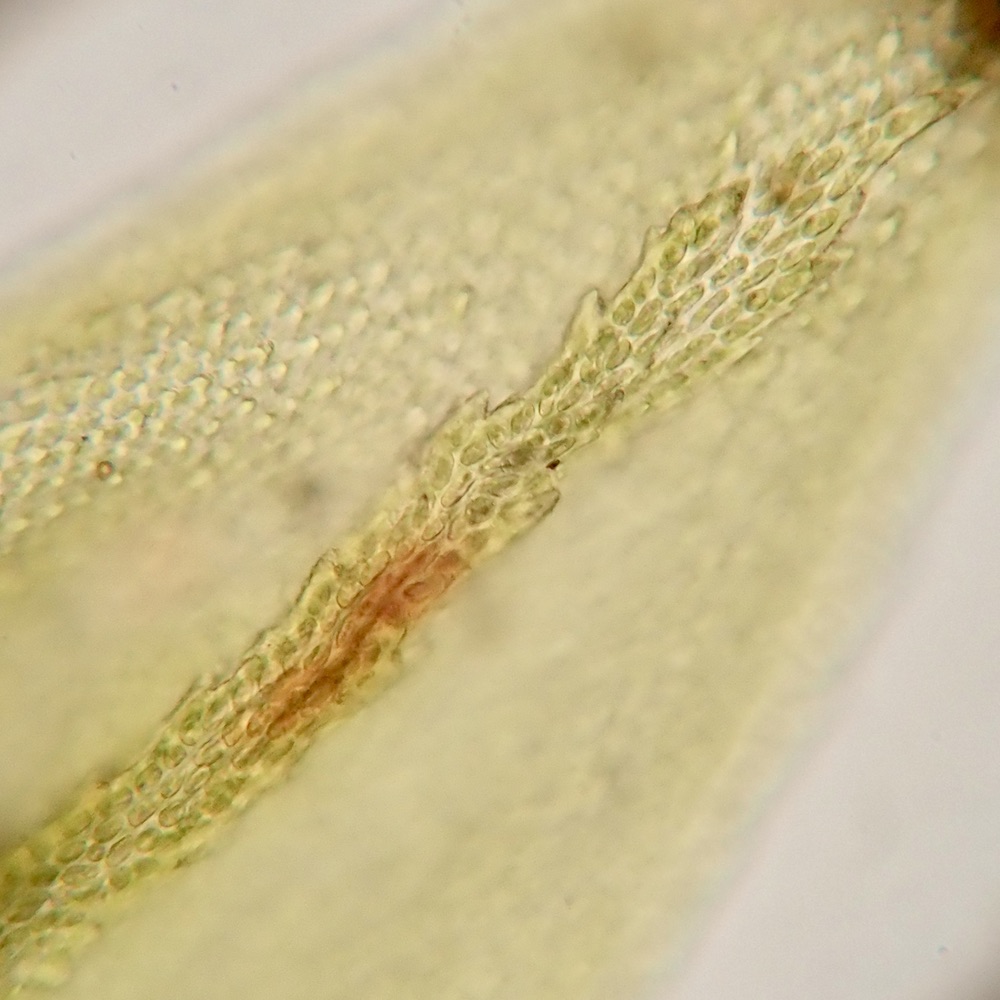
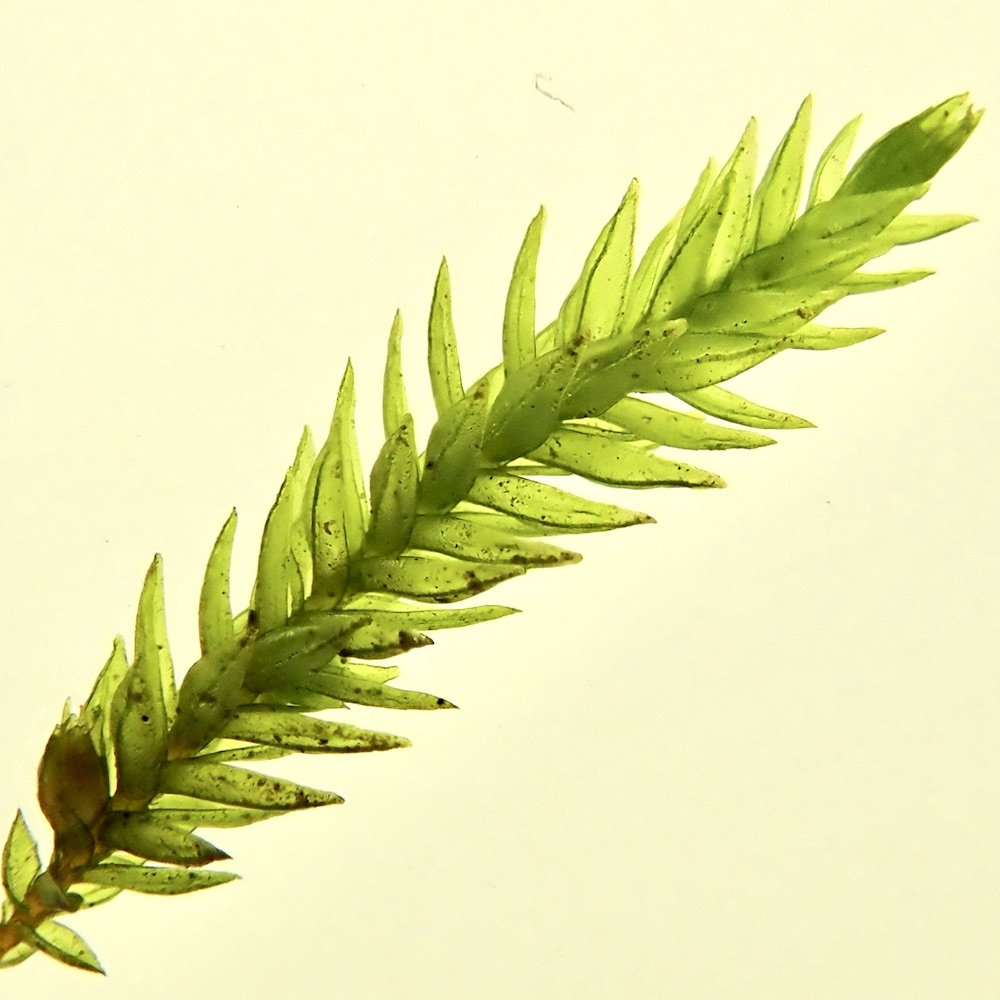
Leaves:  Dendroalsia abietina leaves spread from the stem when moist in 5 distinct rows, and overlap neatly and tightly against the stem when dry. Stem leaves are larger (2.5-3.6 mm long) than branch leaves (1.6-2.2 mm long) but both are ovate-lanceolate, and taper toward a relatively blunt, toothy tip, and have margins that are recurved near the base. Near the leaf tip, the midrib (costa) has many coarse teeth, and the mid-leaf (laminal) cells overlap slightly forming little bumps (i.e. are prorate). The stems are covered with many branched paraphyllia, which can be more easily seen if a few leaves are removed.
Dendroalsia abietina branch
Dendroalsia abietina leaves spread from the stem when moist, in five distinct rows. (CAH 938) CC BY-NC Amanda Heinrich
Dendroalsia abietina branch
Dendroalsia abietina leaves are tightly appressed to the stem, neatly overlapping when dry. (CAH 938) CC BY-NC Amanda Heinrich
Dendroalsia abietina leaf
Dendroalsia abietina secondary stem leaves are ovate-lanceolate, with margins recurved at the base, and a bluntly tapered toothy tip. (CAH 987, 100x) CC BY-NC Amanda Heinrich
Dendroalsia abietina leaf tip
Dendroalsia abietina leaves are toothed along the margin near the somewhat blunt tip. (CAH 987, 400x) CC BY-NC Amanda Heinrich
Dendroalsia abietina costa spines
Near the Dendroalsia abietina leaf tip, the costa has many coarse spines on the back (abaxial) side. The laminal cells overlap slightly forming little bumps (prorae). (CAH 987, 400x) CC BY-NC Amanda Heinrich
Dendroalsia abietina paraphyllia
Dendroalsia abietina stems are covered with many multicellular, branched paraphyllia. (CAH 987, 400x) CC BY-NC Amanda Heinrich
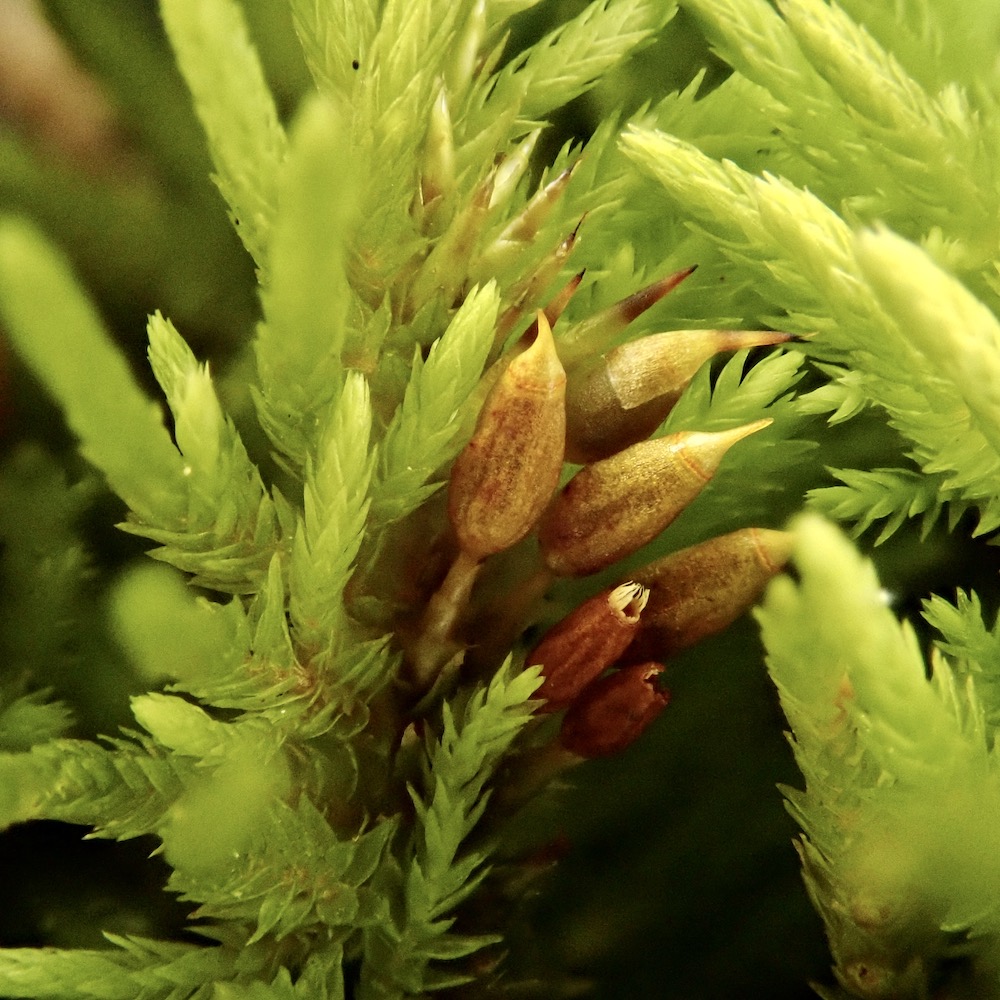
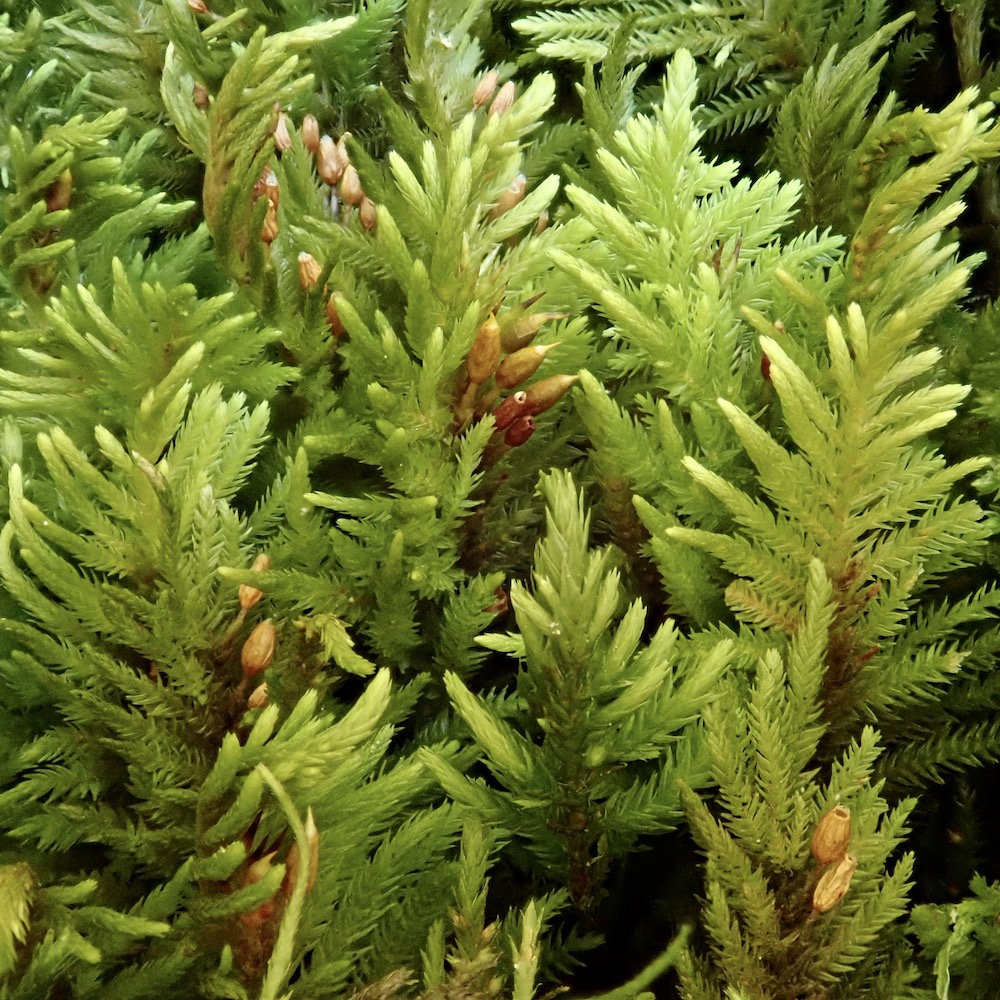
Sporophytes: Dendroalsia abietina sporophytes are on the underside of female plants, on branches very close to the stem. Capsules are atop short (2 mm) setae.
Dendroalsia abietina with sporophytes
Dendroalsia abietina sporophytes on the underside of female plants. (CAH 987)
Dendroalsia abietina sporophytes
Dendroalsia abietina sporophyte capsules on very short setae. (CAH 987) CC BY-NC Amanda Heinrich
Dendroalsia abietina sporophytes
Dendroalsia abietina sporophytes; one here still covered by calyptra (cap), which is cone shaped and split up one side (cucullate). (CAH 987) CC BY-NC Amanda Heinrich
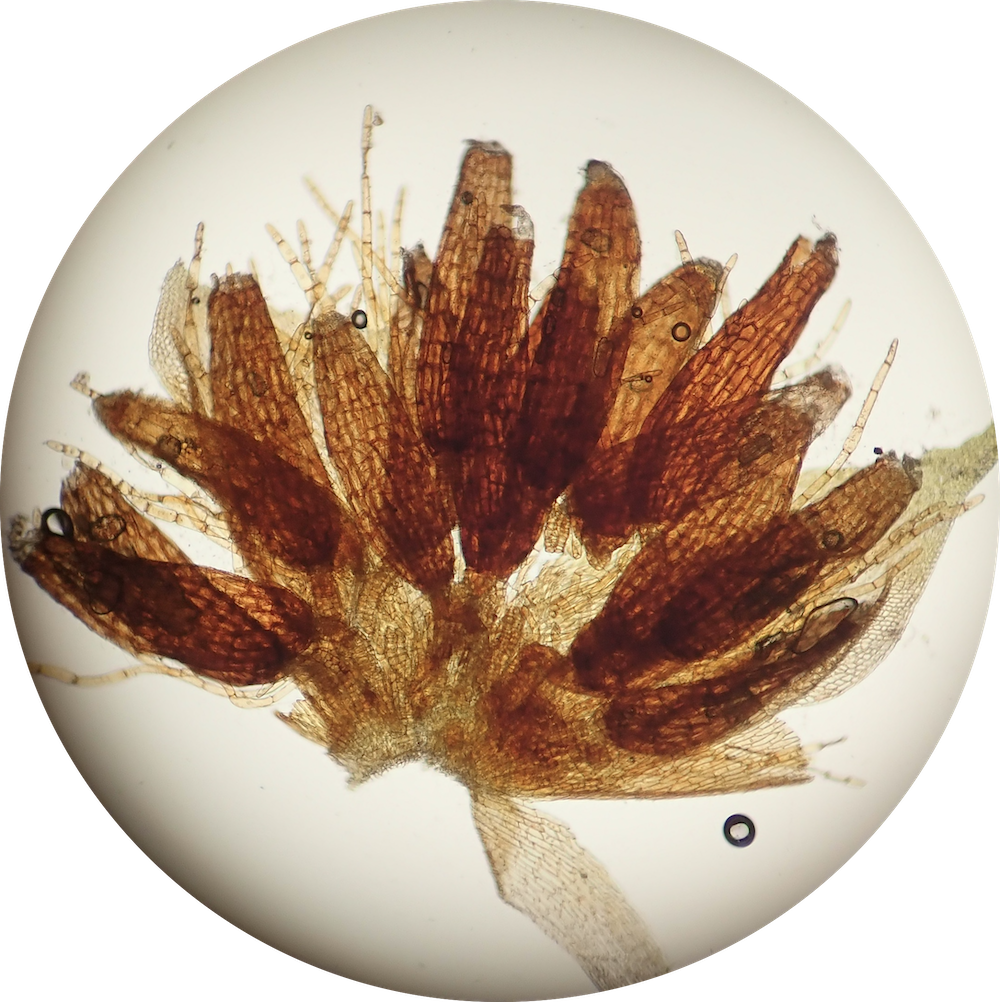
Perigonia:  Dendroalsia abietina is dioicous, with separate male and female plants. Perigonia, the male organs, appear as tiny onions (2 mm) on the underside of the male plants, near the stem. Each perigonium contains many sausage-shaped antheridia, each containing thousands of sperm.
Dendroalsia abietina male plant
Dendroalsia abietina perigonia on the underside of male plant (CAH 938) CC BY-NC Amanda Heinrich
Dendroalsia abietina antheridia
Dendroalsia abietina antheridia from dissected perigonium (CAH 938, 100x) CC BY-NC Amanda Heinrich
Distribution:  Dendroalsia abietina is found along the west coast of North America. It is common throughout California, and is relatively common in Santa Barbara County.
Dendroalsia abietina distribution
Dendroalsia abietina collections. Map generated by google maps using data from the Consortium of Bryophyte Herbaria of accessioned collections from herbaria.
Name: The genus name Dendroalsia means tree-like (dendron is Greek for tree) Alsia, another similar genus. The species name presumably means ‘little fir,’ referring to the fir-like appearance of the branches.
Similar Species in Santa Barbara County
Beginners may confuse Dendroalsia abietina with Bestia longipes, another large moss with regularly pinnate branches.  Bestia longipes is restricted to rock faces in canyons along the immediate coast of California, and has more delicate leaves and softer, more pliable branches and stems which do not curl under as significantly when dry.
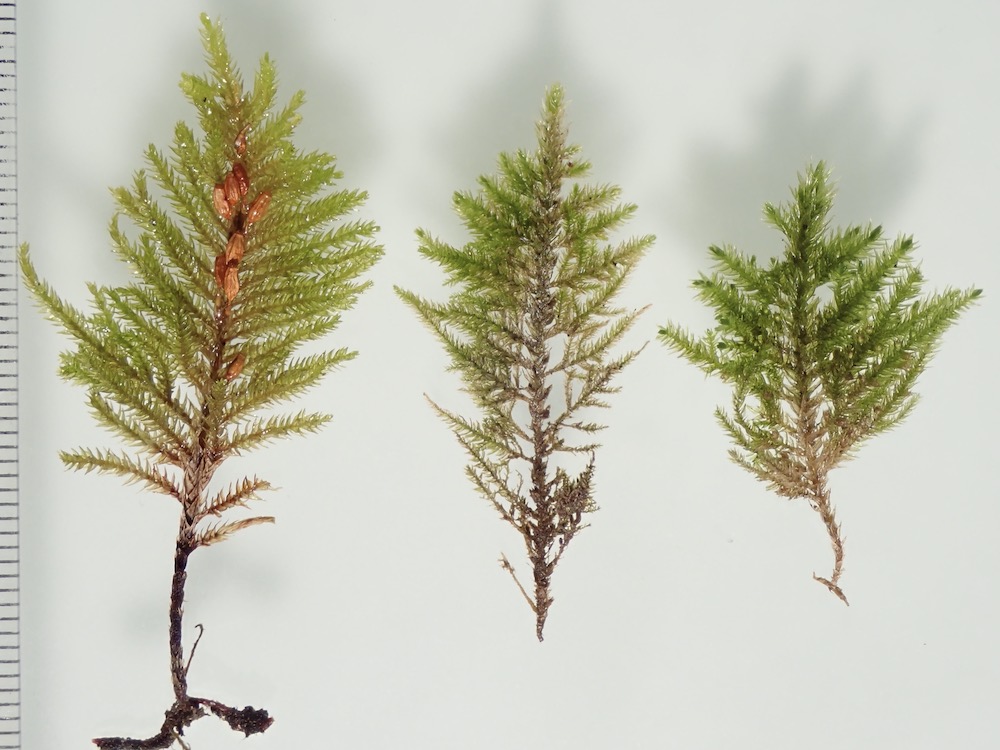
Dendroalsia abietina on the left, with two Bestia longipes plants on the right, moist. CC BY-NC Amanda Heinrich
Dendroalsia abietina with Bestia longipes
Dendroalsia abietina on the left, with two Bestia longipes plants on the right, dry. CC BY-NC Amanda Heinrich
References and Further Reading
Dendroalsia abietina, Clayton C. Newberry, Flora of North America Vol. 28, www.efloras.org
California Mosses, Bill and Nancy Malcolm, Jim Shevock and Dan Norris. Available for purchase from the California Native Plant Society here.
Contributions toward a Bryoflora of California II. A Key to the Mosses, Daniel H. Norris and James R. Shevock, Madrono 51(2): 133-269. 2004. Available for purchase  here.
Common Mosses of Western Oregon and Washington, Bruce McCune & Martin Hutten
The Moss Flora of Mexico, Edited by Aaron J. Sharp, Howard Crum & Patricia M Eckel, The New York Botanical Garden, 1994