
Targionia hypophylla L.
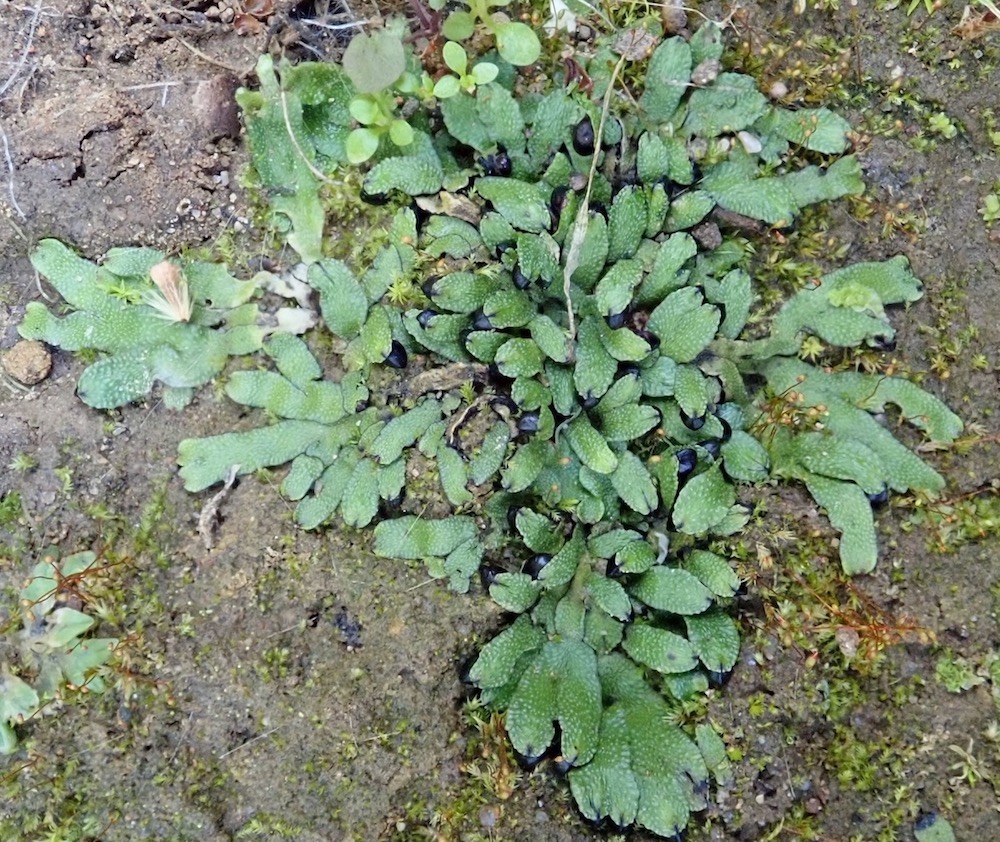
Targionia hypophylla is a medium-sized complex thallose liverwort with thalli 1-2 cm long and 2-5 mm wide. Its dark green thalli have purplish-black margins and tend to have rather parallel sides, giving it a strap-like appearance. The upper surface is dotted with white pores, resulting in a reptilian texture. The underside of the thallus is covered with purple-black scales, and has a tuft of white, single-celled rhizoids, which anchor the plant to the substrate. Thalli branch dichotomously and ventrally (side branches develop from underside). Targionia hypophylla is unmistakeable when fertile, with its black clam-shaped involucres at the lobe tips. It can be found on soil and less frequently on rock, typically in some shade but also exposed, often along trail cuts and roadcuts.
Scroll down for photos with labeled parts and more detailed descriptions.
Detailed Descriptions with Photos (click to enlarge)
Targionia hypophylla‘s distinctive, shiny, black clam-shaped involucres on the underside of lobe tips initially contain female reproductive structures. Following fertilization, the egg develops into the sporophyte, which remains fully contained within the involucre. The black involucres are unique to the genus, and as of 2023, Targionia hypophylla is the only species reported for California.
For a review of the liverwort life cycle click here.
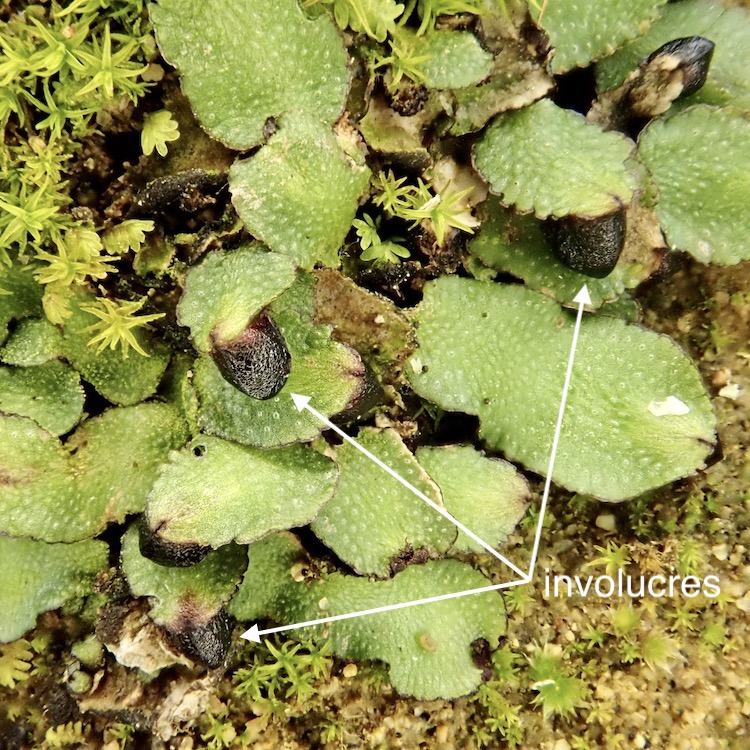
The upper surface of Targionia hypophylla is covered with small pores leading to photosynthetic air chambers within the thallus. The pores are raised slightly above the surface and give the plants a bumpy, somewhat reptilian look. The distinctive clam-shelled involucre can be seen peeking out from underneath the lobe tip.

The underside of Targionia hypophylla is covered with black ventral scales. The proximal region of the lobe has a generous tuft of white, single-celled rhizoids, which anchor the plant to the substrate. The shiny black bivalved involucre can be seen at the lobe tip.

Developing involucres of Targionia hypophylla are purplish-red.

This photomicrograph shows a cross-section of a Targionia hypophylla involucre containing a developing sporophyte capsule (large white sphere), which in turn contains immature spores (tiny white dots).

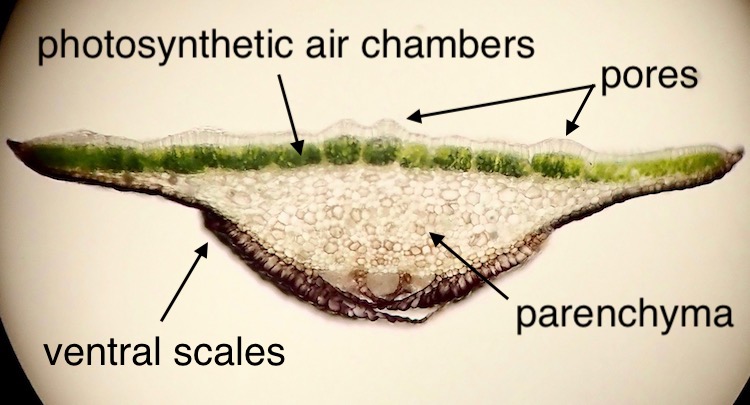
This photomicrograph shows a cross-section of a Targionia hypophylla thallus. It is quite different from those of other complex thalloid liverworts such as Asterella, Cryptomitrium, and Mannia species, and can be a useful reference when attempting to identify vegetative plants.
Targionia hypophylla is a monoicous species, with each individual plant bearing both female and male structures. The male structures, antheridia, are on small side branches, as seen in this photo. Each bump on the side branches is an ostiole, an opening leading to an antheridium within the thallus.

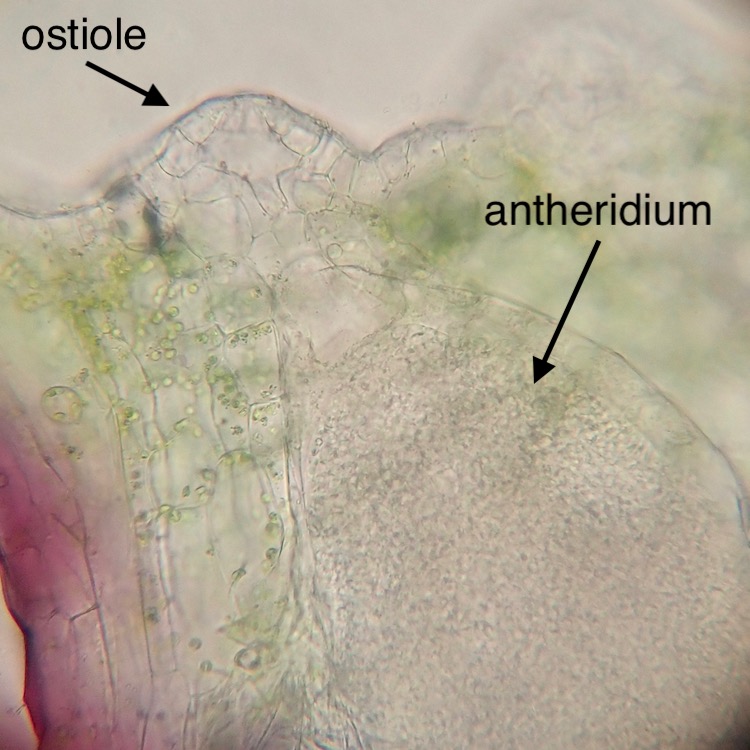
This cross-section of a male Targionia hypophylla branch shows an antheridium, the male organ containing sperm, and several ostioles, the openings through which sperm will depart. Each antheridium contains thousands of sperm, which must swim through liquid water to a neighboring archegonium in order to fertilize the egg. The fertilized egg will develop into a sporophyte within the bivalved involucre and eventually bear spores.
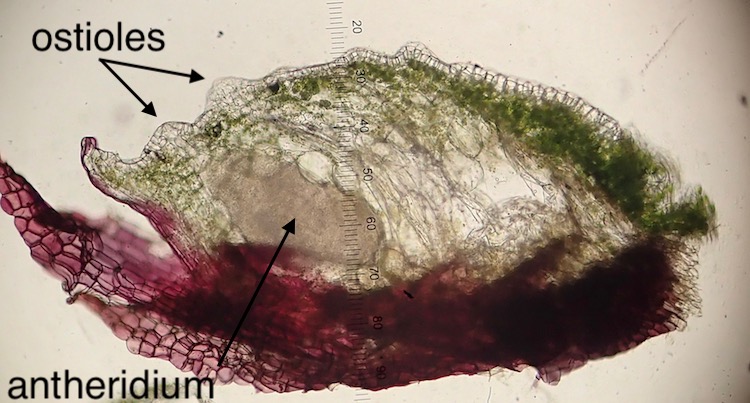
This photomicrograph shows the same Targionia hypophylla antheridium and ostiole shown above, magnified 400x so that the connection between the two can be seen.
When dry, the thallus margins of Targionia hypophylla roll in, revealing the black ventral scales. The involucres are held up with mouths open wide, and, if the sporophyte capsule has dehisced, the spores are free to fly into the wind. Targionia is desiccation tolerant and will remain dormant in this dried up greasy streak state throughout the dry summer and fall months, unfurling and resuming life once the winter rains return. In this photo the brown spores can be seen spilling out of the open involucres.

This photo was taken at the same location as the dry plants shown above, immediately following the first rain of the season. These moistened plants have unfurled and are ready to resume growth.

Targionia hypophylla spores (45-85 µm in diameter) are brown with fine areolae, which give them a “frothy” look (Doyle and Stottler). Spring-like elater cells contract and expand to give the spores an extra boost and send them on their merry way.

Habitat and Distribution
Targionia hypophylla grows on soil and on rocks, typically in some shade, but also exposed, often along trail cuts and road cuts, sometimes in profusion.

Targionia hypophylla can be found on all continents except Antarctica. In the United States it is found primarily on the west coast and in the southwest.
Map generated by google maps using data from the Consortium of Bryophyte Herbaria of collections accessioned in herbaria.

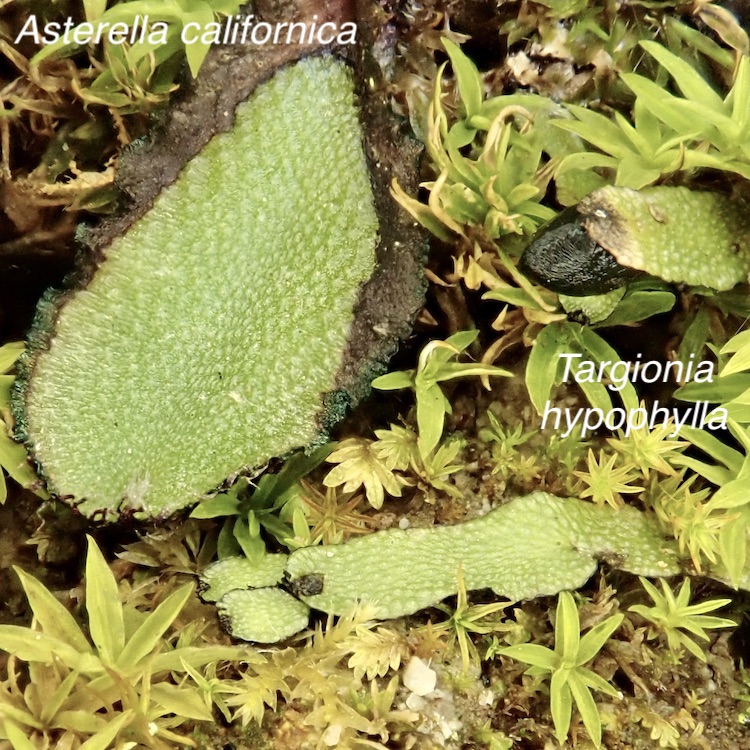
In Santa Barbara County, Targionia hypophylla appears to be as common as Asterella californica, often growing side by side. Targionia is significantly smaller than Asterella californica and has more parallel-sided thalli.

In this close-up, the more petite, strappy Targionia hypophylla is on the right, and the more robust, flared Asterella californica is on the upper left.
 Bryophytes of Santa Barbara