
Sphaerocarpos cristatus M. Howe and Sphaerocarpos texanus Austin
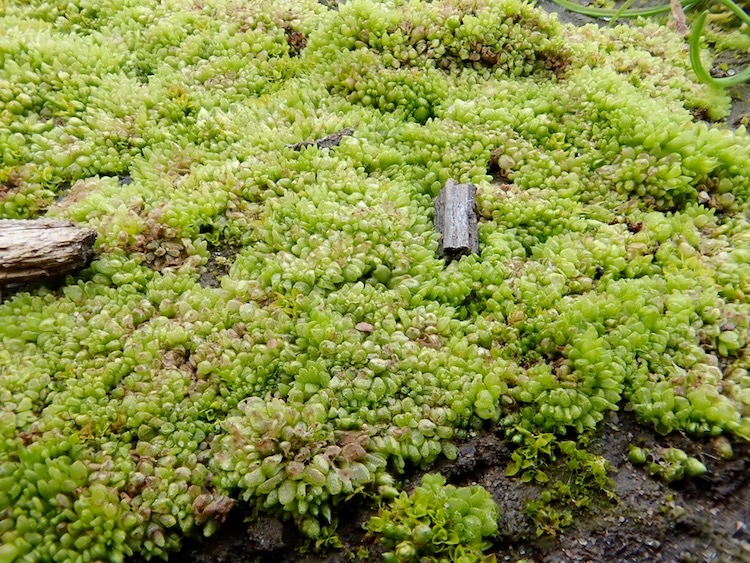
Sphaerocarpos cristatus and Sphaerocarpos texanus are bottle pore liverworts which are immediately recognizable in the field by the light green balloon-like involucres covering the surface. The plants are very small (S. cristatus 2.5-8.5 mm, and S. texanus 6-15 mm), and consist of a stem and leaves (also sometimes referred to as wings) but these are completely obscured by the involucres. Both species are dioicous, with separate female and male plants growing intermixed. Female plants are larger and have larger, cylindrical to spherical involucres. Male plants are smaller, with smaller flask-shaped involucres, often reddish, particularly in more exposed habitats. The two species are distinguishable only by examination of spore characters.
Scroll down for photos with labeled parts and more detailed descriptions.

Detailed Descriptions with Photos (click to enlarge)
Sphaerocarpos species are dioicous, with separate male and female plants growing intermixed. The male plants are generally significantly smaller than the female plants, and are typically reddish-brown.

Female Sphaerocarpos plants are covered with cylindrical balloon like structures with an opening on top. These are involucres, which initially house the female reproductive parts, archegonia, each containing a single egg. Male Sphaerocarpos plants are covered with smaller flask-shaped involucres, which house the male reproductive parts, antheridia, each containing thousands of sperm. These involucres are often reddish brown at the base, completing the wine flask look.
For a review of the liverwort life cycle click here.

Early in the season, the involucres on the female Sphaerocarpos plants are rather slim and cylindrical. Ultimately, if the egg within the archegonium is fertilized, the sporophyte develops within the involucre, which swells and becomes more spherical at the base. Spores develop within the sporophyte, and when mature, the perfectly spherical black sporophyte capsules can be seen as the involucre erodes away. Eventually the capsule opens and the spores are released.

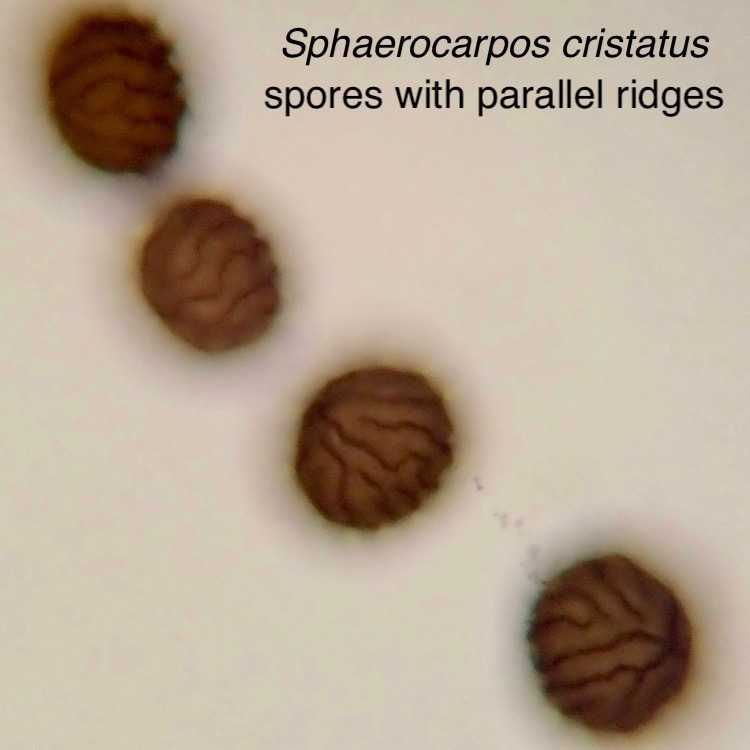
In order to identify Sphaerocarpos to species, one must examine spores under the compound microscope. Sphaerocarpos cristatus spores separate from tetrads early in development, and are covered with long, mostly parallel ridges.
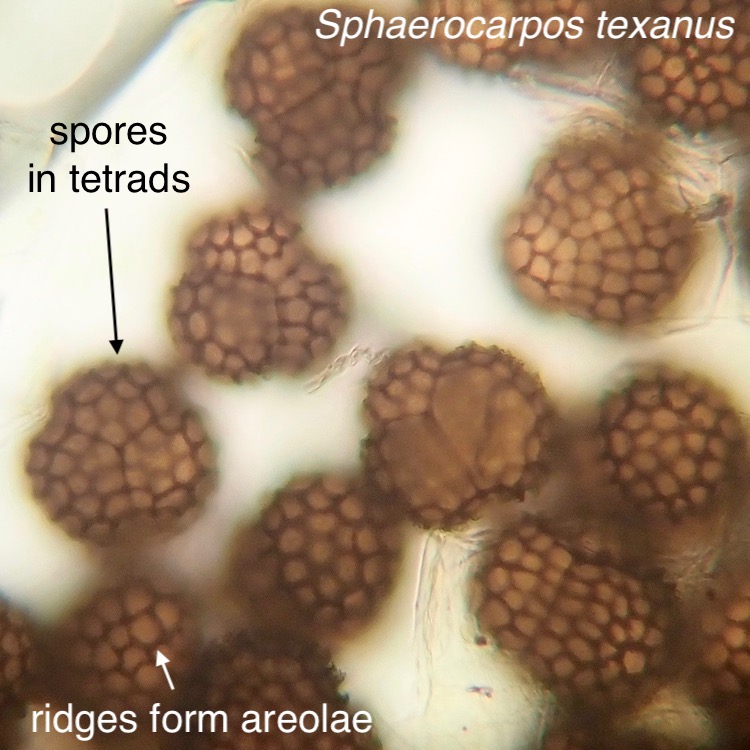
Sphaerocarpos texanus, which is much more common in Santa Barbara County and indeed, all over California, has spores which remain in tetrads even at maturity, and which are covered with ridges which form areolae, small enclosed spaces.
Though individual plants are quite small, they may grow in profusion, forming a veritable “Sphaerocarpet” over several centimeters, or even a few feet.
Habitat and Distribution
Sphaerocarpos is typically found on relatively flat soils in ruderal areas such as along trails, at rest areas and playgrounds.
Sphaerocarpos texanus is quite widespread in North America.

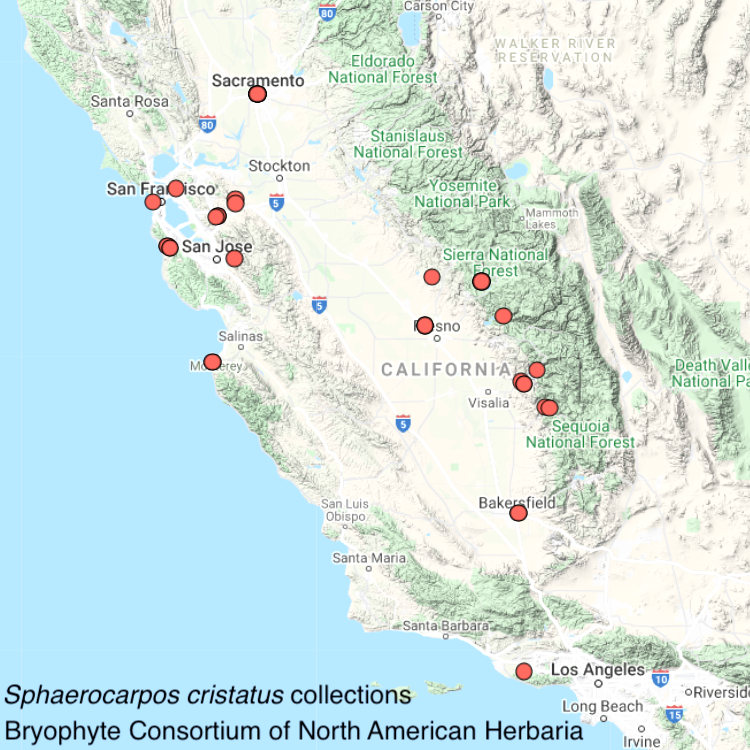
Sphaerocarpos cristatus is restricted to California and is reportedly less common.
 Bryophytes of Santa Barbara