
Porella bolanderi (Austin) Pearson
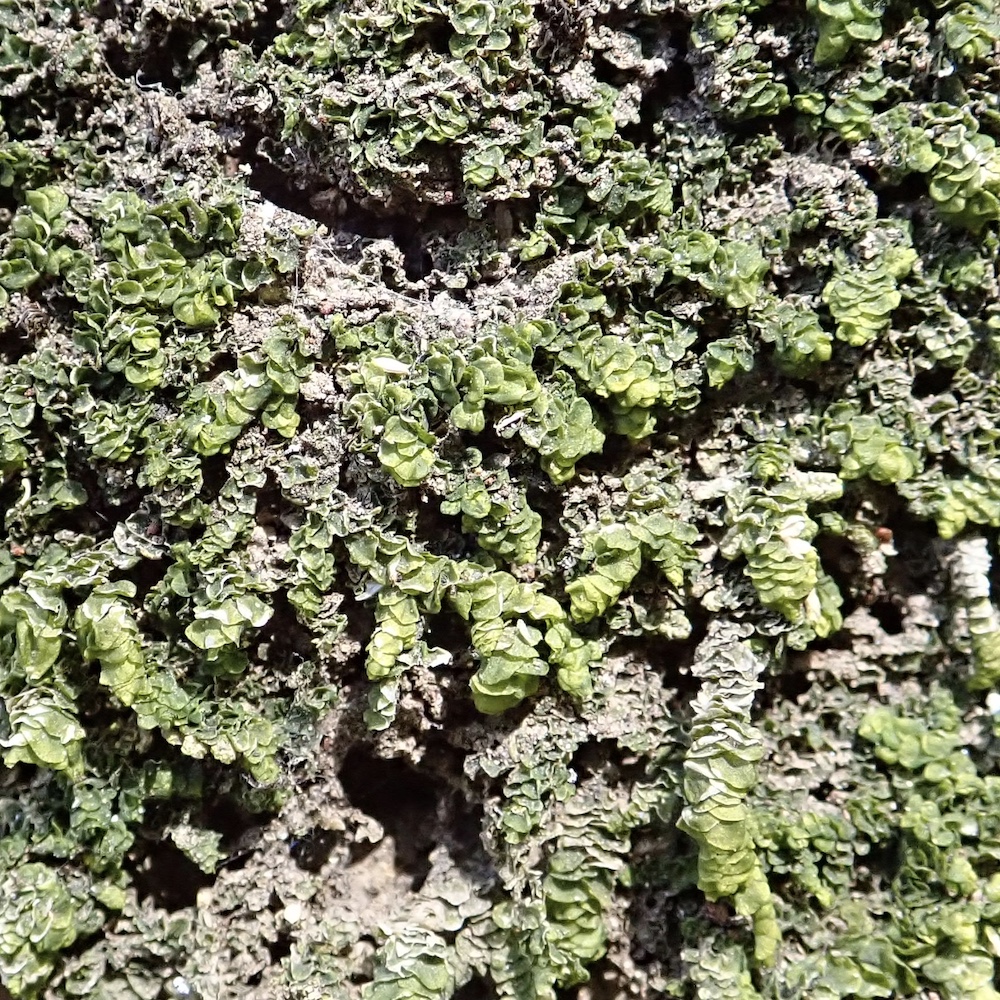
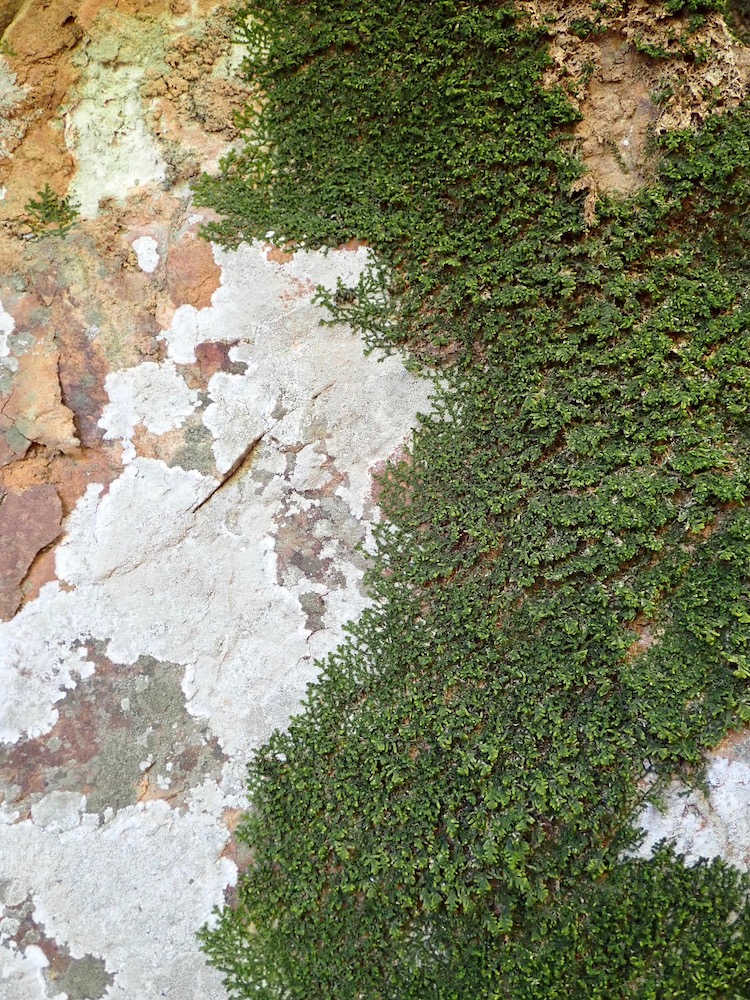
Porella bolanderi is a leafy liverwort, which comes in various shades of green, and is easily recognized by the shingle look of its two rows of overlapping (incubous) rounded leaves. Plants are approximately 2-4 mm wide and up to 6 mm long, and are irregularly pinnately branched, 1-2 times. The leaves are complicate-bilobed, with dorsal lobes much larger than the ventral lobes. There is a third row of underleaves along the stem which are not lobed. Porella bolanderi typically grows in large mats on trunks of angiosperms, or on large boulders or rocky cliffs.
Scroll down for photos with labeled parts and more detailed descriptions.
Detailed Descriptions with Photos (click to enlarge)
Plants along the edge of a Porella bolanderi colony often stretch out elegantly, and one can clearly see the irregularly pinnate branching pattern. These plants are dry, but not dead. Like most bryophytes, Porella bolanderi is desiccation tolerant and goes into a state of suspended animation when dry, reviving when wet.

Each leaf of Porella bolanderi overlaps the leaf beyond it (closer to the apex) in an “incubous” fashion. The leaves are complicate-bilobed, with a large dorsal lobe and very small ventral lobe. When viewed from above, only the dorsal lobes can be seen.

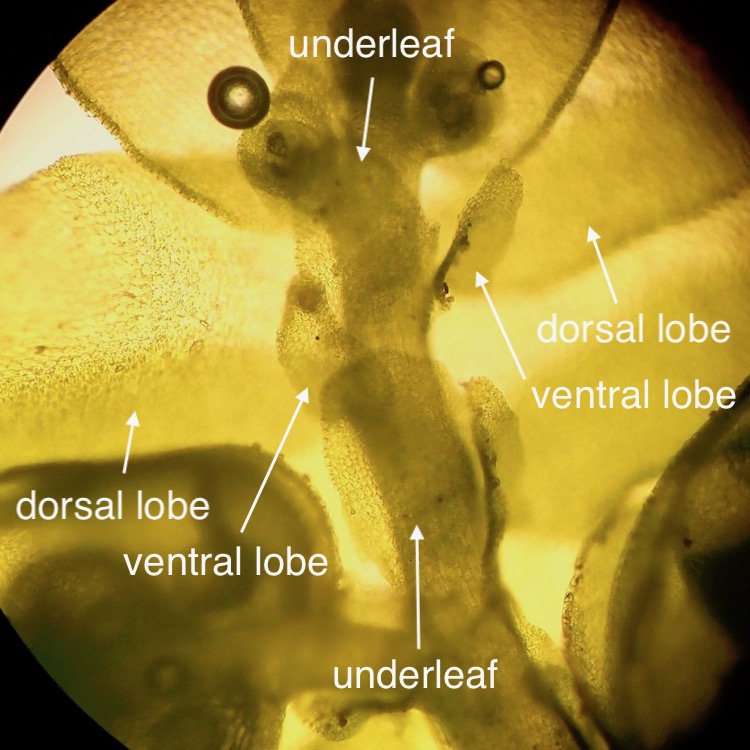
From the underside, the significantly smaller ventral lobes of Porella bolanderi can be seen at the base of the dorsal lobes. Porella bolanderi also has a third row of unlobed, somewhat rounded underleaves, which can be seen along the stem (see photomicrograph below).
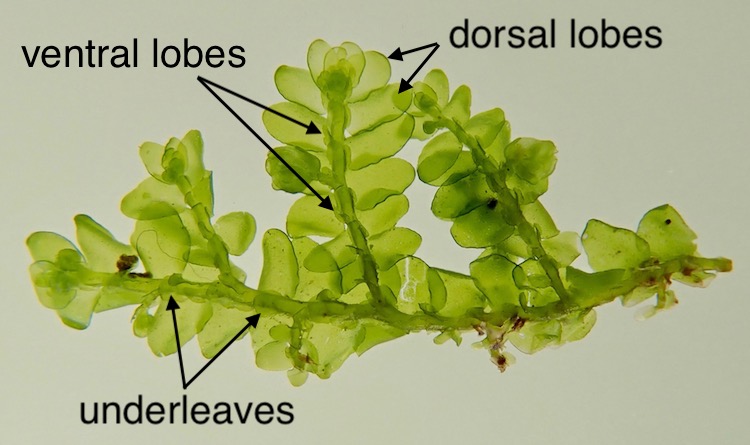
In this photomicrograph, the ventral lobes of Porella bolanderi can be seen more clearly, like folded thumbs on a mitten. The underleaves are unlobed.
All species in the genus Porella are dioicous, with male and female plants typically growing in separate mats. Fertile female plants have tube-like structures called perianths at the tips of short lateral branches. Perianths contain the female reproductive structures, archegonia. Each archegonium houses a single egg. If the egg is fertilized, it develops into a sporophyte, the part of the plant that produces spores. Here, several Porella bolanderi sporophytes can be seen emerging from their perianths.
Review the liverwort life cycle here.
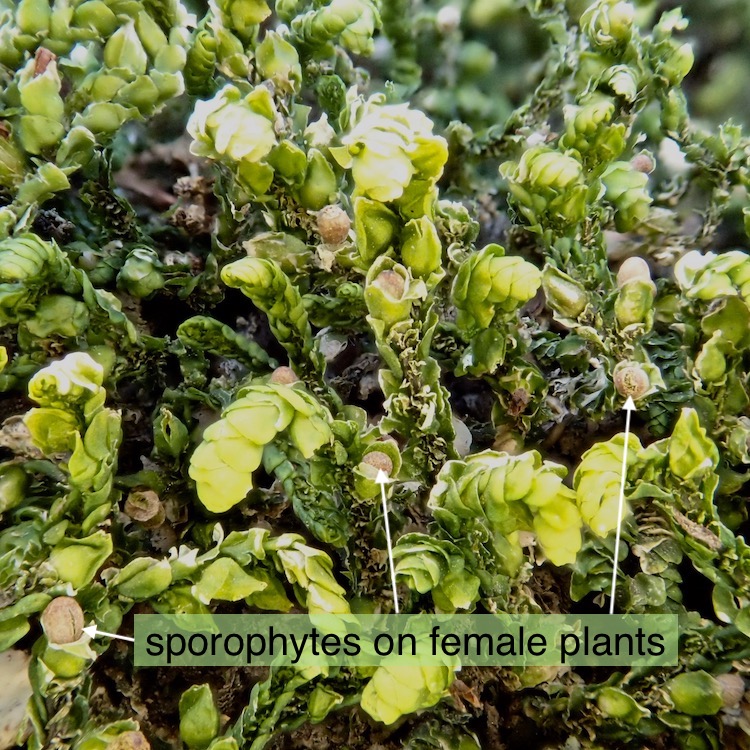
A single female Porella bolanderi plant may have many perianths on many side branches. Several perianths can be seen in this photo, each housing archegonia and sporophytes at different stages of development. The sporophyte on the bottom right is nearly mature and is emerging from the perianth.

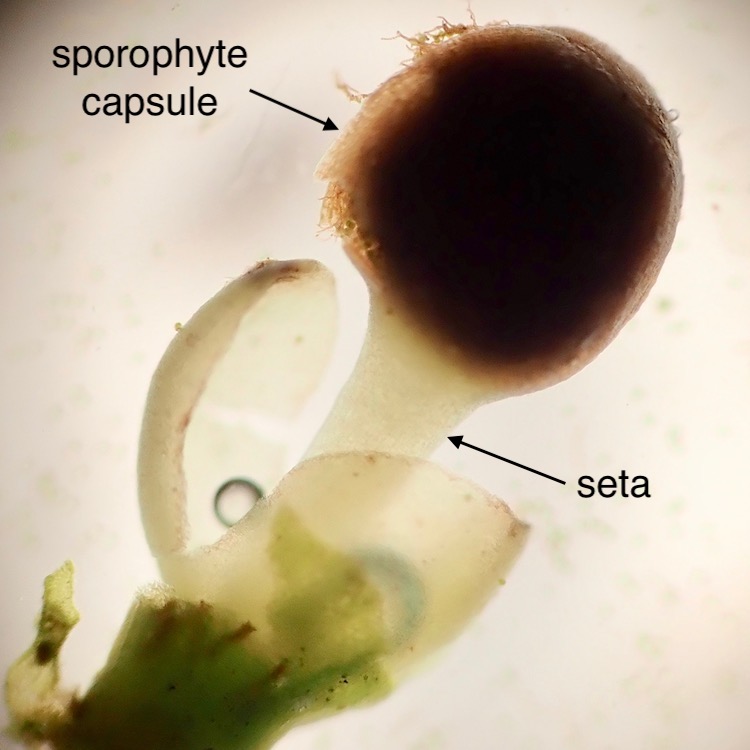
This nearly mature Porella bolanderi sporophyte has been removed from the perianth. The spores are produced in the spherical brown capsule. When the spores are mature, the cells in the stalk (the seta) elongate, raising the capsule out of the perianth. The capsule will then split open to release the spores.
This photomicrograph shows Porella bolanderi spores and an elater from the sporophyte capsule shown above. Elater cells contract and expand like springs to push the spores out into the world beyond, where they will hopefully land in a suitable habitat and develop into a new plant.

Perianth characters are useful in identifying Porella plants to species. The perianth of Porella bolanderi is plicate with 2-5 pleats. The mouth of the perianth is narrow, about 1/3 (or less) the width of the perianth, and has cilia 2-6 cells long. Shown here is the ciliated perianth of Porella bolanderi magnified 40x.
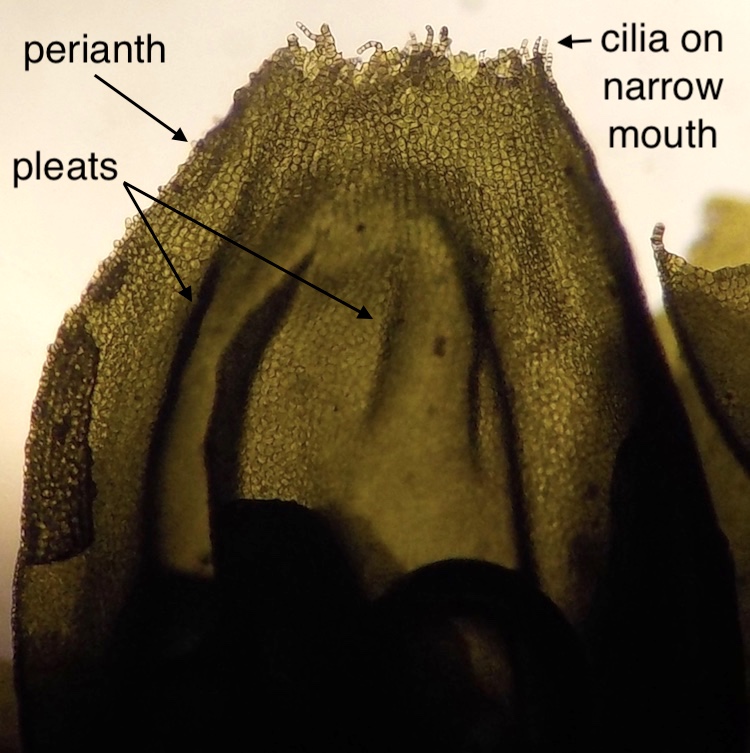
In this photomicrograph, a Porella bolanderi perianth is magnified 100x, showing the cilia around narrowed mouth. Each cilium is 2-6 cells long.

Male Porella bolanderi plants also have their reproductive parts, antheridia, on side branches, which can be short or quite long, and oftentimes numerous. With their tightly overlapping leaves or bracts, the antheridial branches tend to have a worm-like appearance.

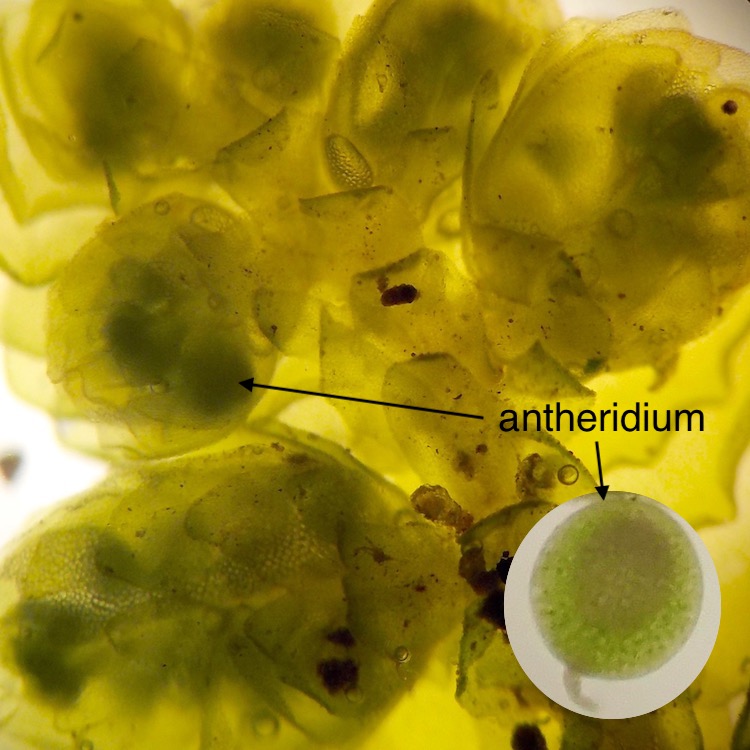
The side branches with tightly overlapping leaves or bracts on the male Porella bolanderi plants house antheridia containing sperm.
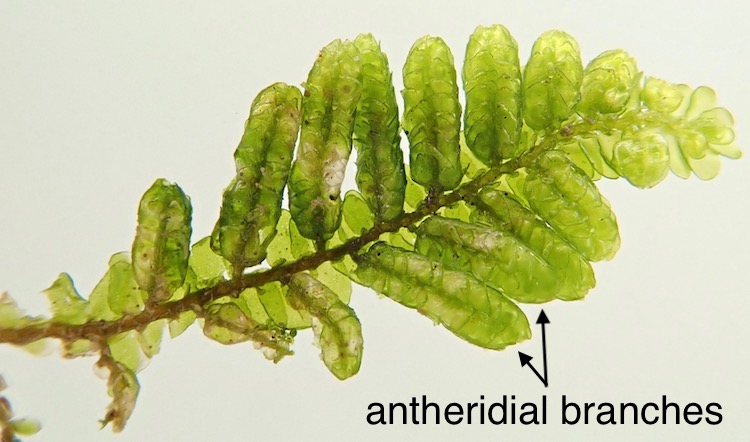
Each antheridial branch on male Porella bolanderi plants contains several spherical antheridia at various stages of development. Each antheridium contains probably thousands of sperm.
Habitat and Distribution
Porella bolanderi can be found growing on rocks and boulders as well as on tree trunks, often in large mats, generally in some shade. It is apparently occasionally found on soil though I have never observed this.
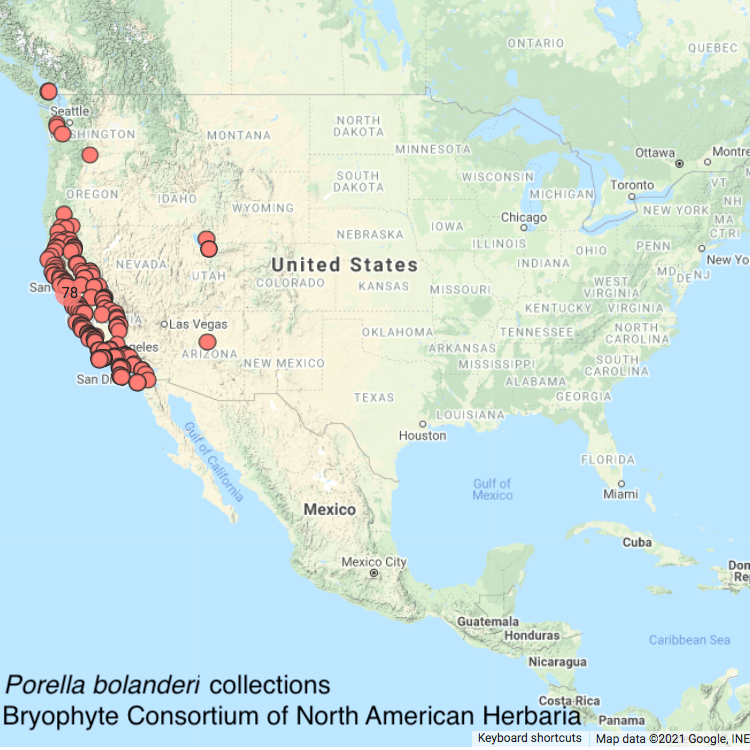
Porella bolanderi is endemic to western North America and is fairly common in Santa Barbara County.
 Bryophytes of Santa Barbara