
Lunularia cruciata (L.) Dumort. ex Lindb.
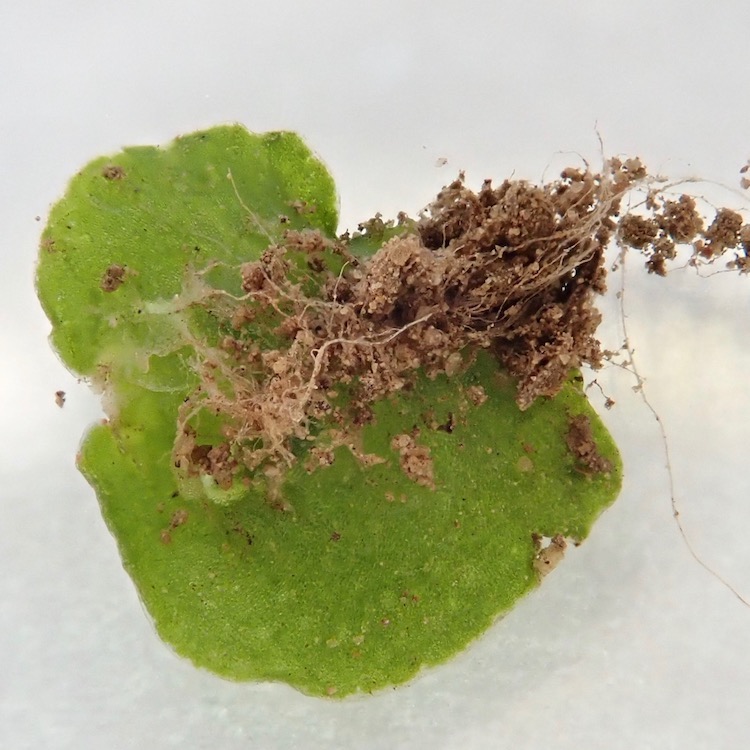
Lunularia cruciata is a large complex thallose liverwort with distinctive crescent-shaped gemmae cups containing multicellular disc-shaped gemmae (asexual propagules). Gemmae cups are typically present on at least a few thalli within a population. Thalli are 1.5-4 cm long, 5-10 mm wide, light green and glossy, very thin, and have simple pores leading to air chambers arranged in a very thin layer. Sexual reproduction is rare but archegoniophores bearing sporophytes have been seen recently in the Berkeley Hills. Photos of these can be seen in the newsletter of the California Native Plant Society Bryophyte Chapter here. It can be found on soil along creeks and banks, as well as in greenhouses.
Scroll down for photos with labeled parts and more detailed descriptions.
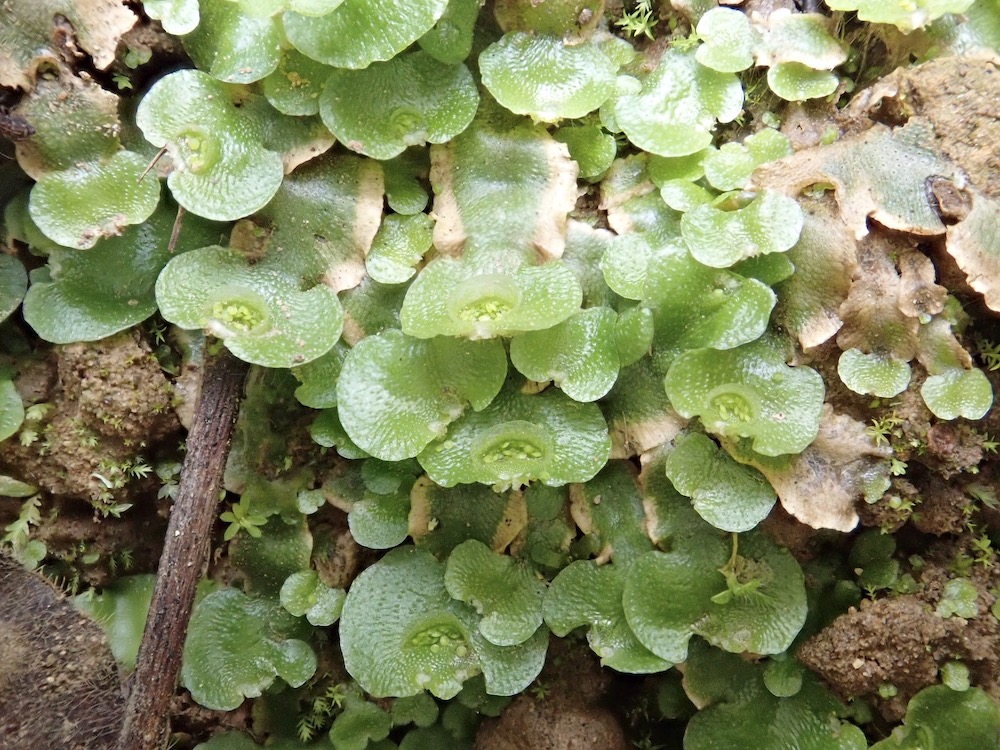
Detailed Descriptions with Photos (click to enlarge)
The crescent-shaped gemmae cups of Lunularia cruciata are diagnostic for the genus, and indeed for the species as it is a monotypic genus.
Gemmae are asexual propagules, which can develop into an entirely new plant of the same genotype, if they land in a suitable habitat. Dispersal mechanisms vary, but in this case the gemmae are thought to be dispersed mainly by rain droplets, hence the alternate name, splash cup, for gemmae cup.
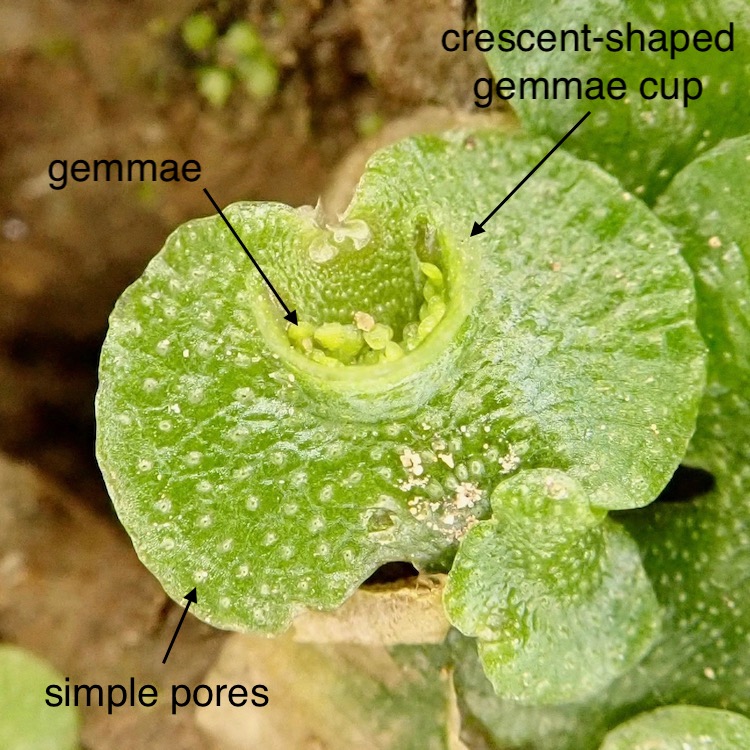
In this close-up of a Lunularia cruciata gemmae cup, the disc-shaped gemmae can be seen budding from the surface.
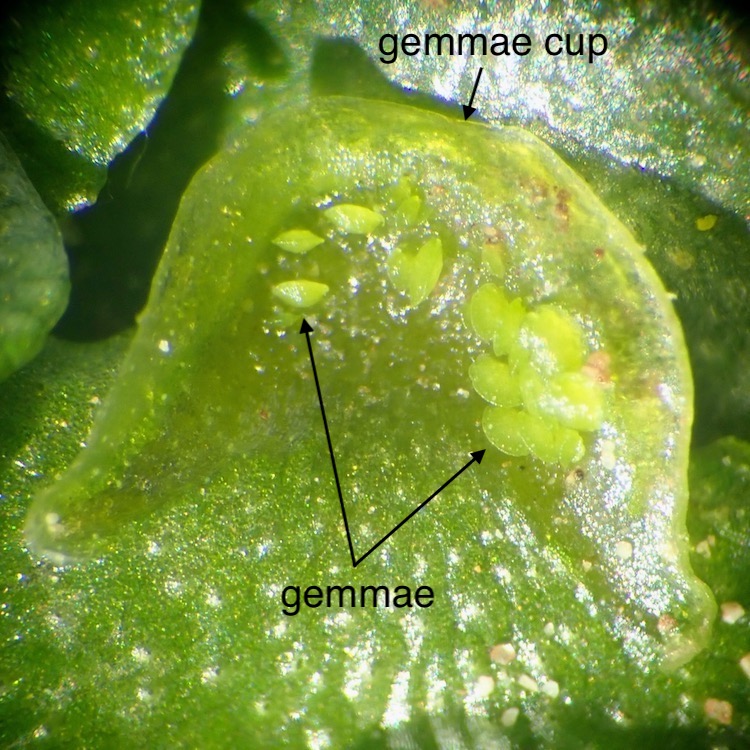
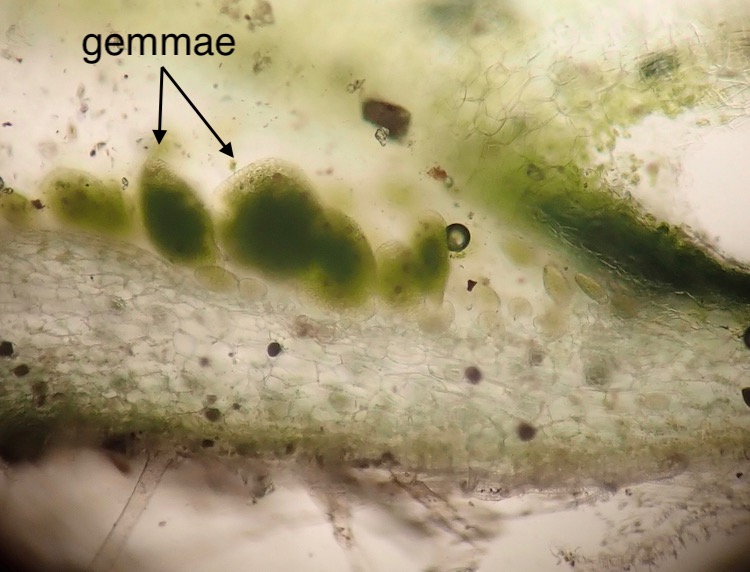
This photomicrograph of a cross-section of a Lunularia cruciata gemmae cup, again shows the gemmae budding from the surface.
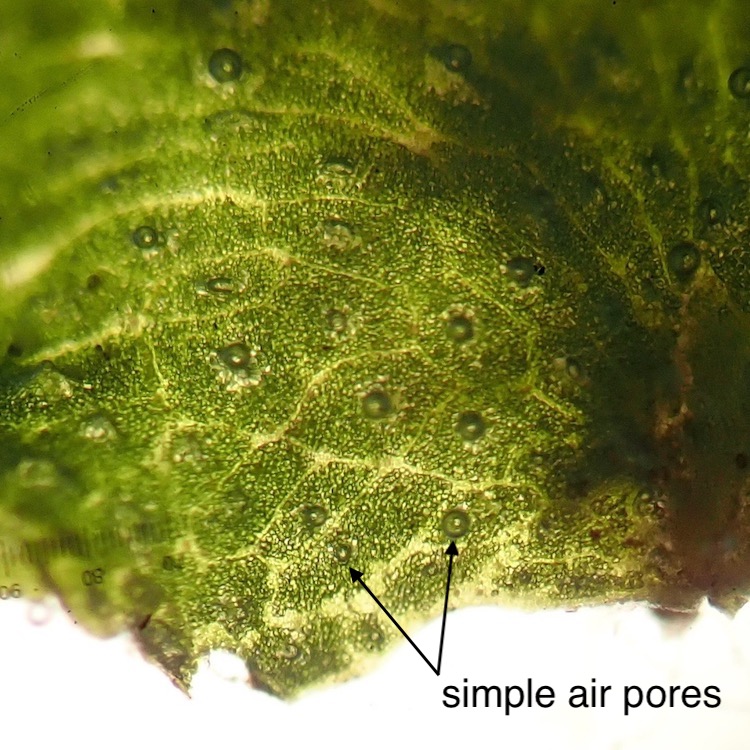
The upper surface of Lunularia cruciata is dotted with simple pores leading to air chambers within the thallus, as seen in this photomicrograph.
Lunularia cruciata has a very thin layer of photosynthetic air chambers, as seen in this photomicrograph of a cross-section of the thallus.
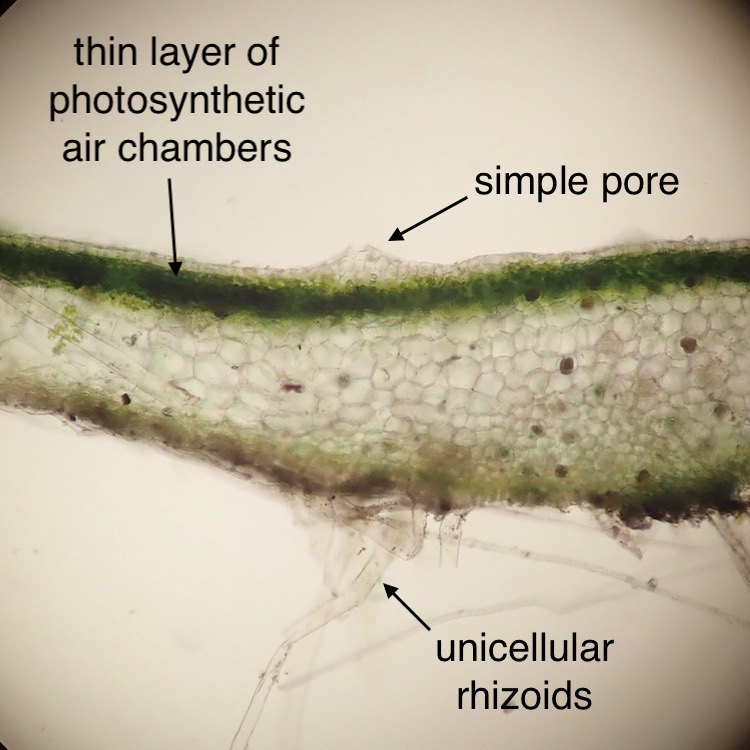
Lunularia cruciata is said to have hyaline to light brown ventral scales, however, in the small sample I observed, I failed to locate them.
Habitat and Distribution
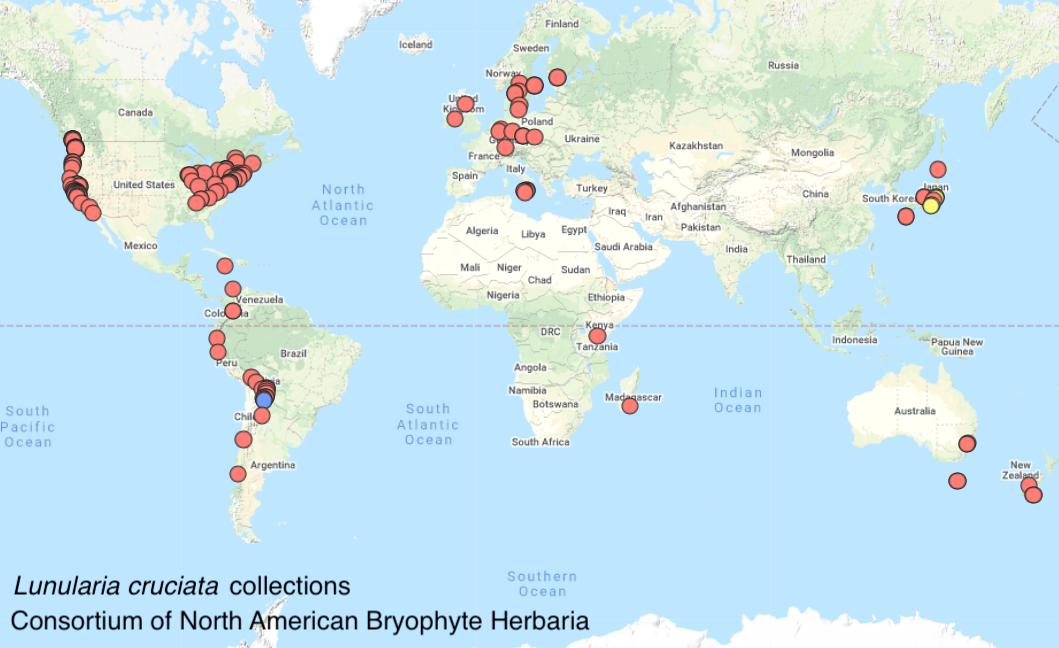
Lunularia cruciata is considered native to the Mediterranean but has become a worldwide weed, found on soil in greenhouses, gardens, and lawns, in addition to riverbanks, trail cuts and road cuts, usually in some shade. I have thus far found Lunularia cruciata in only a few locations in Santa Barbara County.
Map generated by google maps using data from the Consortium of Bryophyte Herbaria of accessioned collections from herbaria.
 Bryophytes of Santa Barbara