
Frullania catalinae A. Evans
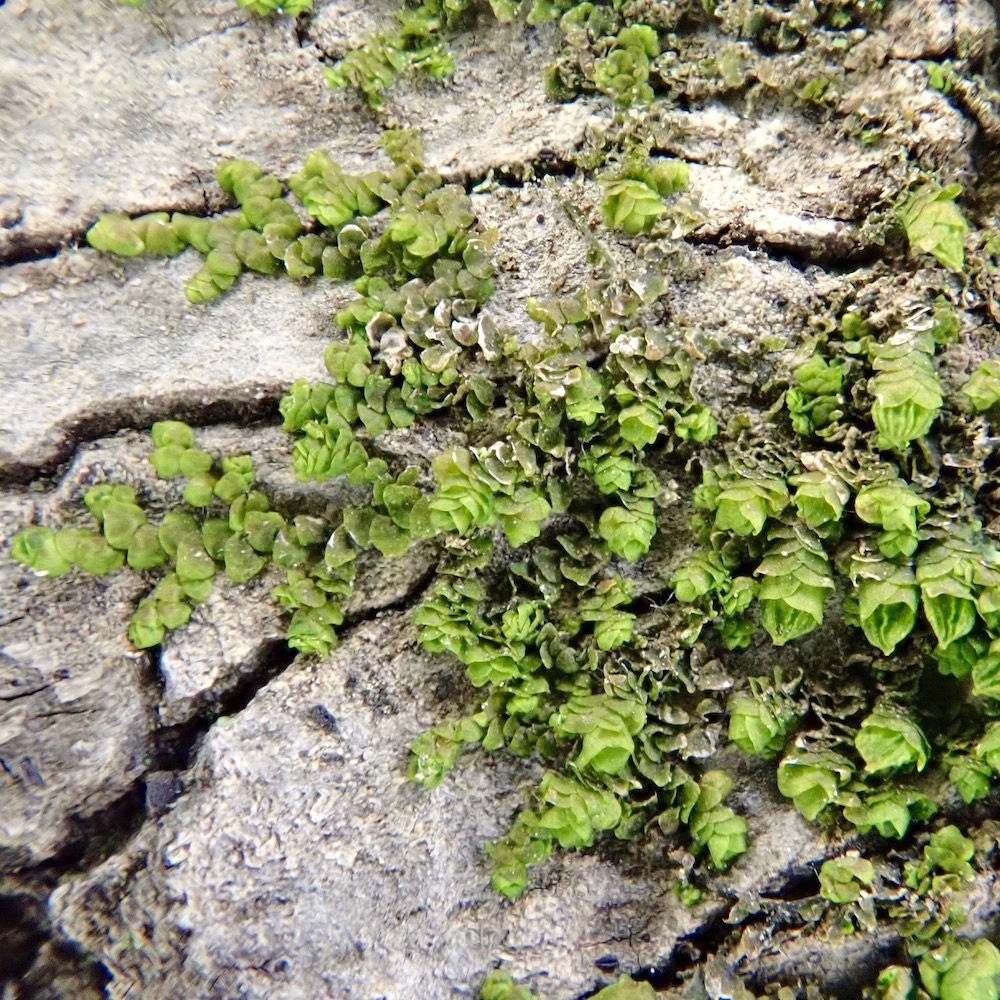
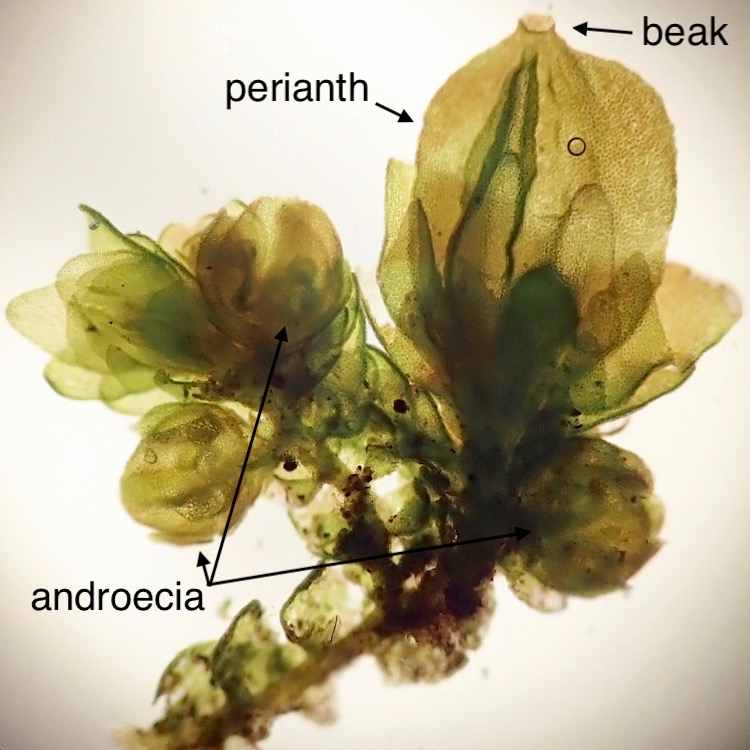
Frullania catalinae is a leafy liverwort with complicate-bilobed leaves and bilobed underleaves. The leaves range in color from green to red, typically in response to degree of sun exposure. Unlike most Frullania species which have helmet-shaped (galeate) ventral lobes, F. catalinae has mostly flat (explanate) ventral lobes (lobules). It is the only paraoicous Frullania species in the state of California, with both female (archegonia) and male (androecia) reproductive structures on the same individual plant. The perianths, which house the archegonia and ultimately the sporophyte, taper gradually to a beak-like opening.
Scroll down for photos with labeled parts and more detailed descriptions.
Detailed Descriptions with Photos (click to enlarge)
When Frullania catalinae branches are viewed from above, the larger dorsal lobes of the complicate bilobed leaves mostly obscure the smaller ventral lobes.

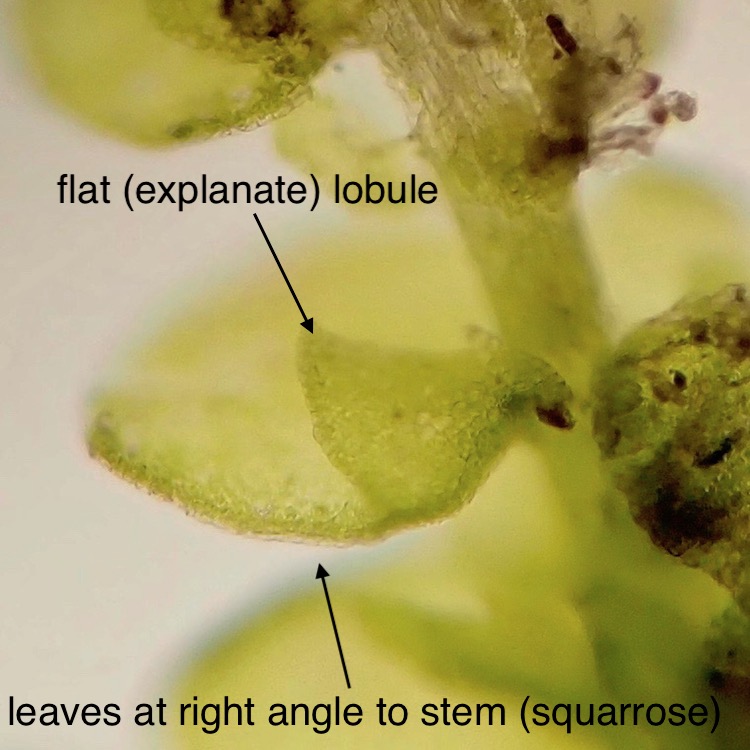
When Frullania catalinae is viewed from below, the smaller ventral lobes (sometimes called lobules) can be seen. These are generally flat (explanate), but can be broadly helmet-shaped (galeate). Both explanate and galeate lobules can sometimes be found on the same branch.

The leaves of Frullania catalinae are generally said to be squarrose, held a right angle to the stem, as seen in this photomicrograph. In the field, this is more easily seen in branches which are crowded on top of one another, as opposed to those on the edges of a population which tend to be flattened against the substrate.
Frullania catalinae has a third row of small leaves along the underside of the stem. These underleaves are deeply divided into two lobes.
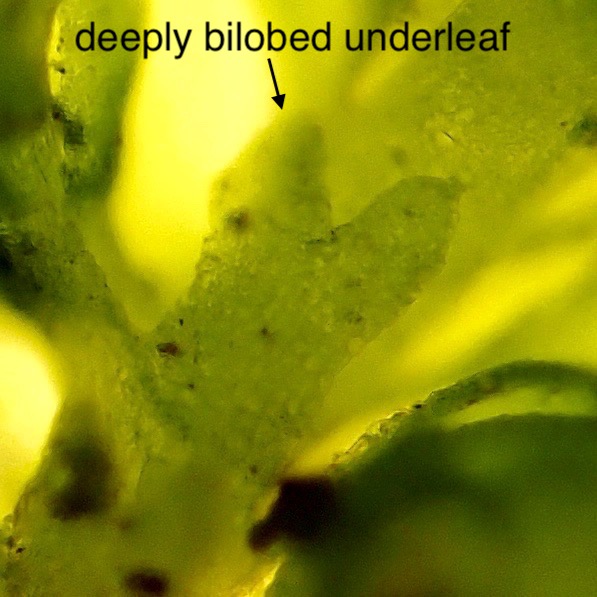
The underleaves of Frullania catalinae often have a tuft of rhizoids which facilitate attachment to the substrate. In this photomicrograph, magnified 400x, the individual rhizoids are clumped together in a large mass.

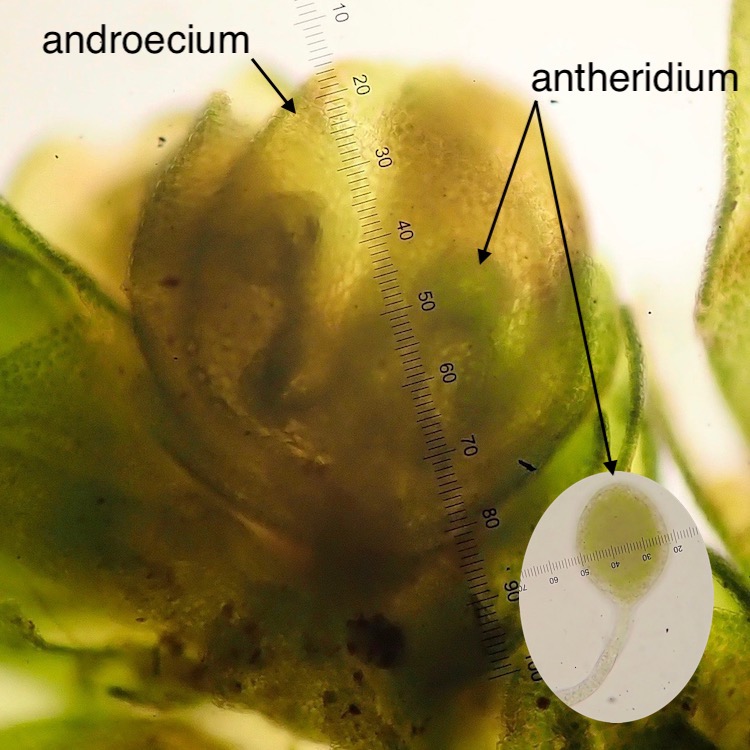
Frullania catalinae is the only paraoicous species in the genus in California. Both the female and male reproductive structures can be seen on the same plant, oftentimes many of each. The female archegonium is housed inside the ballon-like perianth with a beaked opening. The male antheridia are within bracts resembling brussels sprouts.
When fertilized, the egg within the archegonium (in turn within the perianth) will develop into the sporophyte. The Frullania catalinae sporophyte in this photomicrograph has been dissected from the perianth. In doing so, it was slightly ruptured and the spores and elaters can be seen leaking out. The elaters are single cells which expand and contract in relation to humidity, acting like a spring to push the spores into the air.
For a review of the liverwort life cycle click here.

When mature, the Frullania catalinae sporophyte capsule splits along four lines of dehiscence and the elaters push the spores out into the great yonder. In this photomicrograph, the capsule has dehisced and the spores have been ejected, leaving some elaters behind.

Dehisced Frullania catalinae sporophyte capsules can be seen with a hand lens in the field. In the center of this photo, one perfectly round intact sporophyte can be seen surrounded by many dehisced capsules with elaters extended like fuzzy brown pompoms.

The male reproductive organs, or antheridia, of Frullania catalinae, are housed within bracts resembling tiny brussels sprouts (androecia). In this photomicrograph, an antheridium or two can be seen in silhouette within the bracts. The inset shows an individual antheridium dissected out of the androecium. Each androecium has several antherida, and each antheridium has thousands of sperm, which must swim through liquid water to reach an archegonium and fertilize the egg within.
Habitat and Distribution
Frullania catalinae grows on the trunks of angiosperms as well as on rock, generally in some shade. It is restricted to coastal California and Baja California, from San Luis Obispo County south.

Here, Frullania catalinae can be seen on the trunk of a Coast Live Oak along the Jesusita Trail in Santa Barbara County.

 Bryophytes of Santa Barbara