
Frullania bolanderi Austin
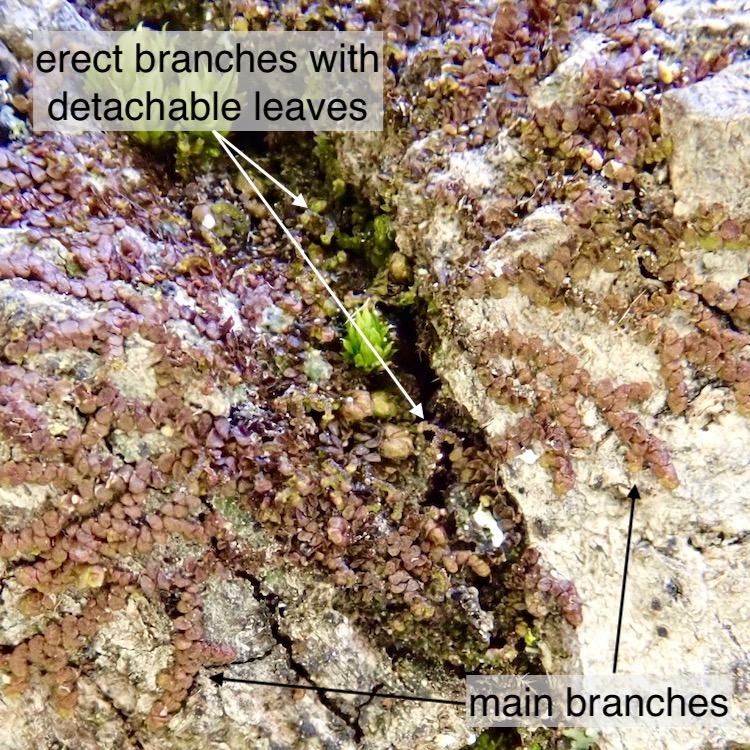
Frullania bolanderi is a small, green to dark reddish-brown leafy liverwort, which typically grows on tree trunks and large boulders. The main branches are tightly adhered to the substrate and have two rows of complicate-bilobed leaves as well as a row of smaller bifid underleaves. Mature patches of Frullania bolanderi are easily recognized in the field by the presence of additional short erect branches with small, detachable (caducous) leaves which act as asexual propagules.
Scroll down for photos with labeled parts and more detailed descriptions.

Detailed Descriptions with Photos (click to enlarge)
Though it is a very small plant, Frullania bolanderi can form extensive patches. Here it is seen growing alongside Frullania catalinae on a coast live oak.

The main branches of Frullania bolanderi are 0.5-0.7 mm wide and are generally tightly adhered to the substrate. Plants exposed to any sun tend to be reddish, whereas more shaded plants, for example those in a cleft in the bark, may be green.
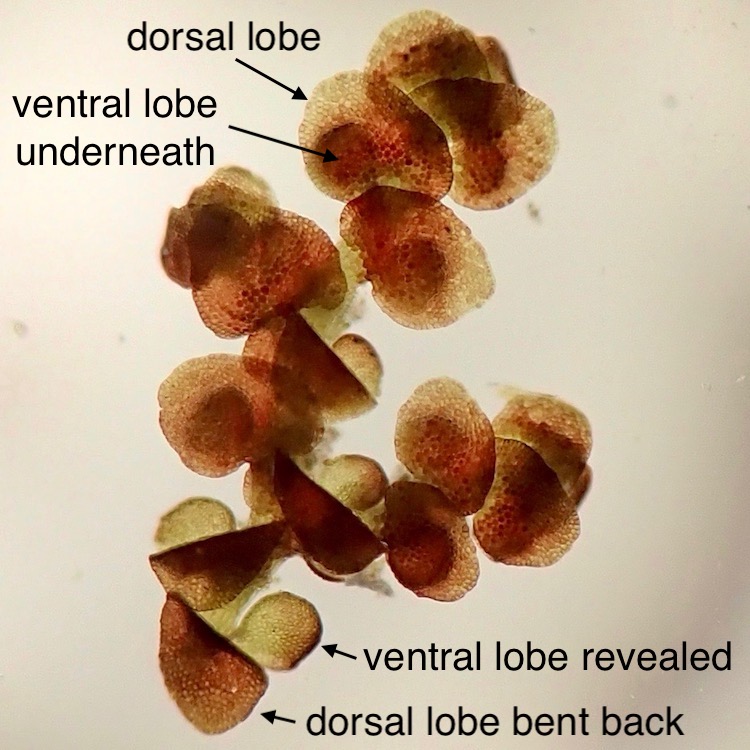
Frullania bolanderi has complicate-bilobed leaves. Each leaf consists of two lobes joined together by a keel and folded on top of one another. The dorsal lobe is large, ovate, and mostly flat. The ventral lobule is smaller, rounder, helmet-shaped (galeate) and inflated. The leaf shown in this photomicrograph has been removed from the stem so that the dorsal lobe and ventral lobule and their attachment can be easily seen.

Frullania bolanderi has two rows of alternating complicate-bilobed leaves, one row on either side of the stem. The larger dorsal lobes overlap one another like shingles on a roof (incubous). In this photomicrograph, the smaller ventral lobules can be seen as round darker patches through the dorsal leaf lobes. A few of the dorsal lobes are folded back revealing the ventral lobes underneath.
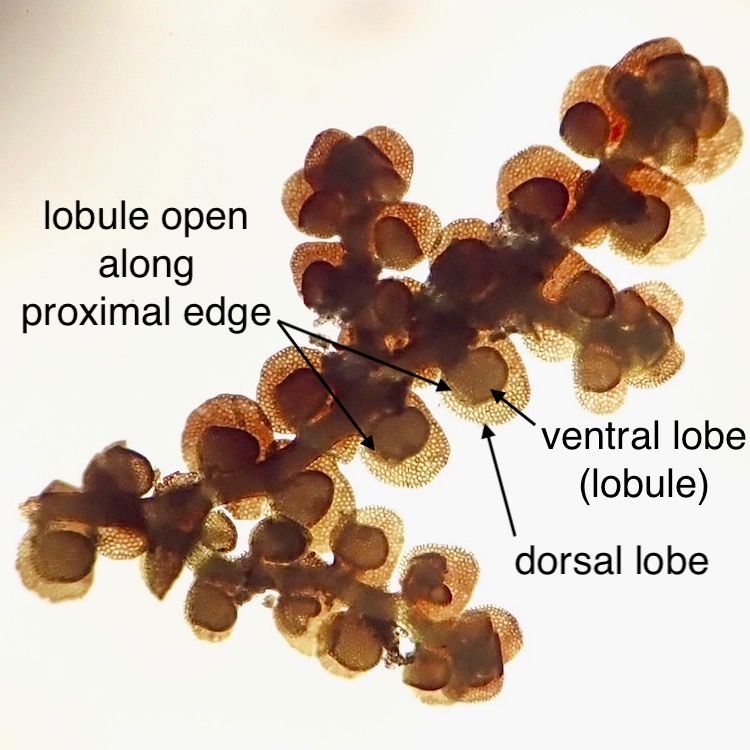
This photomicrograph of Frullania bolanderi shows the ventral lobules more clearly as viewed from the underside of the plant. The ventral lobules are inflated and may function as water storage pockets. When viewed in water on a microscope slide the ventral lobules typically contain air bubbles but I have removed them here by heating the slide with a match.
In addition to the main branches, Frullania bolanderi has smaller erect branches with detachable (caducous) leaves, which fall off and act as vegetative propagules, developing into a genetically identical plant if they land in a suitable habitat. These branches are visible in the field with a hand lens, standing out like funny little inch worms, as a result of their upward posture and mostly naked stems. The erect branches are diagnostic for the species – if you see them, you can be certain that you are looking at the one and only Frullania bolanderi.
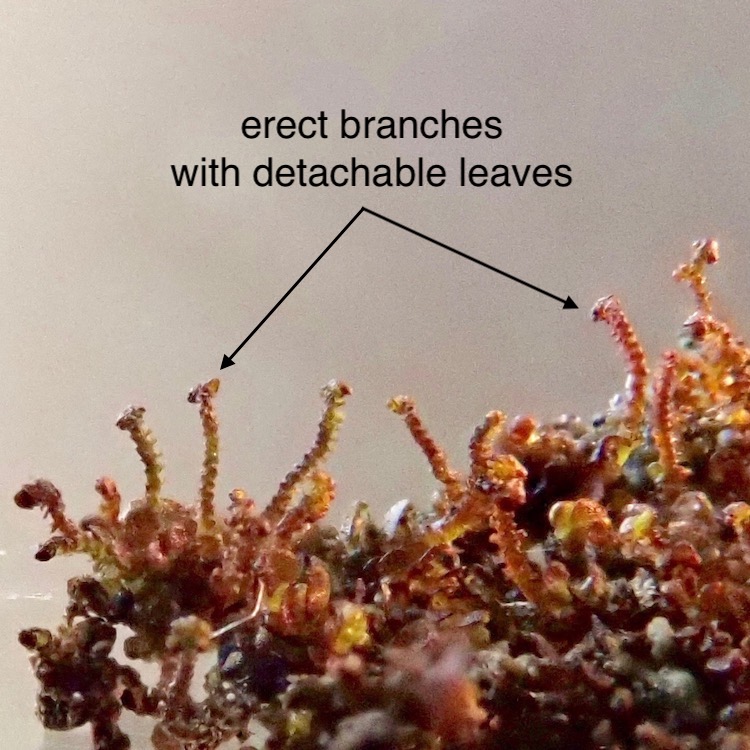
In this photomicrograph, one can see the modified underleaves, which are left behind on the erect branches after the caducous leaves detach.

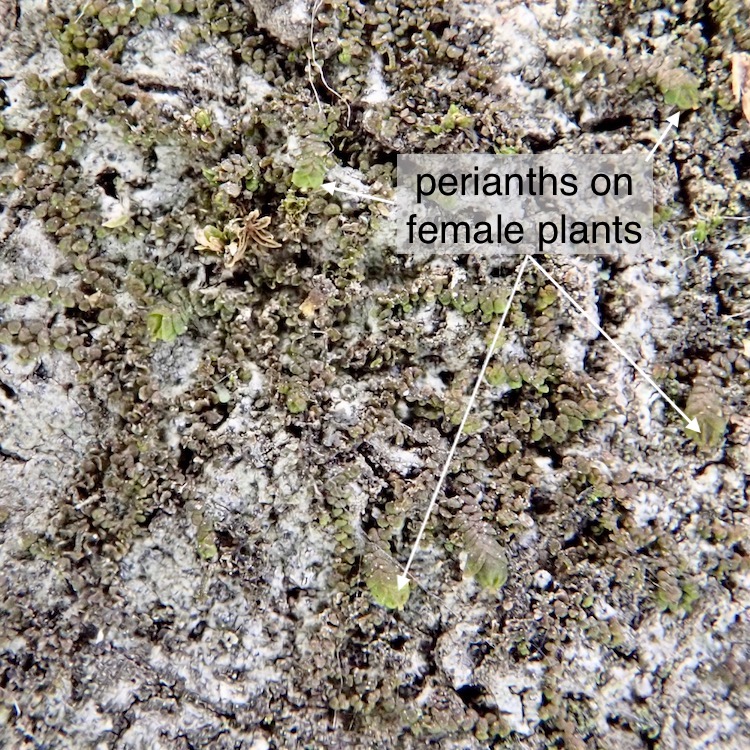
Frullania bolanderi is dioicous, with separate male and female plants. Fertile female plants have a perianth at the apex of the main branch. The perianth initially houses the female reproductive organs (archegonia) each with an individual egg. Once the egg is fertilized, it develops into the sporophyte, the part of the plant that produces spores.
For a review of the liverwort life cycle click here.
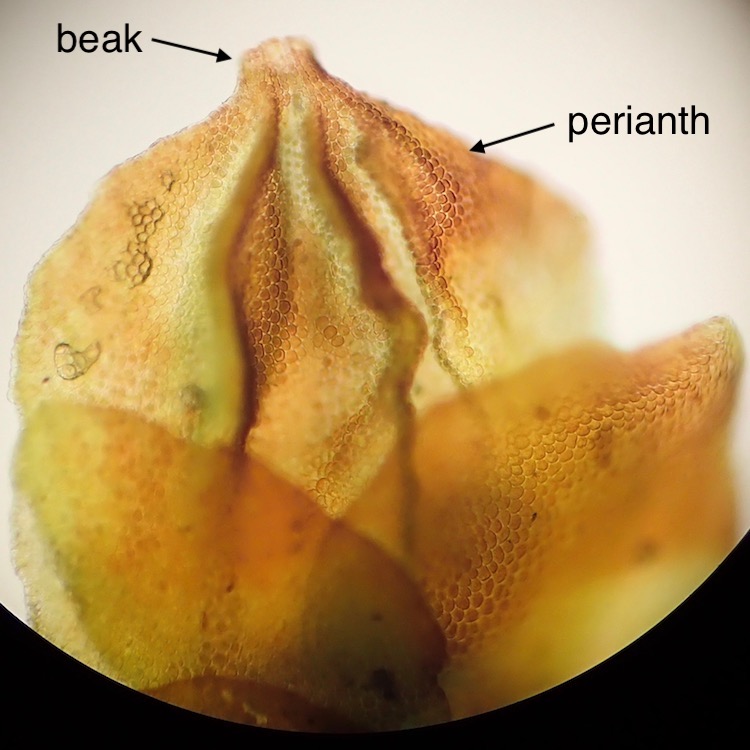
The opening atop the perianth of Frullania bolanderi is quite narrow and is said to be beaked.
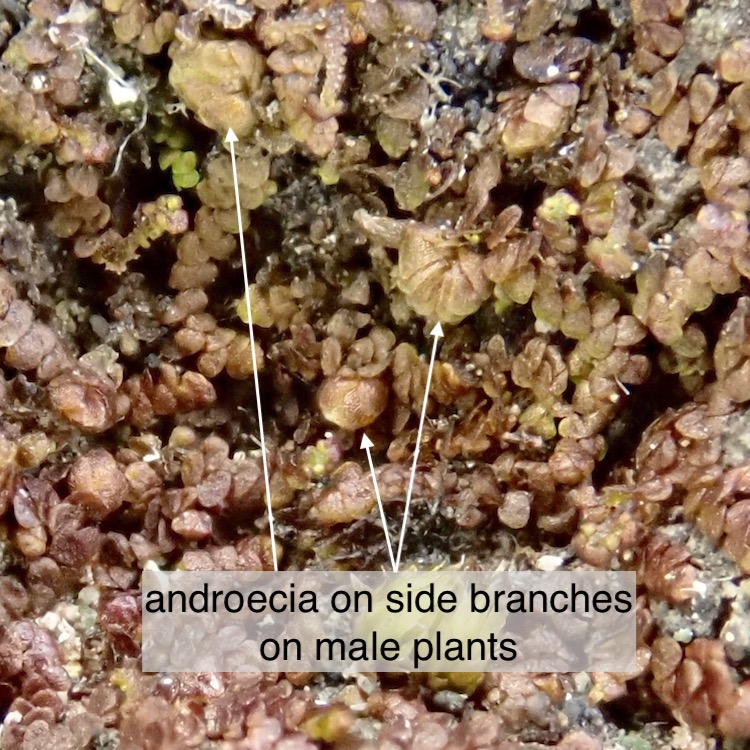
Male Frullania bolanderi plants have androecia on short side branches. Androecia house the male reproductive organs (antheridia) each of which contains thousands of sperm. Sperm must swim through liquid water to a neighboring female plant to fertilize the egg within the archegonium within the perianth.
This photomicrograph shows an androecium on a short side branch on a male Frullania bolanderi plant. One can just make out the silhouette of one of the spherical antheridia within.

Habitat and Distribution
Frullania bolanderi is most frequently found on the bark of angiosperms, but can also be found on rocks, decaying wood, and apparently even soil. It is found in western North America, as well as in northeastern North America, and in northern Europe.

Name: The genus, Frullania, is named for Leonardo Frullani (1756-1824), a Tuscan statesman. The specific epithet, bolanderi, honors the German-American botanist, Henry Bolander (1831-1897), who first found the plant.
Similar Species in Santa Barbara County
Frullania catalinae is significantly larger than Frullania bolanderi, tends to be a lighter shade of green, lacks the erect branches with detachable leaves, and is paraoicous, with both male and female organs on the same individual plant.

 Bryophytes of Santa Barbara