
Cryptomitrium tenerum (Hook.) Austin ex. Underw.
Brief Overview: Cryptomitrium tenerum is a large complex thallose liverwort (0.5-1.5 cm long, 3-10 mm wide) with archegoniophores (umbrella-like structures) with distinctive flying saucer-shaped tops (carpocephela) with slightly concave upper surfaces and typically a scalloped or wavy margin. In more mature plants, the black bowling ball sporophyte capsules can easily be seen emerging from slits in the underside of the carpocephela. The thallus is wide but thin and delicate, with a shiny green upper surface and purple underside, and a wavy or scalloped margin which may also appear purplish. The species is monoicous, with female and male reproductive organs on the same plant, the archegoniophores arising near the tips of main branches, and the antheridia in a row in the slight groove directly behind.
Scroll down for photos with labeled parts and more detailed descriptions.

Detailed Descriptions with Photos (click to enlarge)
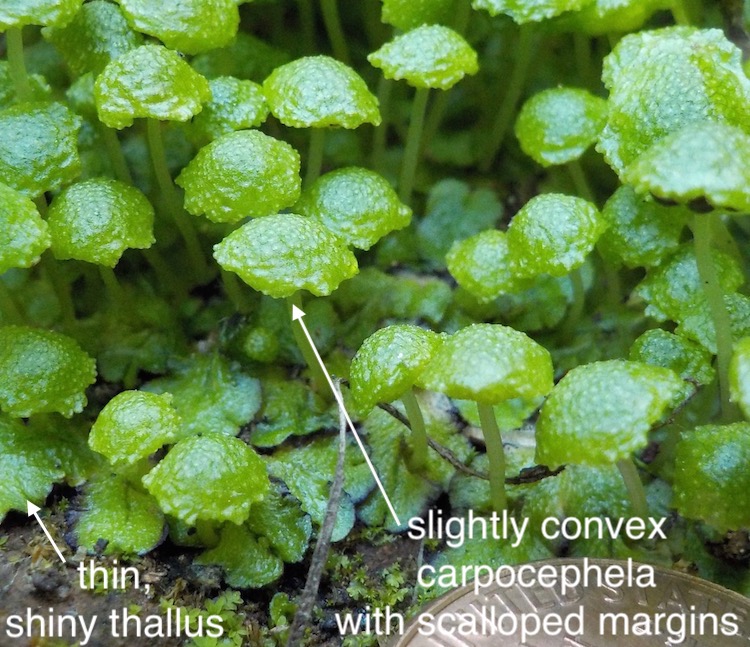
The thallus of Cryptomitrium tenerum is thin, delicate and shiny green, sometimes with a purple margin. The carpocephela have a slightly convex, bumpy upper surface with a wavy margin.
Two rows of purple scales line the ventral (under) surface of the thallus of Cryptomitrium tenerumand can occasionally give the upper surface a purple outline, as seen in the plants on the right side of this photo. The scales become more visible when plants begin to dry and the margins curl up, as seen in the plants on the left side of this photo.

On mature plants, the black sporophyte capsules of Cryptomitrium tenerum can be seen clearly, peeking out from slits on the underside of the carpocephela.
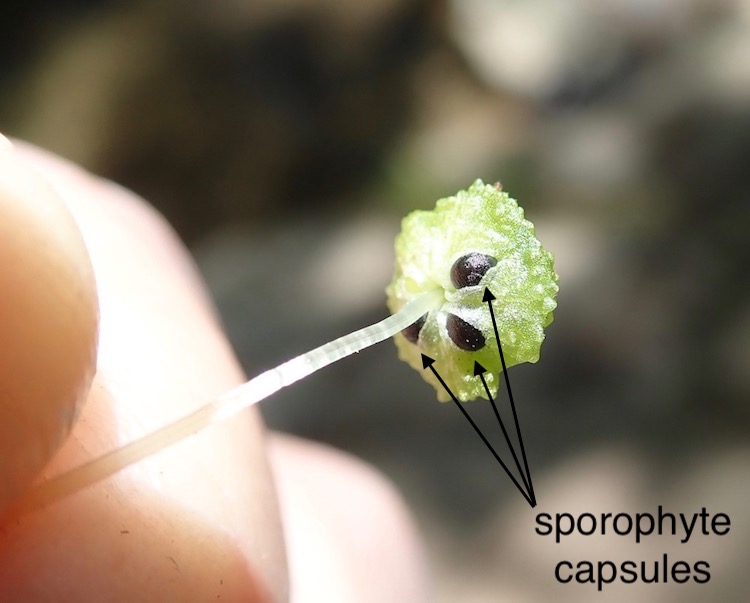
As the sporophytes mature and begin to bulge out, the carpocephela of Cryptomitrium tenerum may begin to look concave rather than convex.

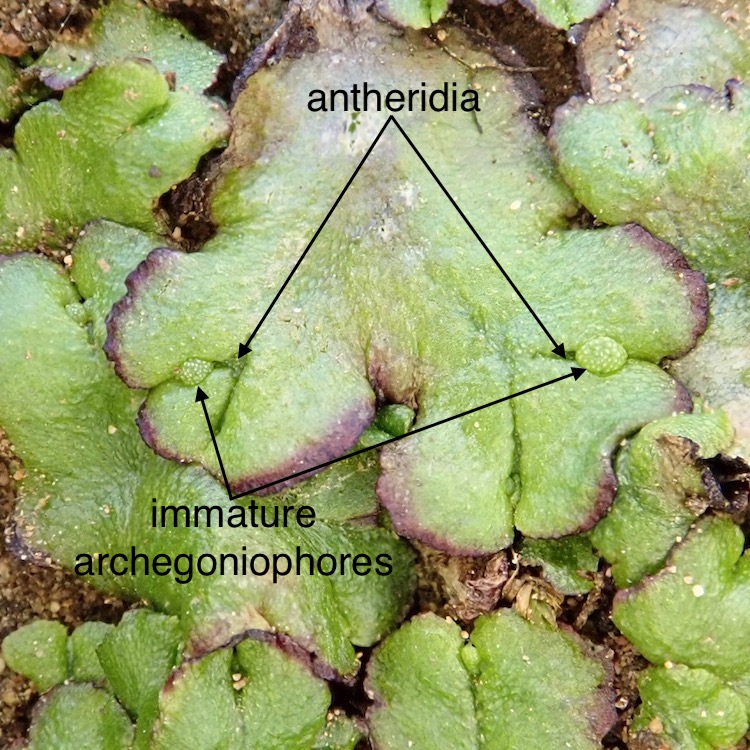
Cryptomitrium tenerum is a monoicous species, with both female and male reproductive organs on the same plant. The male parts, antheridia, are located in the furrow behind the archegoniophores, visible as a collection of small inconspicuous bumps. The archegoniophores on the plant in this photo are immature and remain sessile on the plant. As they develop, the setae will extend, raising the carpocephela high above the surface.
For a review of the liverwort life cycle click here.
In this photomicrograph of a cross section of a Cryptomitrium tenerum thallus, the antheridia can be seen as large sacs within the thallus, filled with sperm which will be released through the ostioles, openings in the bumps visible from above. Sperm must swim through liquid water to fertilize an egg within a carpocephalum (hopefully of a genetically different plant). Plunking raindrops may facilitate this seemingly impossible task.

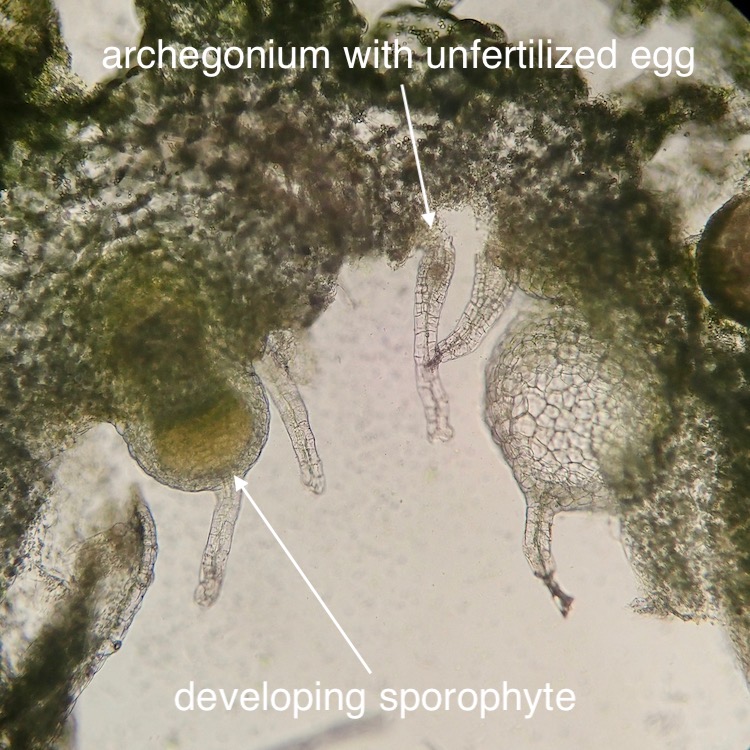
The following two photomicrographs demonstrate what goes on in the female part of the plant. This is a cross-section of a Cryptomitrium tenerum carpocephalum, the flying saucer umbrella at the top of the archegoniophore, the mushroom-like stalk which houses the archegonia, the female reproductive structures. Initially the carpocephalum has many archegonia, each containing an unfertilized egg. Eggs which are fertilized by sperm will develop into a sporophyte. Scroll down to the next photo which has these stages labeled.
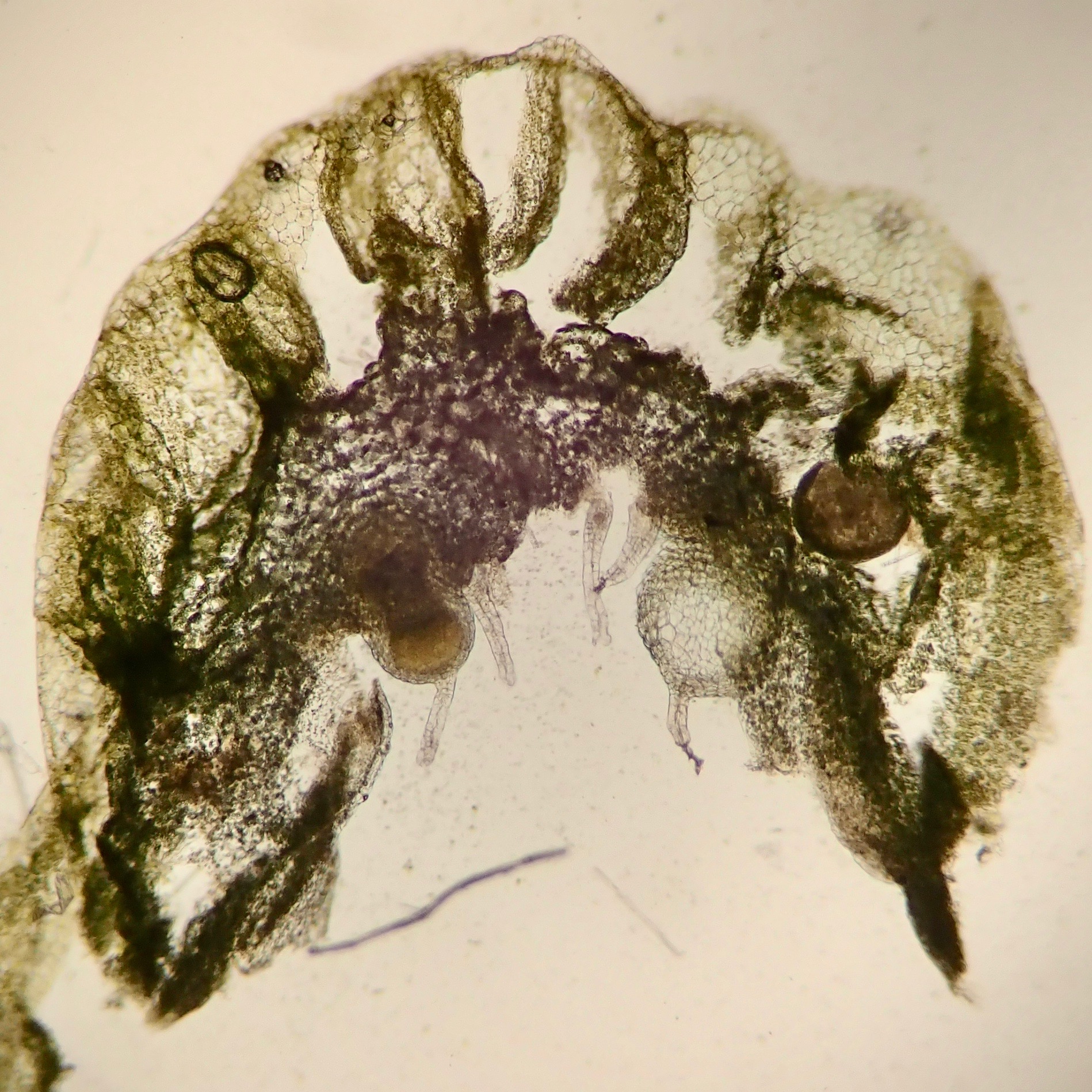
In this close-up of the same cross section of a Cryptomitrium tenerum carpocephalum shown above, one archegonium containing an unfertilized egg can clearly be seen in the center of the photo. The two archegonia surrounding it are less clear but likely also contain unfertilized eggs. The bulging archegonium on the left contains what was once a fertilized egg and is now developing into a sporophyte. The developing sporophyte from the even larger empty archegonium on the right was expelled during the cutting and can be seen to the upper right.
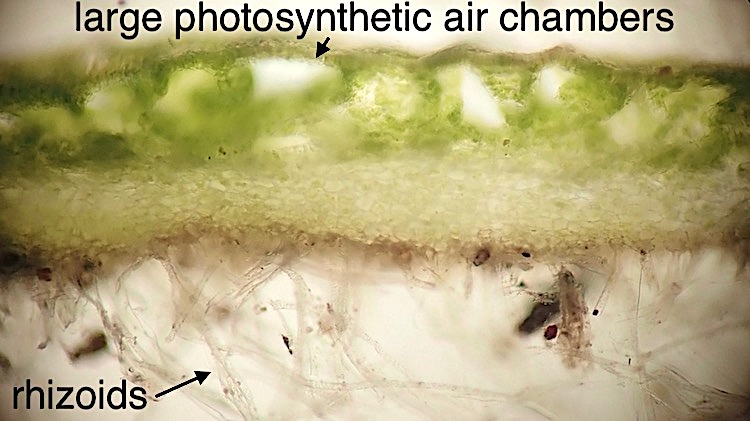
Cryptomitrium tenerum looks quite different in cross section from other local complex thallose liverworts, with large cavernous air chambers visible in the upper layer.
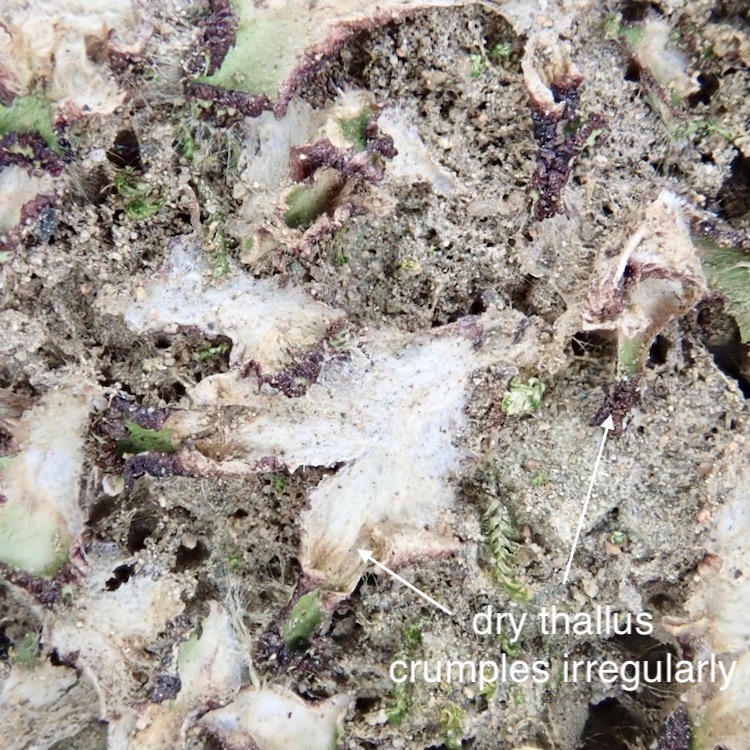
Cryptomitrium tenerum tends to crumple in an irregular manner when dry, unlike the neatly rolled-in thalli of Asterella or Targionia. Possible exceptions are Cryptomitrium tenerum plants growing on rock, whose margins seem to roll in more regularly. Nevertheless, Cryptomitrium tenerum is desiccation tolerant, lying dormant over the dry summer and fall months, and resuming growth once the winter rains return.
Habitat and Distribution
Cryptomitrium tenerum can be found along the shadier and moister trail cuts and road cuts in the canyons of Santa Barbara County. It is perhaps more commonly found in the more humid habitat along creeks, typically on soil but occasionally on rock.

Cryptomitrium tenerum is found across California and into Southern Oregon, as well as in Chile.
Map generated by google maps using data from the Consortium of Bryophyte Herbaria of collections accessioned in herbaria.

 Bryophytes of Santa Barbara