
Cephaloziella turneri (Hooker) Müll. Frib.
Cephaloziella turneri is a tiny leafy liverwort (0.4-0.5 mm wide, 2-7 mm long) with two rows of deeply bilobed leaves with long, distinct teeth along the margins, and no underleaves. Plants range in color from light green to reddish brown and are often fertile, with sporophytes at the tip of the main shoot, and androecia (male reproductive structures) on lateral branches. Asexual reproduction is also common and angular gemmae can often be found among the leaves at the apex of the shoot.
Scroll down for photos with labeled parts and more detailed descriptions.

Detailed Descriptions with Photos (click to enlarge)
Individual Cephaloziella turneri plants are tiny (0.4-0.5 mm wide, 2-7 mm long) but they may form dense mats on soil, perhaps a few centimeters across.

The leaves of Cephaloziella turneri come out of the stem at a right angle (transverse), are slightly concave, bilobed, and have long, distinct teeth along the margin, which are visible in the field with a hand lens.

Cephaloziella turneri is autoicous, with individual plants having both male and female reproductive parts, but on separate branches. This photomicrograph shows a side branch with male antheridia along the stem, each surrounded by a toothed bract. The antheridia contain sperm which must swim to an egg in the female organ (an archegonium).

The female reproductive organs (archegonia) of Cephaloziella turneri are located at the tips of the main shoots and are surrounded by a perianth, a protective structure formed by the fusion of specialized leaves. Upon fertilization of the egg, the zygote develops into the sporophyte, the part of the plant that produces spores. The sporophyte consists of a black ovate capsule in which the spores are produced, atop a watery glass noodle-like stalk (seta). The capsule remains within the perianth until the spores are mature, whereupon the seta extends rapidly by cell elongation and the capsule can clearly be seen high above the plant.

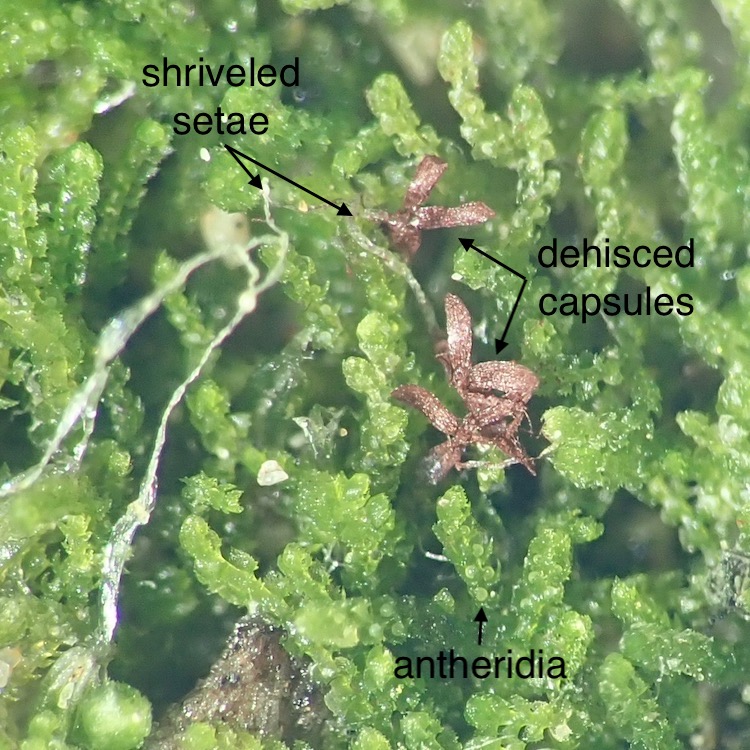
Soon after the seta has elongated, the sporophyte capsule of Cephaloziella turneri splits along four lines of dehiscence to release the spores. Seen here, under the dissection microscope, are three capsules which have split open and released their spores. The glass noodle setae have shriveled, and the spent capsules are lying atop the plants.
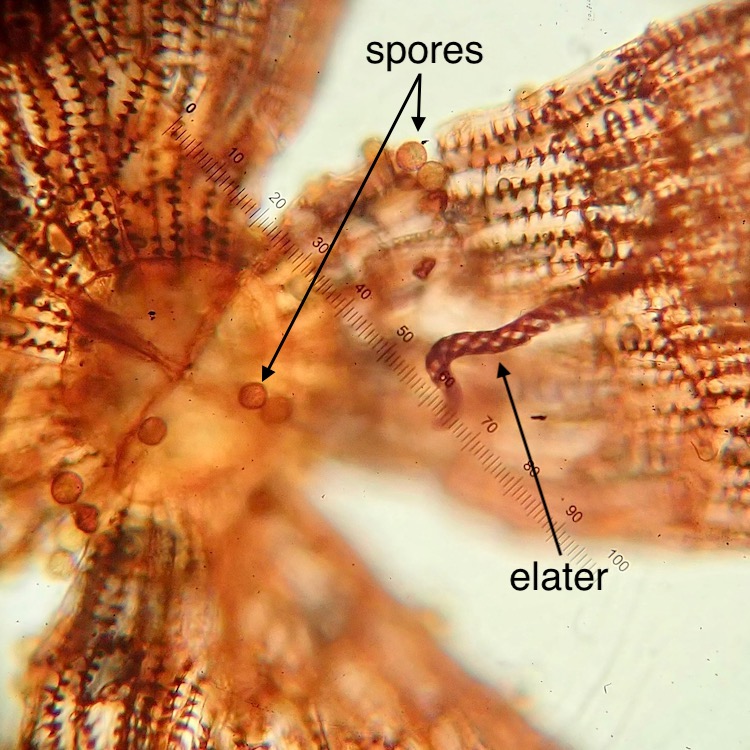
This photomicrograph shows a single Cephaloziella turneri sporophyte capsule which has split open along the four lines of dehiscence. Scroll down to see the same capsule at higher magnification, revealing the remaining spores and elaters more clearly.

Cephaloziella turneri spores are aided in their journey by spring-like elater cells. A spore which lands in a suitable habitat will develop into a new plant which is genetically different from the parent plants.
Cephaloziella turneri also reproduces asexually by producing 1-2 celled gemmae with quite angular sides. Each gemma is capable of developing into a new plant, genetically identical to the parent plant. These gemmae can be found amongst the leaves at the shoot apices.

Habitat and Distribution
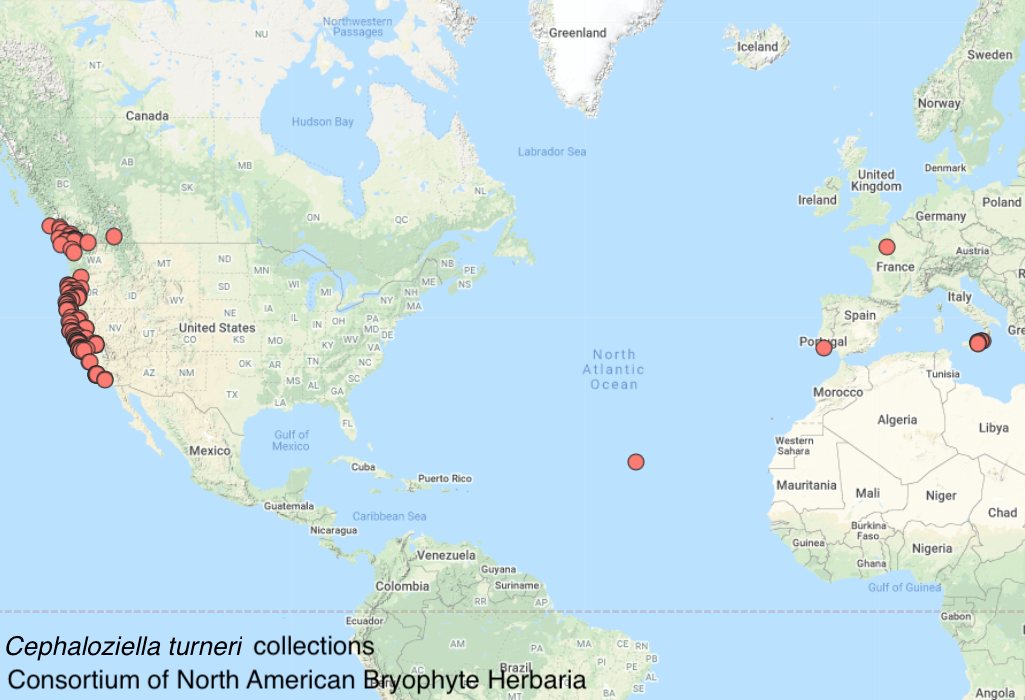
Cephaloziella turneri can be found on soil or sand and apparently occasionally on wood, in exposed or shaded sites. It has been reported from California, Oregon, Washington and British Columbia, as well as in Europe and in North Africa, though a search of the Consortium of Bryophyte Herbaria did not show any collections from the latter.
 Bryophytes of Santa Barbara