
Calasterella californica/Asterella californica (Hampe) Underw.
Asterella californica is a large complex thallose liverwort, easily recognized at maturity by its umbrella-like structures (archegoniophores) with tops, which are deeply divided into 3-5 lobes, and which arise from the tips of its reptilian-textured thallus. A pleated white pseudoperianth can be seen dangling beneath each lobe. As the archegoniophores age, the lobes and the pseudoperianths become more and more horizontal. The thallus is dichotomously branched, with branches approximately 0.9-2.3 cm long, and 5-10 mm wide. The ventral surface of mature plants is covered with purplish-black scales, and older or more exposed specimens often have reddish to blackish margins. The species is dioicous, with separate male and female plants often growing intermixed.
Scroll down for photos with labeled parts and more detailed descriptions.

Detailed Descriptions with Photos (click to enlarge)
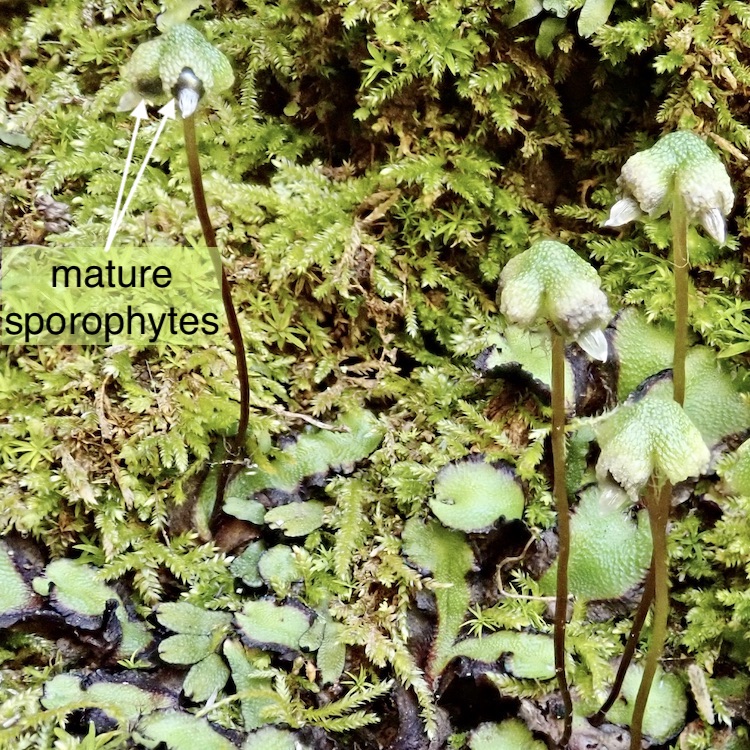
The genus Asterella is characterized by the white veil-like involucres, or pseudoperianths, dangling down from the umbrella tops (carpocephela). Initially, the pseudoperianths surround the female reproductive structures of the plant (archegonia), each containing one egg. Once fertilized, the egg develops into a sporophyte. At maturity, Asterella californica‘s carpocephela lobes and pseudoperianths tend to flare out at a horizontal angle and the black sporophyte capsules can be found within the white veil-like pseudoperianths. For a review of the liverwort life cycle click here.

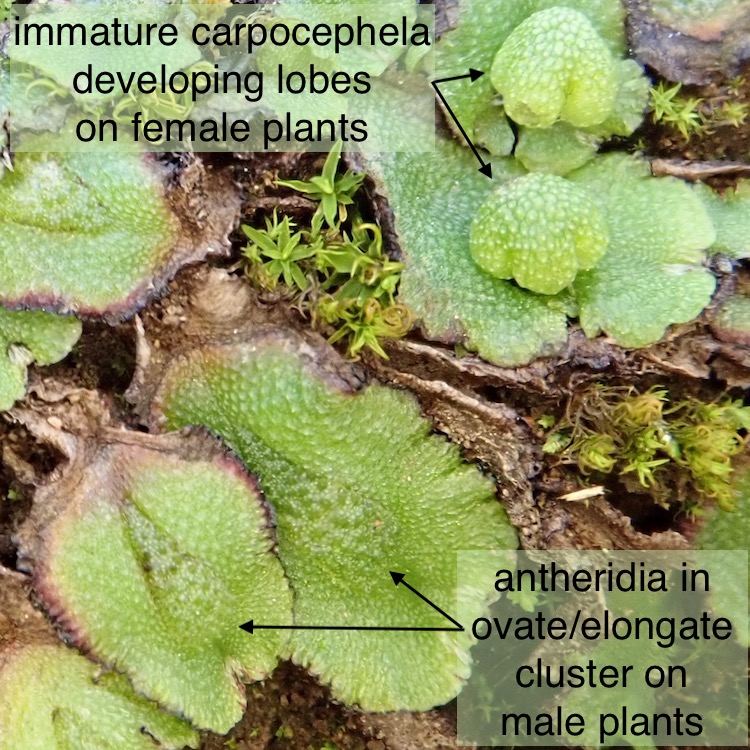
Asterella californica is the only California species in the genus which is dioicous, with separate male and female plants growing intermixed or in separate populations. Male plants, when mature, can be recognized by a bumpy ovate or elongate mound containing the antheridia, the male reproductive structures. Female plants, when mature, will have the deeply lobed umbrella-like archegoniophores.
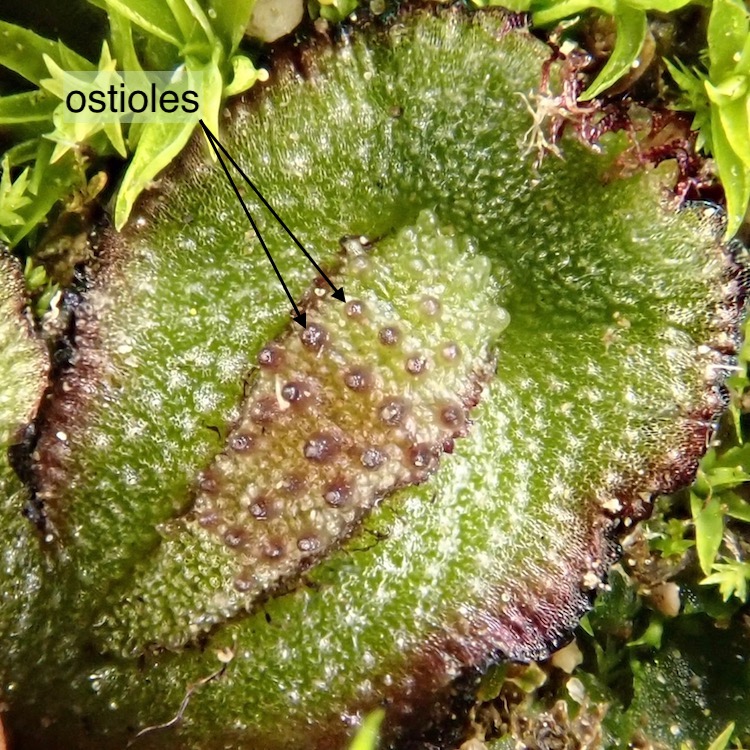
This photo shows an individual male Asterella californica plant with an antheridial pad in the center of the thallus. The purple bumps are ostioles, and each one leads to an individual antheridium within the thallus, seen in the next photo below.
This photomicrograph shows a cross section of a male Asterella californica thallus with three antheridia, the white sacs. The ostioles, the openings at the thallus surface, were partially broken off while cutting the section (intact ostioles can be seen below). Each antheridium contains thousands of sperm, which must exit the male plant through the connected ostiole, and swim through liquid water to an egg within the carpocephalum of a female plant. Plunking raindrops may facilitate this seemingly impossible task.

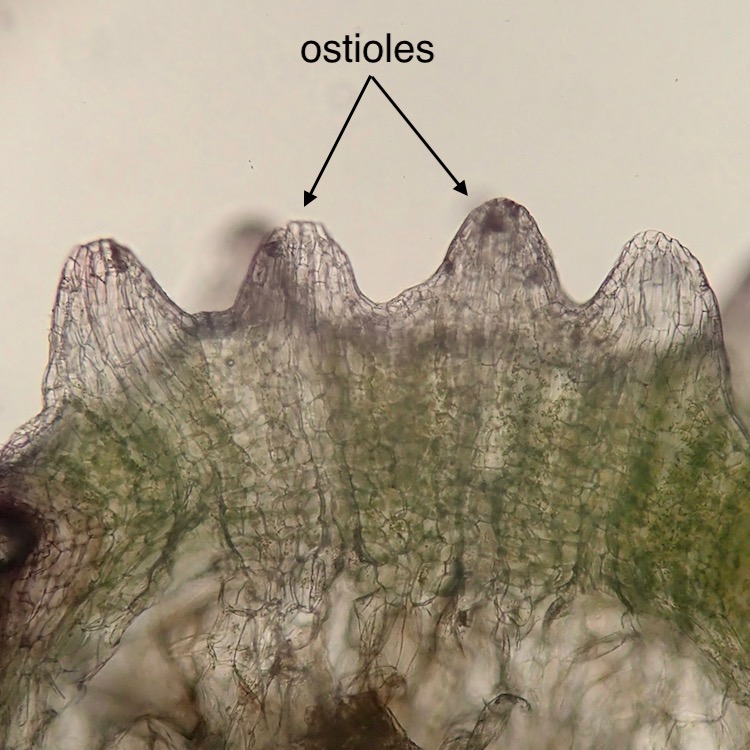
This photomicrograph shows a cross section of a male Asterella californica plant with intact ostioles, the volcano-like openings through which sperm exit the plant in search of an egg to fertilize.
Female Asterella californica plants have umbrella-like structures called archegoniophores, which house the female reproductive structures, archegonia. Initially each archegonium contains an unfertilized egg. Once fertilized, the egg becomes a zygote, which develops into a sporophyte. This photomicrograph of a dissected umbrella top, or carpocephalum, shows an archegonium containing what was once an egg, but which has been fertilized and is now beginning to develop into a sporophyte. The neck of the archegonium can still be seen.

This photomicrograph of cross-section of an Asterella californica carpocephalum shows a developing sporophyte at a later stage of development, now containing immature spores.

When Asterella californica sporophytes are mature, the shiny black, spherical capsules can be seen bulging through the white pseudoperianth veil.
The mature spores of Asterella californica are yellow-brown and are described by Stotler and Doyle as having a “frothy” appearance due to the fine areolations on the surface.

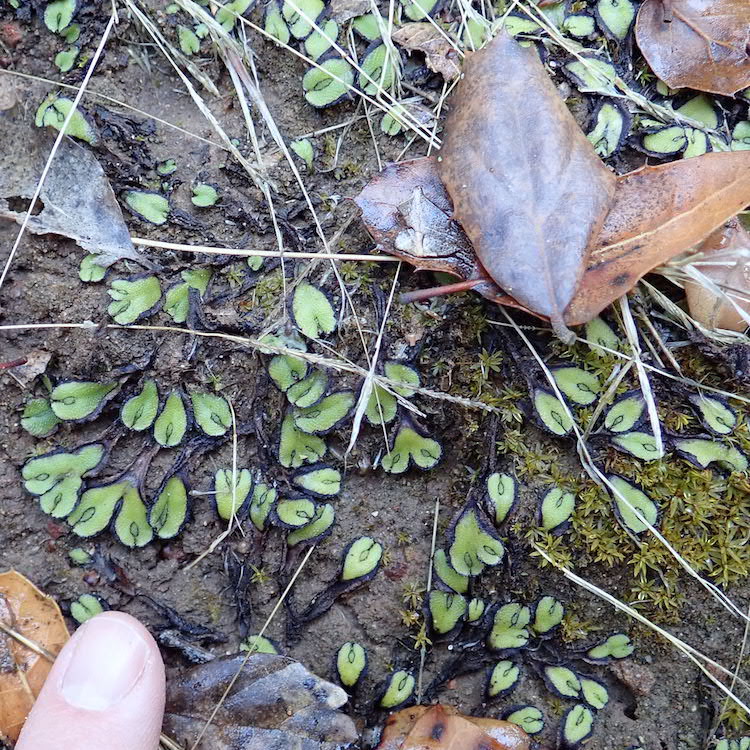
Immature or infertile Asterella californica plants with just the vegetative thallus can be more challenging to identify. The thallus is rather thick, is typically dichotomously branched, with lobe tips flaring out and thus wider than the main thallus. The upper surface is covered with prominent openings to internal air chambers, resulting in a rough texture resembling the skin of a reptile. It can be helpful to look at a cross-section of the thallus, as seen in the adjacent photomicrograph, as the cells are arranged differently in various genera. Asterella californica has narrow photosynthetic chambers, in contrast, for example, to the vastly spacious chambers of Cryptomitrium tenerum.

Asterella californica has two rows of purplish-black scales on the ventral surface of the thallus. These can be seen by lifting up the thallus. The margins of the upper thallus of Asterella californicaoften appear purplish-black, as the ventral scales peek out from underneath.
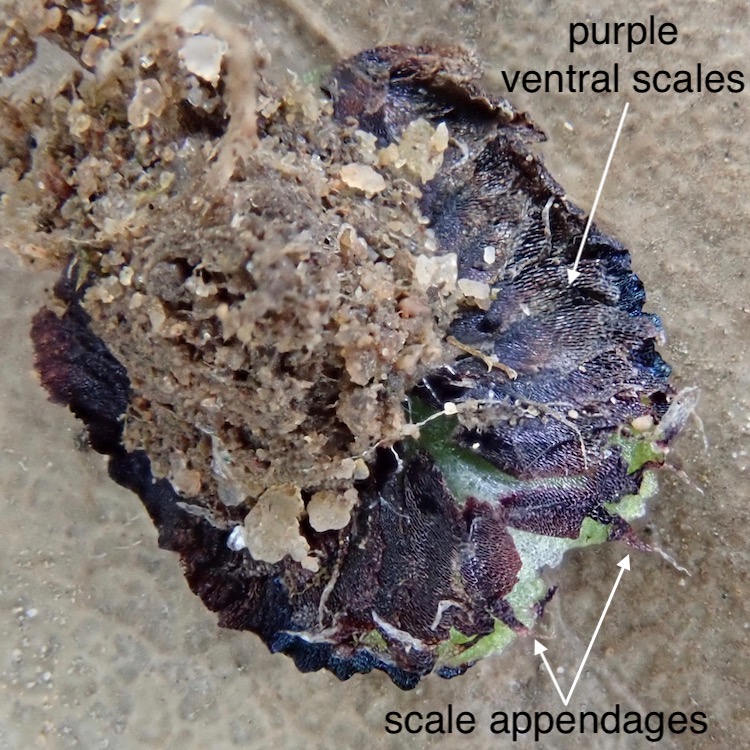
When the plants dry, the margins roll in, revealing the purplish-black ventral scales, as seen in this photo. Asterella californica is a “perennial” liverwort and remains in this rolled up dry state throughout the summer and fall, lying dormant until the rains return.
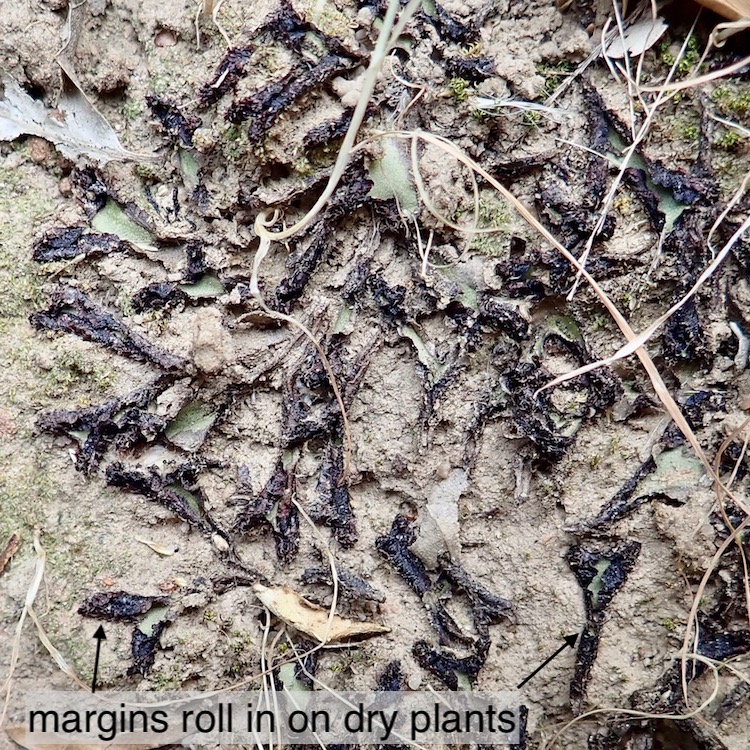
Here, Asterella californica male plants can be seen unrolling at the tips immediately following the first rain of the season. The more proximal regions of the thalli are still rolled up in the greasy black streak state.
Habitat and Distribution
Asterella californica typically grows on soil but can also be found on rock, generally in a bit of shade, and is common in Santa Barbara County and, indeed, all across California, particularly on the more vertical soil of trail cuts and road cuts where vascular plants are less apt to take over. Despite the name, Asterella californica is also found in southern Oregon, as well as Arizona and Mexico.
Map generated by google maps using data from the Consortium of Bryophyte Herbaria of accessioned collections from herbaria.


 Bryophytes of Santa Barbara