
Asterella palmeri (Austin) Underw.
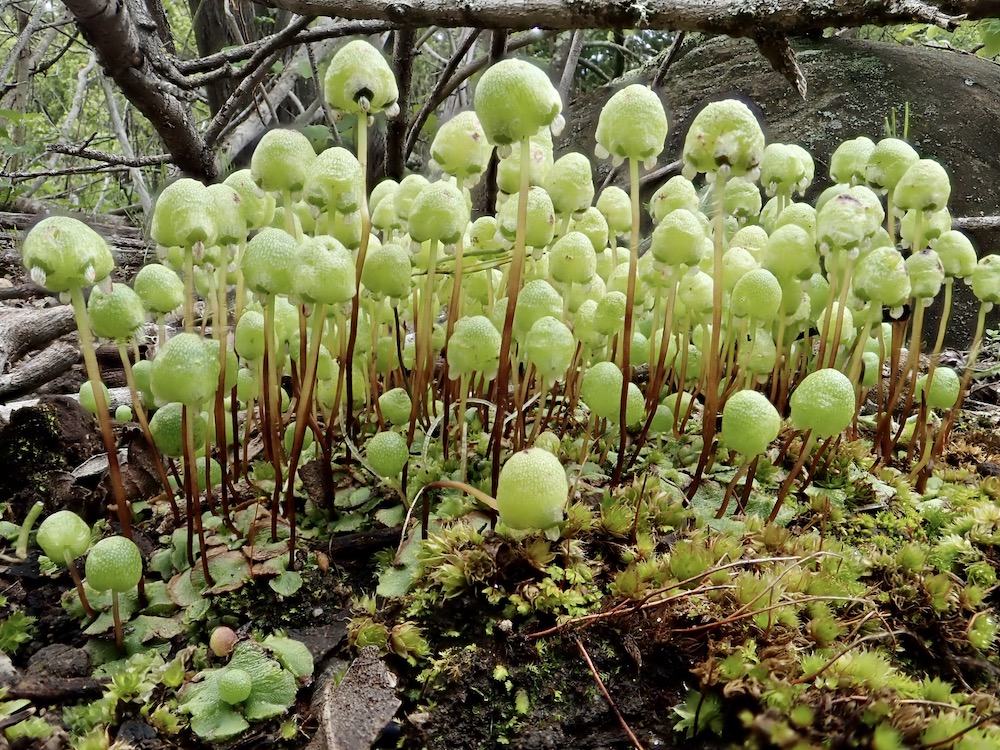
Brief Overview: Asterella palmeri is a large complex thallose liverwort, easily recognized at maturity by its dome-shaped, unlobed umbrella tops (carpocephela), with white veil-like pseudoperianths hanging straight down. The light green dichotomously branched thalli have a reptilian texture on the upper surface, and purple scales on the underside. Asterella palmeri is monoicous, with both female and male reproductive organs on the same individual plant, the umbrella-like female archegoniophores at the tips of the thalli, and the male antheridia in a small, inconspicuous group directly behind them. It is found on soil, in partial shade to full sun, often in chaparral.
Scroll down for photos with labeled parts and more detailed descriptions.
Detailed Descriptions with Photos (click to enlarge)
The carpocephela of Asterella palmeri are dome-shaped and unlobed. These archegoniophore are not yet fully mature, but the pseudoperianths (white, veil-like structures surrounding the developing sporophytes) are just beginning to be visible below, dangling characteristically straight down.

Asterella palmeri is monoicous, with both male and female reproductive organs on the same individual plant. The male antheridia appear as an inconspicuous group of bumps behind the umbrella-like female archegoniophore.
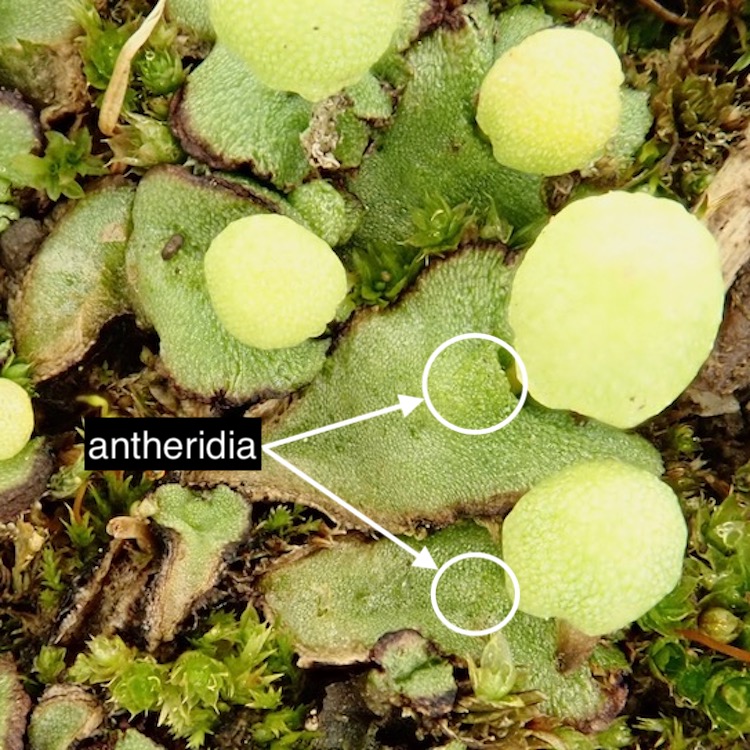
Even at close magnification, the antheridial bumps, or ostioles, of Asterella palmeri are rather subtle.
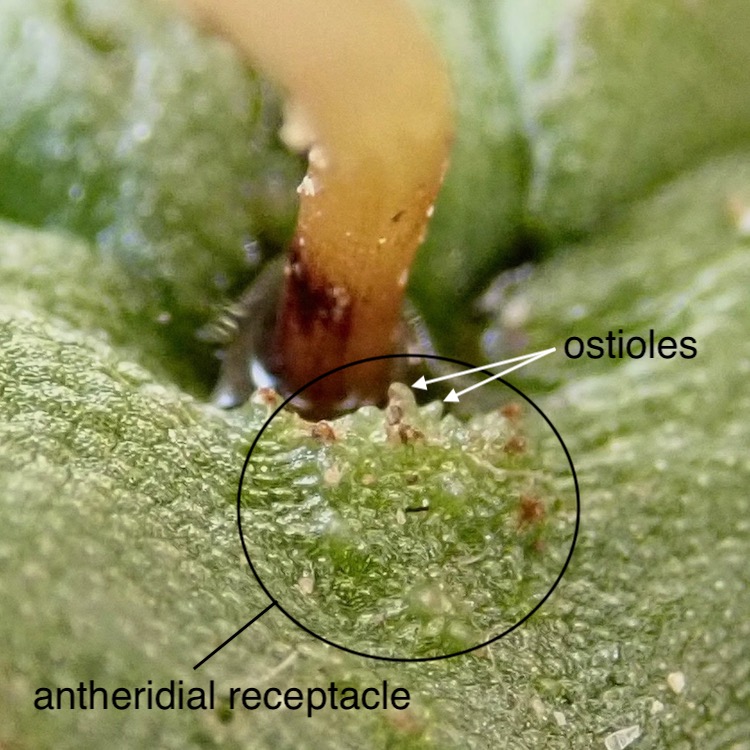
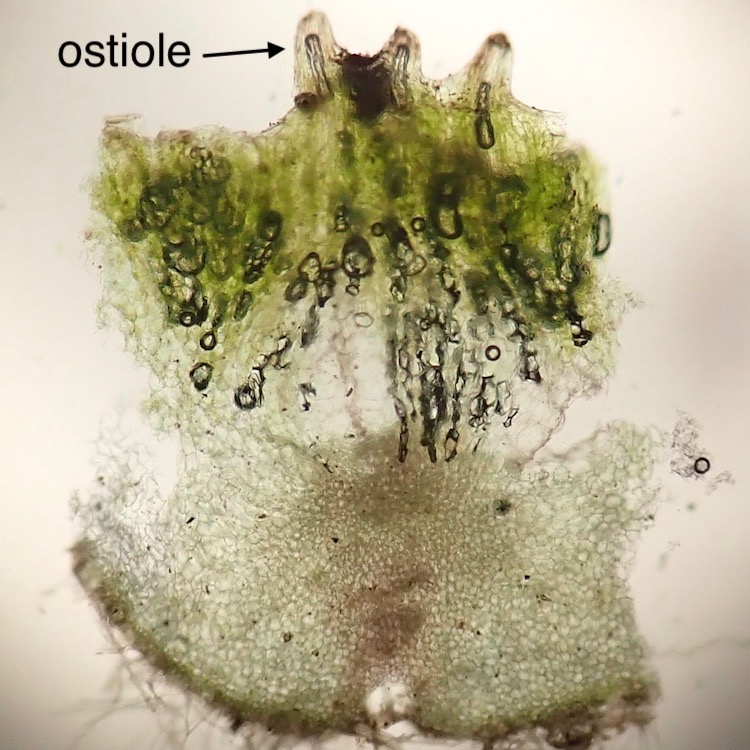
In this photomicrograph of a cross section of Asterella palmeri magnified 400x, three volcano-like ostioles can be seen at the surface. The antheridia, large sacs filled with sperm, are within the thallus, not clearly seen in this section. At maturity, the sperm swim up through the ostioles and off to search for an egg to fertilize in a nearby archegonium.
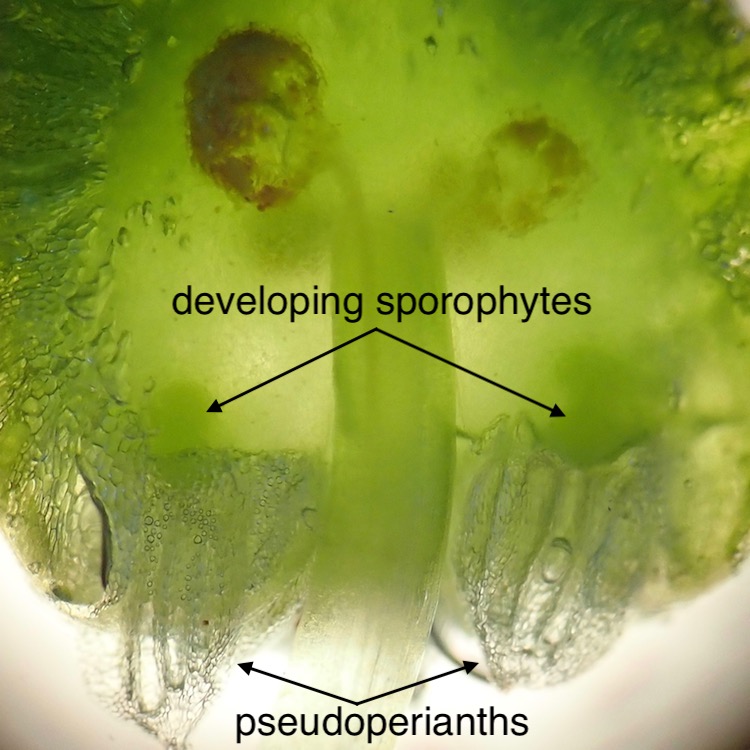
Initially, an archegoniphore contains four archegonia, each with an unfertilized egg. (For an example of an archegonium, see my Liverwort Life Cycle page). Upon fertilization, the egg begins to develop into a sporophyte, the part of the plant that produces spores. This photomicrograph is a cross-section of an immature Asterella palmeri archegoniophore, with sporophytes just beginning to develop within the dome, above and within the pseudoperianths.
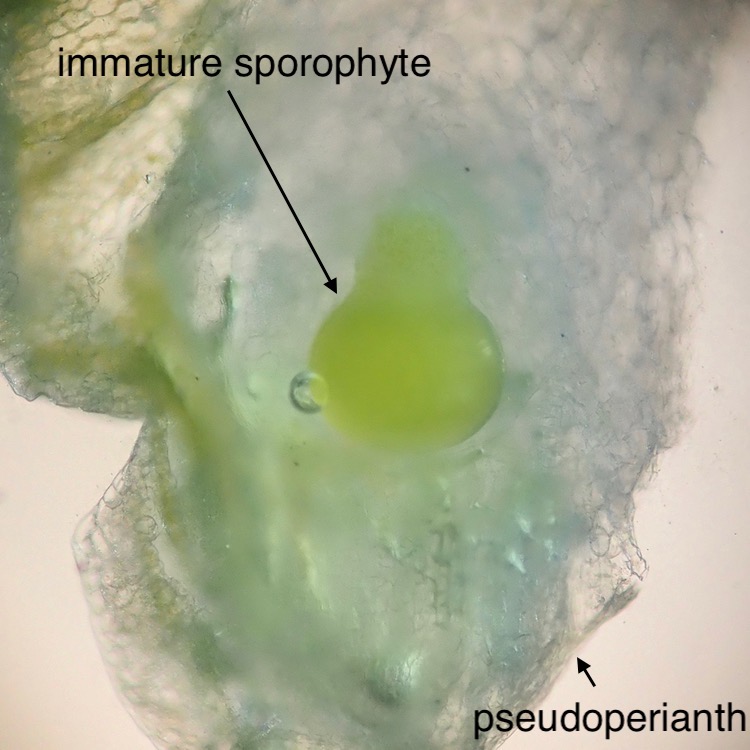
Here an immature Asterella palmeri sporophyte can be seen developing within the carpocephelum dome, just above and within the pseudoperianth.
These Asterella palmeri archegoinophores are more mature and the black bowling ball sporophyte capsules can be seen bulging out of the still mostly vertical pseudoperianths. Note that upon drying the pseudoperianths may be held out at a more oblique angle.

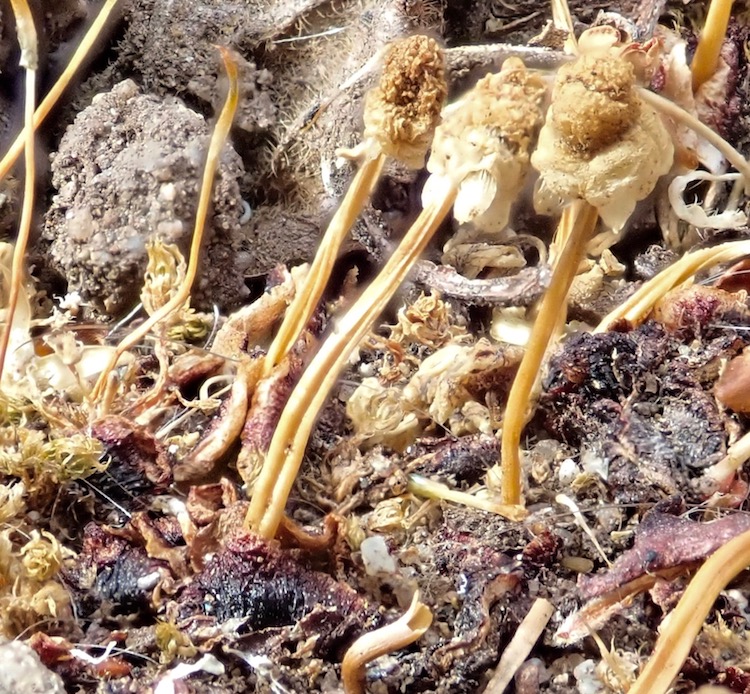
This is an Asterella palmeri archegonium which has dried in a collection packet. The dome-shaped carpocephalum has shriveled, and the pseudoperianths are angled slightly. A hint of one of the black sporophyte capsules can be seen above the pseudoperianth on the right, and a couple of spores can be seen on the right pseudoperianth itself. Asterella palmeri is desiccation tolerant, drying up in the dry summer months with the margins of the thalli curling up to reveal the purple ventral scales. When winter rains return, the thalli uncurl and resume growth. Last year’s archegoniophores, however, generally wither and new ones develop.

This photomicrograph shows spores and elaters from the Asterella palmeri plants in the photo above. In this first photo, spores at several stages of development can be seen, with immature spores a lighter more transparent brown, and more mature spores a darker more opaque brown.
According to the Bryophyte Flora of North America, the dark brown spores are diagnostic for the species, as no other Asterella species (at least in North America) has dark brown spores.

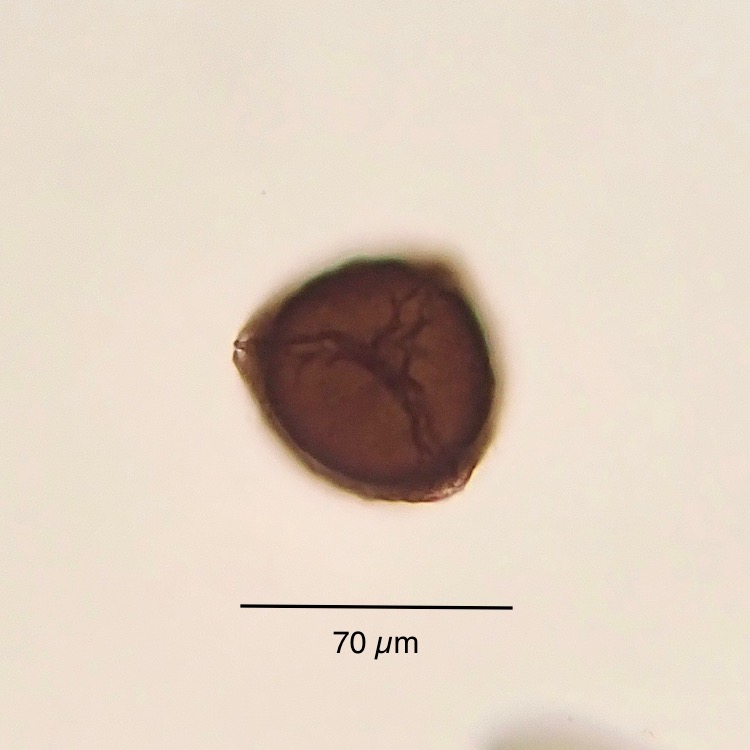
This photomicrograph shows a mature Asterella palmeri spore and an elater at 400x. The elater is a single spiral-shaped cell, which shrinks and expands in response to changes in humidity, acting as a spring to help eject spores into the air.

In this 400x photomicrograph, the ridges can be seen on the distal surface of a mature Asterella palmeri spore.
Asterella palmeri spores are described by Doyle and Stotler as being brown to nearly black and 65-93 µm across.
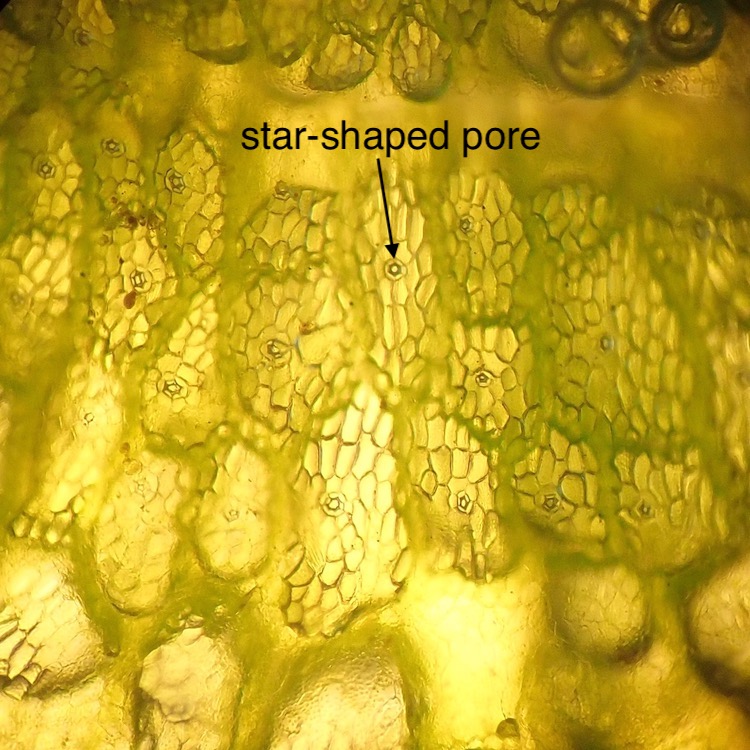
This photomicrograph of the upper thallus surface of Asterella palmeri at 400x shows the star-shaped pores for which the genus is named.
This last photo shows Asterella palmeri dry in the field. The dome-shaped carpocephela appear more conical, the pseudoperianths are mostly vertical, and the purple ventral scales can be seen on the rolled up thallus.
Habitat and Distribution
Here in Santa Barbara County, I have found Asterella palmeri on soil, in rather exposed areas beneath chaparral shrubs. Doyle and Stottler describe the habitat as “Exposed to slightly shaded summer-dry soil; usually on gentle to steep slopes around chaparral, Quercus and Pinus.” The Bryophyte Flora of North America describes the habitat as “Soil in rather dry situations.”
Asterella palmeri is found primarily in California, into southern Oregon, and northern Baja.
Map generated by google maps using data from the Consortium of Bryophyte Herbaria of accessioned collections from herbaria.

 Bryophytes of Santa Barbara