
Asterella bolanderi (Austin) Underw.
Brief Overview: Asterella bolanderi is a large, complex thallose liverwort, with long (10-30 mm) narrow (1.5-4.5 mm) parallel-sided lobes, rarely branching dichotomously. It is a monoicous species, and both the archegoniophores and antheridial pads arise from very small side branches. This is easily seen in the field, but may not be clear when plants are growing in crowded clumps or amongst other bryophytes. The carpocephela are shallowly lobed, and the pseudoperianths dangle at an oblique angle. It is uncommon in Santa Barbara County, found on soil near creeks.
Scroll down for photos with labeled parts and more detailed descriptions.

Detailed Descriptions with Photos (click to enlarge)
Asterella bolanderi has long, narrow, parallel-sided thalli, which rarely branch dichotomously but have numerous side branches bearing either female or male reproductive structures. The female structures (archegoniophores) resemble umbrellas, and as they mature, the carpocephela (umbrella tops) dissect into somewhat subtle lobes, with the white veil-like pseudoperianths dangling at an oblique angle.
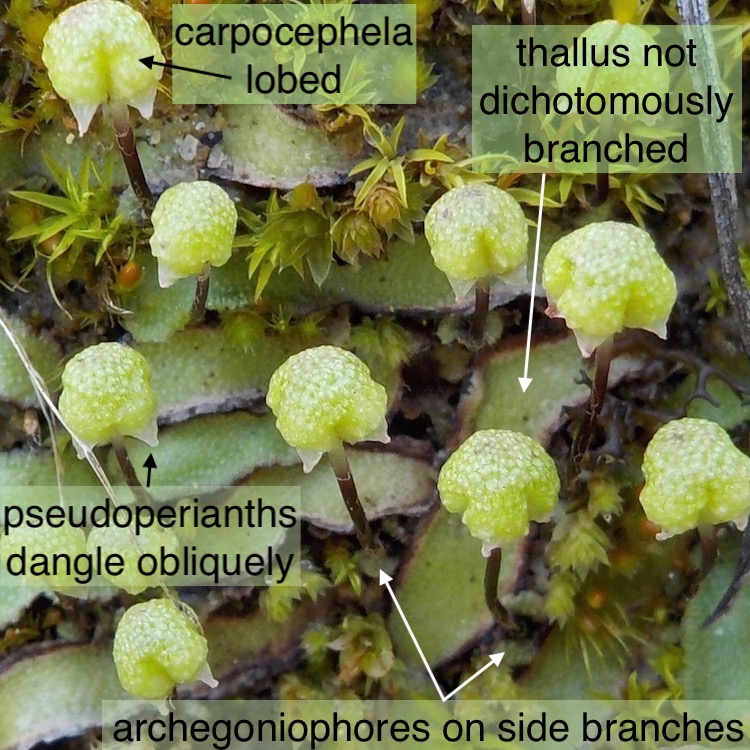
The side branches of Asterella bolanderi arise from the underside of the main lobe, and bear either antheridia (male organs containing sperm) or archegoniophores (containing female archegonia, which in turn contain eggs). In this photo the plants are at an earlier stage of development and the stalks have yet to elongate, therefore the archegoniophores appear to be sessile, and the carpocephela have yet to divide into lobes.

This close-up of Asterella bolanderi shows two side branches with antheridia (small dark bumps) and two side branches with immature archegoniophores (the left one is actually on an adjacent plant). Sperm must swim through liquid water to fertilize an egg, preferably on an adjacent plant. The fertilized egg then develops into the sporophyte, which makes spores.
See my Liverwort Life Cycle page for more background.

The Asterella bolanderi plants in this photo are at a mid-stage of development, with the archegoniophore stalks beginning to elongate and the carpocephala just beginning to divide into lobes.

At maturity, the stalks of Asterella bolanderi archegoniophores may be quite tall. The carpocephela are clearly dissected into lobes, and the black sporophyte capsules can be seen peeking out from the delicate pseudoperianths. Note that a few lobes are missing from the archegoniophore in the center of the photo – did someone eat them?

The underside of Asterella bolanderi has purple ventral scales which do not extend beyond the margin. In this particular example, they do not even make it to the margin.
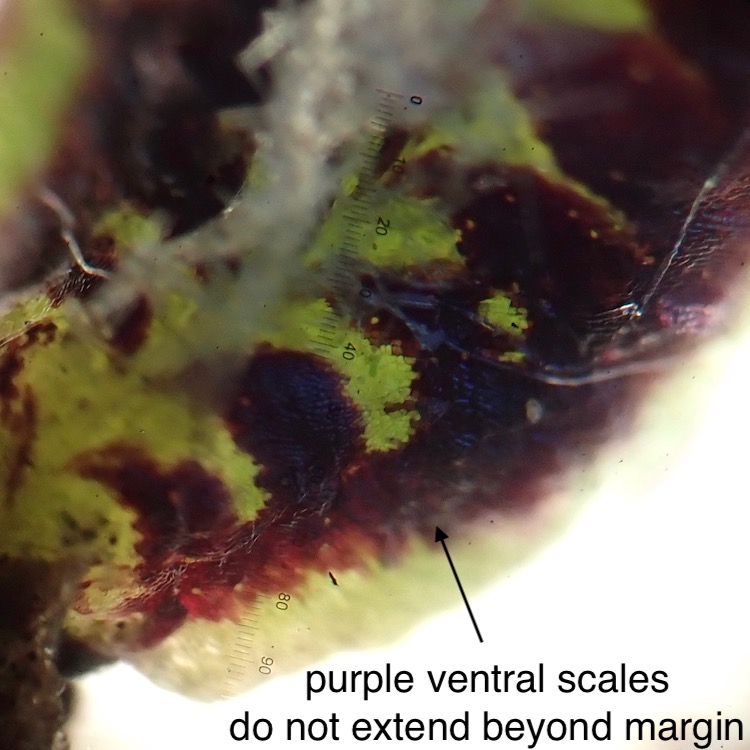
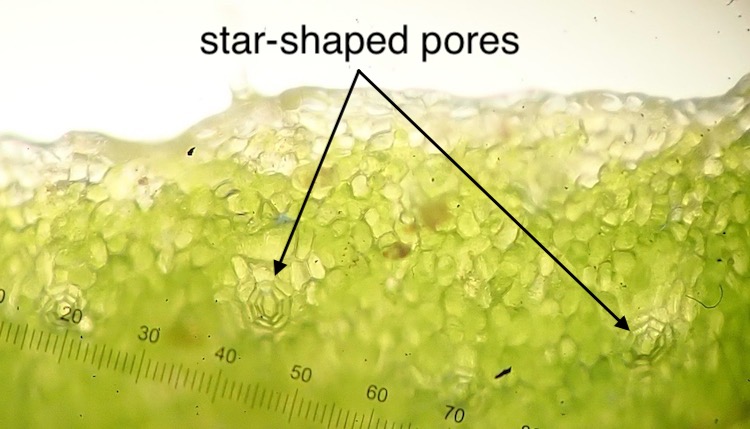
This photomicrograph shows the edge of the upper surface of Asterella bolanderi, which is fairly thin and transparent, in part because the purple ventral scales do not extend to the margin. The star-shaped pores for which the genus is named can also be seen. These pores lead to air chambers within the thallus, facilitating gas exchange for photosynthesis.
This photomicrograph shows a cross section of the Asterella bolanderi thallus. Again, it is evident that the purple ventral scales do not extend to the margin. The colorless, single-celled rhizines used for attachment to the substratum can also be seen.

Asterella bolanderi dries up during the summer months, lying dormant until the winter rains return, whereupon the thalli unfurl and resume growth. The main thallus rolls up into a tube, revealing the purple ventral scales. The lobes of the archegoniophores, when dry at maturity, flare out at an oblique angle, in contrast to the more horizontal lobes of Asterella californica.
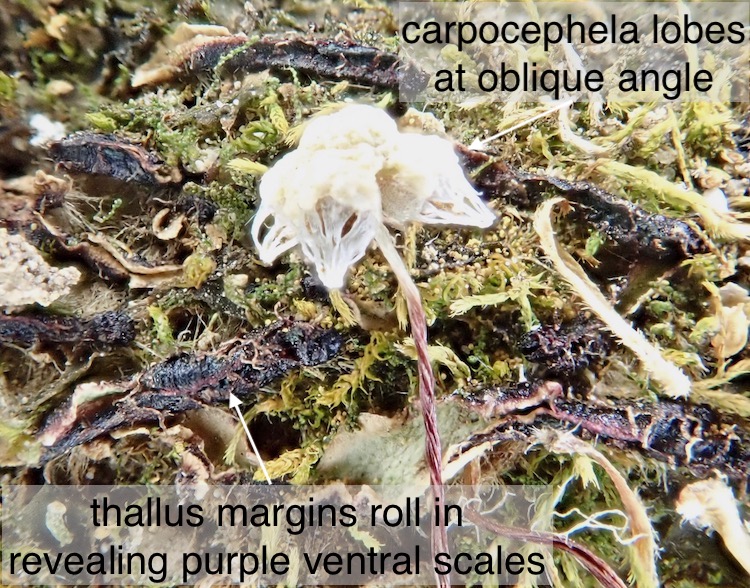
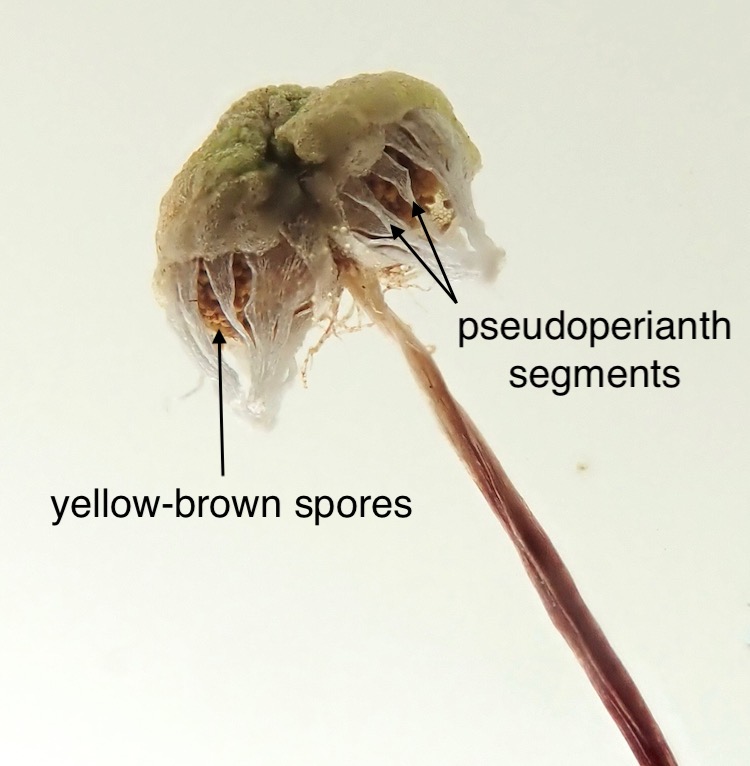
In this photo, the light yellow-brown spores can be seen peeking out from between the white pseudoperianth segments of a dry, mature Asterella bolanderi archegonium.
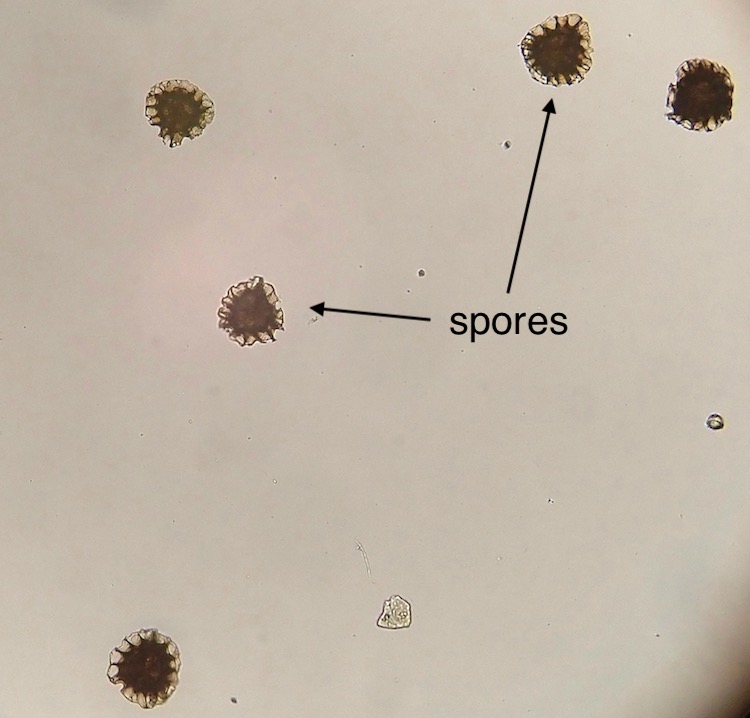
The spores of Asterella bolanderi are yellow-brown, and 65-105 µm across, as seen in this photomicrograph at 400x.
This last photomicrograph shows an Asterella bolanderi spore and an elater, a spring-like cell which contracts and expands to push spores off into the great yonder.

Habitat and Distribution
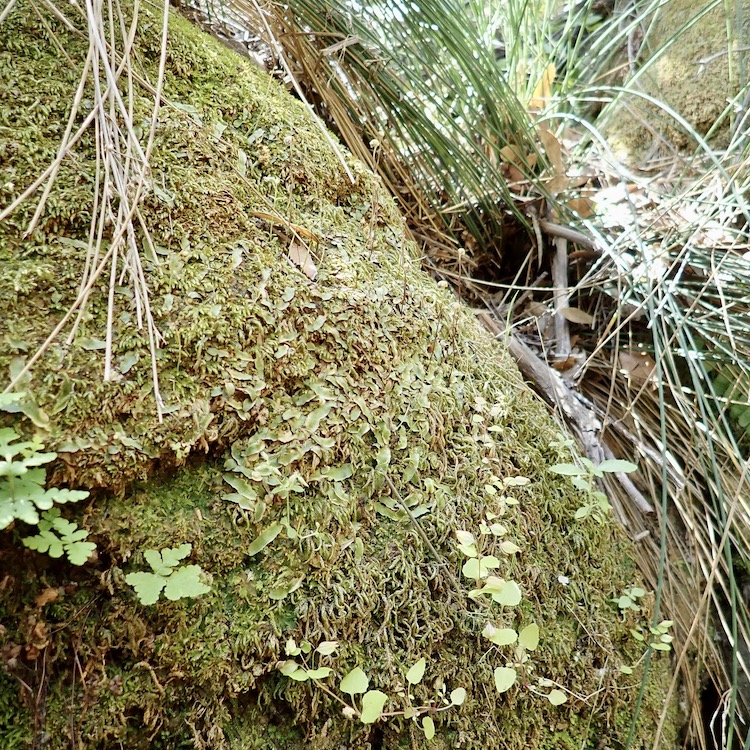
Asterella bolanderi is uncommon in Santa Barbara County, and is more common in Northern California. Thus far, I have found it at a few locations on soil near seasonal creeks in chaparral at 3,000 feet elevation, somewhat shaded. Doyle and Stottler describe the habitat similarly, “exposed to lightly-shaded summer dry areas, soil of meadows, and of creek- road- and ravine banks, soil around rock outcrops, open areas in chaparral and woodlands.”
Asterella bolanderi is found primarily in California and southwestern Oregon, but apparently has been found also in Texas as well as near Mexico City.
Map generated by google maps using data from the Consortium of Bryophyte Herbaria of accessioned collections from herbaria.

 Bryophytes of Santa Barbara