Fossombronia longiseta (Austin) Austin
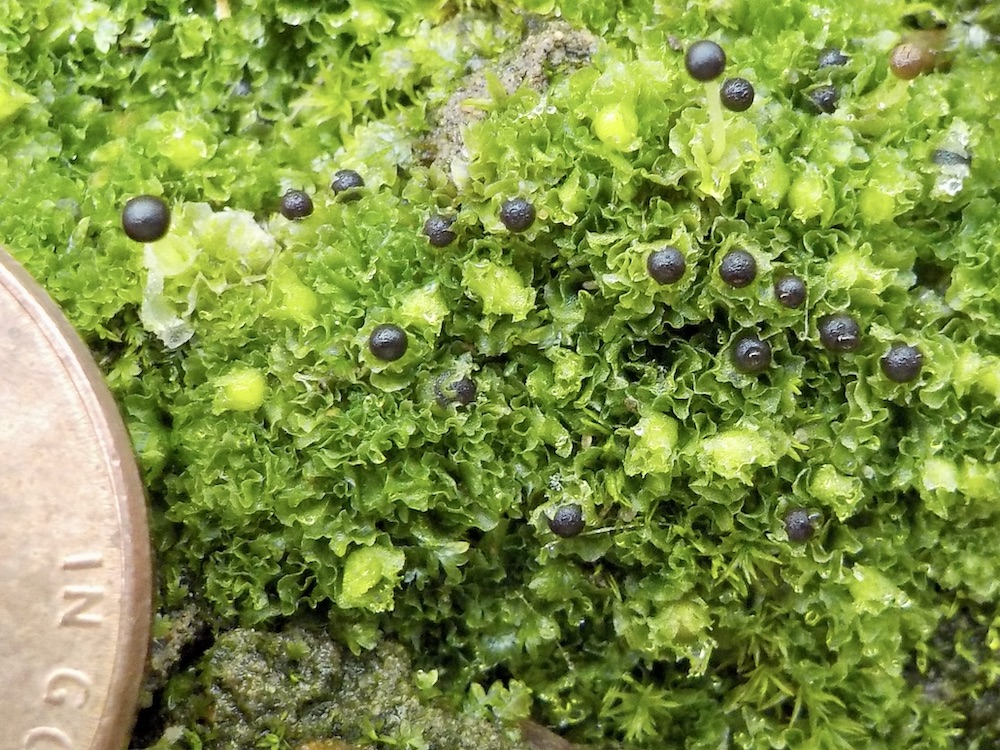
Fossombronia longiseta is a small simple thallose liverwort (1.7-2.8 mm wide) with a distinctive light green leafy lettuce look. It technically has a stem and leaves, but these are typically apparent only in the earliest stages of development; the leaves soon become crowded, obscuring the stem and appearing as one continuous frill. Sporophytes are common and conspicuous, with shiny black capsules atop green translucent setae standing tall above the frilly leaves.
Scroll down for photos with labeled parts and more detailed descriptions.
Detailed Descriptions with Photos (click to enlarge)
Fossombronia longiseta‘s frilly butterleaf lettuce thallus is instantly recognizable.
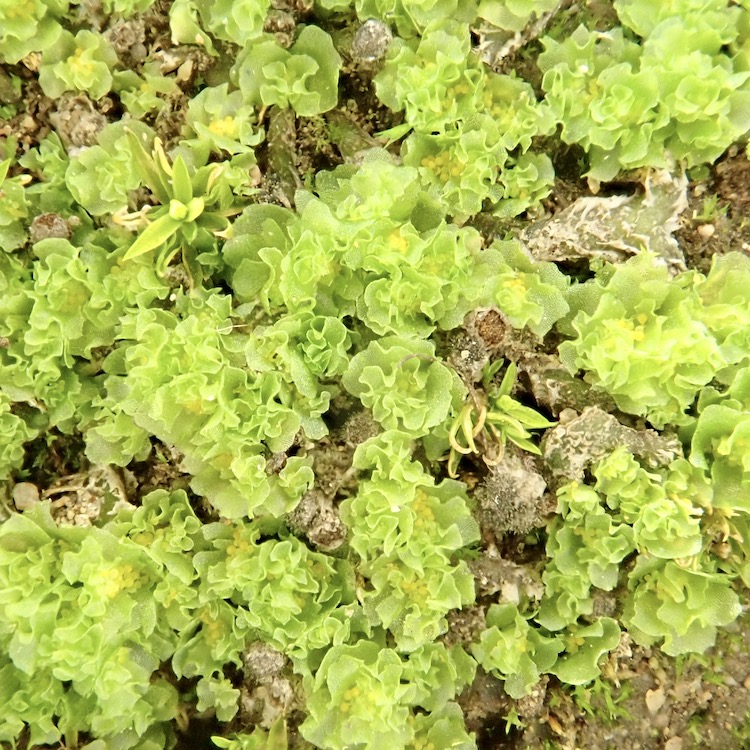
Fossombronia longiseta is monoicous, with both male and female reproductive organs on the same plant. Early in the season, with the aid of a hand lens, one might catch a glimpse of the orange antheridia (sperm-bearing structures) lying seemingly naked, like miniature melon balls atop the lettuce-like leaves. In actuality, they are attached to the stem.
For a review of the liverwort life cycle click here.

The female organs of Fossombronia longiseta, the archegonia, are also naked on the stem. They are smaller than the antheridia and are better appreciated with a microscope, though they can be detected as tiny little pricks with the aid of a hand lens.
Each arechegonium contains a single egg. Once fertilized, the egg develops into the sporophyte, the part of the plant that makes the spores.

An individual Fossombronia longiseta plant may develop several sporophytes which mature sequentially. The sporophyte capsules are initially green, then black and shiny when emerging from the leafy pseudoperianth. The setae (stalks) grow by cell elongation rather than cell division and are transparent and flimsy. When the spores mature, the sporophyte capsule breaks open and the capsule is transformed from a glossy black olive to a dark purple-brown fuzzy pom-pom. The large spores can be seen with the aid of a hand lens.

In order to identify Fossombronia longiseta to species, it is necessary to examine spores using a compound microscope. F. longiseta spores have 30-44 lamellae in equatorial optical cross-section, whereas F. pusilla, the only other Fossombronia species in California, has 11-28.
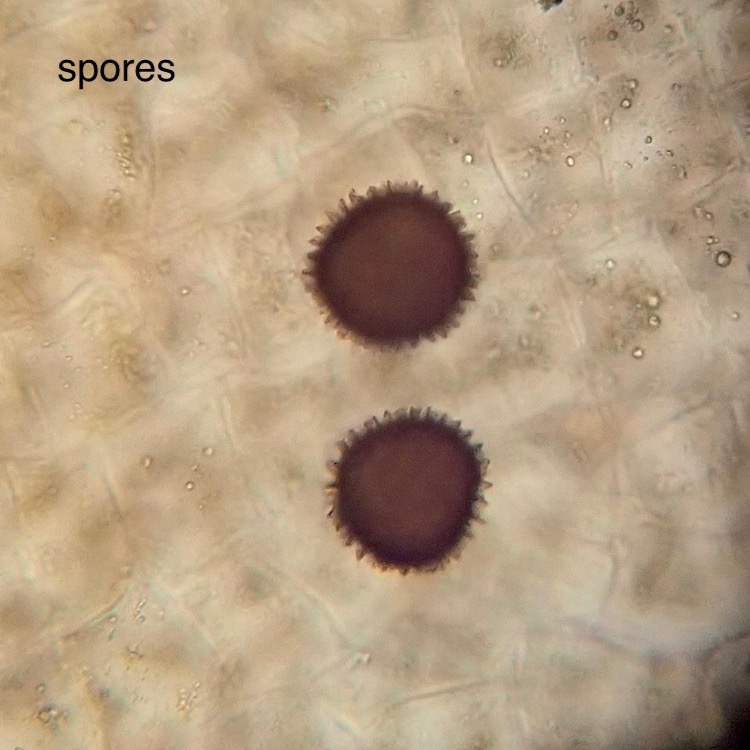
If you do go through the trouble of checking out spores, you will be rewarded with views of the elaters. These spring-like cells aid in spore dispersal, and are one of the unifying features of liverworts. Though not all liverwort species have elaters, most do.

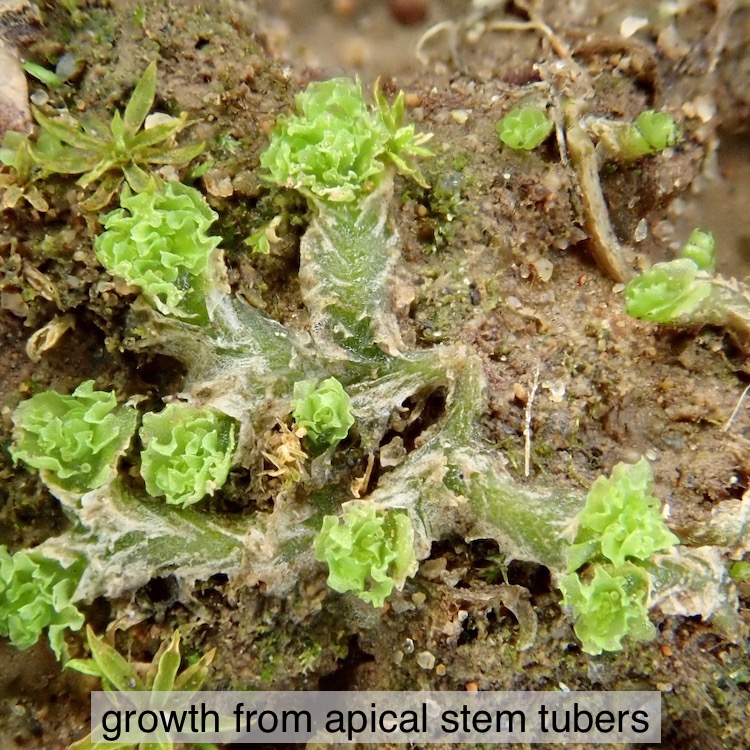
At the end of the growing season, Fossombronia longiseta develops tuberous swellings at the tips of the shoots. Over the dry summer season, plants are all but invisible. When the winter rains return, growth resumes from these tuberous tips.
Habitat and Distribution
Fossombronia longiseta thrives on exposed soil, and is quite common along trails in a modicum of shade, here in Santa Barbara County.

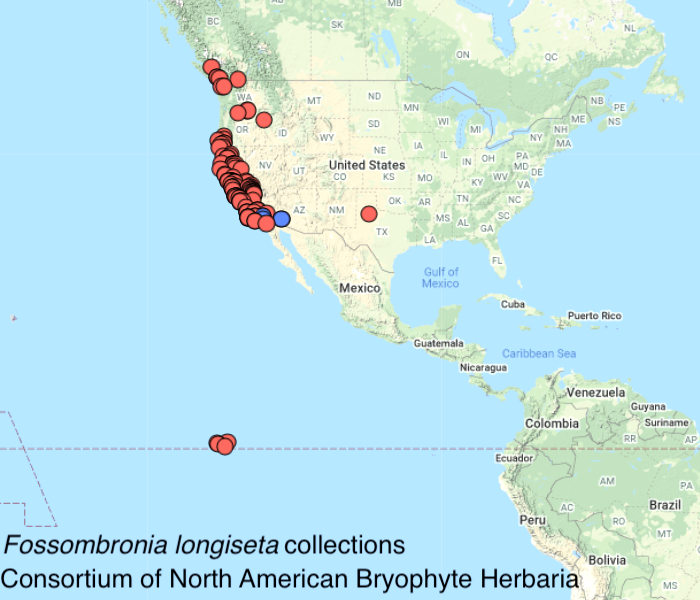
Fossombronia longiseta is found primarily in western North America.
Map generated by google maps using data from the Consortium of Bryophyte Herbaria of accessioned collections from herbaria.